Product1 publisher3 min readPublished
GMO Air's robot ambulance leaves a spare humanoid and takes the broken one away
A working humanoid rides in the back of the van so the broken one can leave with the engineers, and GMO Air says its own repair delays gave it the idea. There is one van so far, and more only if customers ask.
The Product Desk · Product desk
What happened
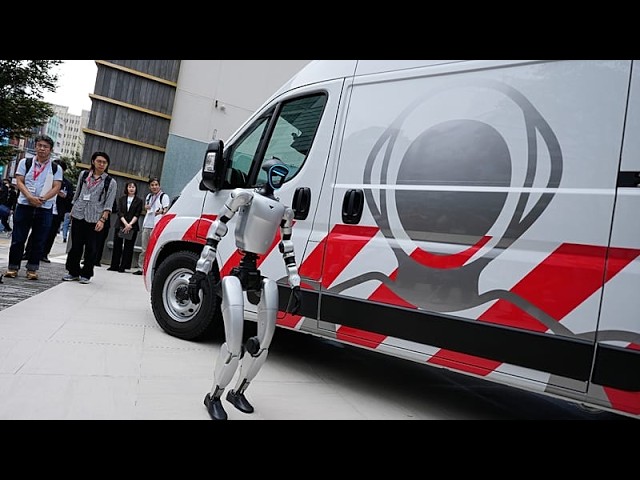
- GMO Internet Group's GMO Air unveiled a van billed as Japan's first robot ambulance, equipped to carry engineers, repair gear, replacement parts and a spare humanoid robot to customer sites.
- The engineers diagnose the fault where the robot stands, repair it on site if they can, and otherwise take the machine away with them.
- The van does not drive itself, and the repair work is the engineers', not another robot's.
- One ambulance exists, at GMO Air's Tokyo headquarters, and the company describes it as a demonstration of a field-support business it expects humanoid deployment to require.
- Japan's government has set a target of 10 million robots in service by 2040 across industries including healthcare and manufacturing.
Compiled by The Product DeskSomething wrong?How this is made
Why it matters
- cost Every van on the road parks a working humanoid as idle inventory, and the capital tied up in that spare has to come back somewhere, either in the callout fee or in a spare the customer buys itself.
- constraint Until the fleet grows, only sites the single Tokyo van can reach get the swap, so operators elsewhere still have to plan around the multi-day outage the service is meant to remove.
- decision Buying a humanoid now involves a second negotiation over who holds the replacement machine and how fast it reaches the floor, and the robot's spec sheet does not settle it.
- precedent If the pilot finds paying customers, field-service terms become part of how humanoids are sold in Japan, the way they already are for cars, industrial machinery, aircraft and IT hardware.
The example in Interesting Engineering's account is a hotel with two humanoid cleaners, one of which stops working at the start of the working day [7]. Send it back to GMO Air and the customer is out of service for several days [7]. Half the humanoid cleaning capacity is gone for the duration [16], on a machine the same account prices at roughly 50,000 to 100,000 pounds [8].
So the van brings a working one. If the fault cannot be fixed at the site, the broken robot goes back to a repair base and the replacement stays with the customer as what the account calls a courtesy car [4]. "The humanoid 'ambulance' carries the replacement humanoid to the site and replaces it with the damaged humanoid," said Shota Takizawa, an engineer at GMO Air [3].
GMO Air says the idea came out of its own trouble when damaged robots had to be sent away [9]. "Learning from that experience, we came up with the idea of providing replacement humanoids," said Tomohiro Uchida, CEO of GMO Air [9].
The buyer of a humanoid answers for hours of work that go undone. The sales conversation is about what the machine can do per shift. The operating conversation is about the morning it does not start, and how long the shift runs short-handed. Interesting Engineering's account makes the same point from the supplier side, listing uptime, field maintenance, spare-parts logistics and replacement machines as the things that begin to matter once a business depends on the robots [15]. A loaner in the back of a van is the part of that list that changes the customer's exposure, because it turns a several-day outage into a same-day swap.
The report does not say what a callout costs, how quickly the van arrives, or how far it will travel. GMO Air says it will add many more vehicles if customer demand justifies it [12]. "When humanoids become more popular, this kind of service will be needed," Takizawa said [10].
For anyone weighing a humanoid before a service fleet like that exists, the useful exercise needs two numbers. First, how many hours the work can sit undone before someone is paid overtime or a customer notices. Second, the supplier's committed time from a fault call to a working machine standing on your floor. When the second number is larger than the first, or the supplier will not commit to one, the spare machine is yours to buy, store and insure, and it belongs in the purchase price rather than the maintenance line. GMO Air is offering to hold that spare instead, from a single van in Tokyo [11].
What to watch
- Whether a second van appears, and where it is based, since GMO Air ties expansion to customer demand.
- Any published callout price or response-time commitment, which would turn a demonstration into terms an operator can sign.
- Whether humanoid suppliers selling into Japan start including a loaner machine in the sale itself.