Build1 distinct publisher2 min readPublished
The keys work because they are keys. A standard sk_live carries refunds and sometimes payouts. The fix that matters today is rotation. The fix that lasts is a document root that refuses to serve dotfiles.
The Engineer · Build desk

build
The runner holds your deploy keys, and nobody put it in the scanning program1 distinct publisher
product
PayPal stopped saying no. Payments teams should now plan for a Stripe-owned checkout rail3 distinct publishers
security
CDN Tsunami: the protocol translation you pay for is the amplifier1 distinct publisher
build
Your agent needs the API call, not the API key1 distinct publisher
Compiled by The EngineerSomething wrong?How this is made
No vulnerability class is needed for the collection step. A scanner issues GET /.env against a host list and reads the response body. If the document root serves dotfiles, that body is key=value text, and one of the values begins with sk_live_. Scanners for /.env, /.git/HEAD and /debug predate this dump and are fully automated [18], which is the working hypothesis the dev.to writeup of Hudson Rock's Infostealers analysis lands on [6].
What the finder then holds is the interface the vendor's own backend holds. Depending on scope, a standard sk_live will service GET /v1/customers, GET /v1/charges and GET /v1/invoices/:id; with charge capability it accepts POST /v1/refunds; if account-settings write is allowed, POST /v1/payouts [10]. The JSON samples in the archive carry explicit charge-access flags, so the read-only reading of these keys does not survive contact with the file [9]. Every one of those calls is a documented Stripe API call. Stripe itself was not broken [11].
Two numbers are worth doing by hand. 1,033 keys across 669 vendors is 1.54 keys per vendor [1], so the average victim exposed more than the single key its checkout path uses. And the delivered archive of 2.37 GB against 33 GB advertised is 7.2% of the volume on offer [2], while the 1,033 counted keys are 5.2% of the actor's claimed 20,000 [3]. The first ratio speaks to deployment habits; the second reflects what a seller says while holding stock.
The server-side fix is a config line, not a project. In nginx, `location ~ /\. { deny all; }` has to be declared before any try_files, or the framework front controller gets the request first [13]. Apache does it with FilesMatch on `^\.env` plus RedirectMatch 404 on /\.git [13]. In Docker, .env belongs in .dockerignore and secrets belong in BuildKit `--mount=type=secret` rather than a COPY into the image [14]. The five-minute audit is a curl loop over /.env, /.env.example, /.git/HEAD and /debug expecting 403 or 404, with the one deliberate exception that /.well-known/security.txt should return 200 under RFC 9116 [12].
Order of operations decides whether any of that helps. Blocking the path closes the exposure; only rolling the key invalidates the copy already taken, via Developers, then API keys, then Roll secret key, then Revoke previous value [16]. After rotation, GET /v1/restricted_keys lists what exists and with which scopes, and the useful question is whether a service that needs payment_intents:write and customers:read was ever handed a standard key with refund and payout reach [17]. That audit is the durable part; the dotfile rule is only the piece you can ship before lunch.
Ranked by verification strength, evidence, and original report placement.
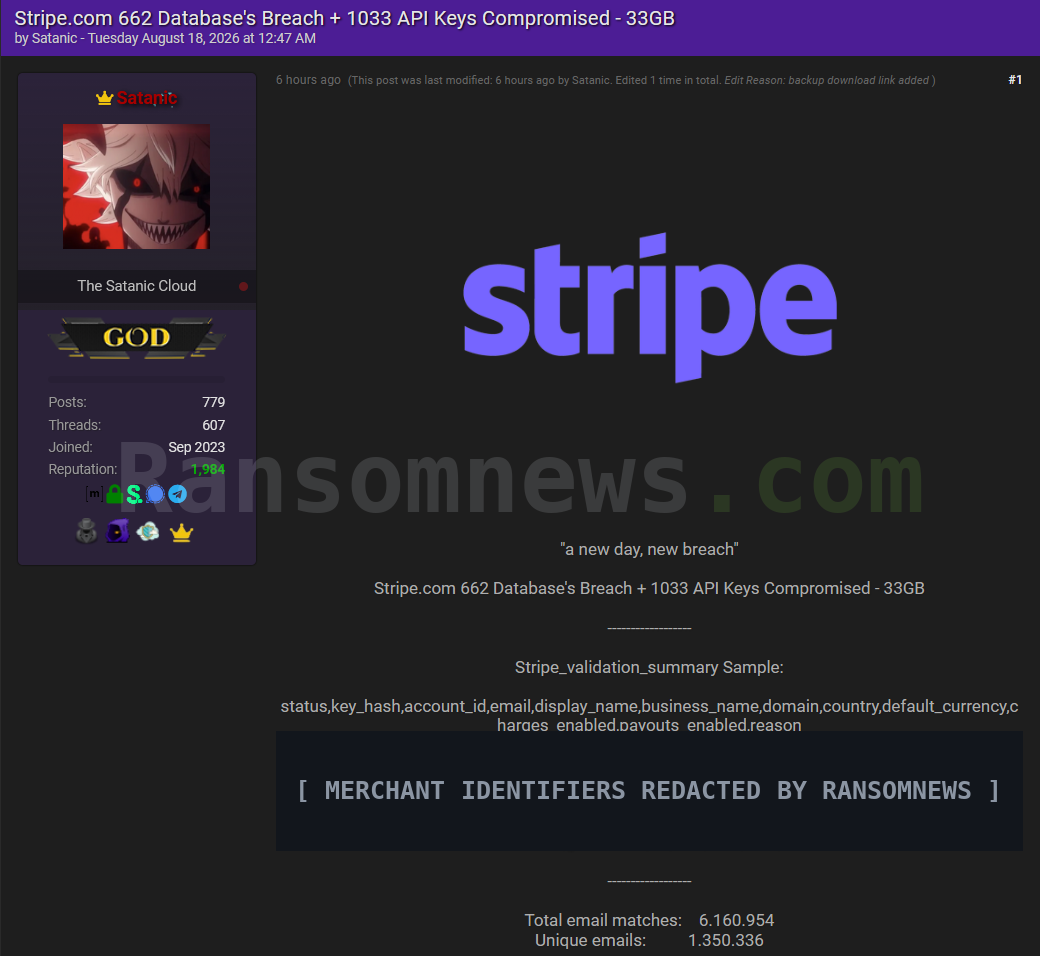
On August 18, 2026, a threat actor dumped 1,033 live Stripe sk_live secret keys belonging to 669 vendors on an illicit forum, along with customer rows, charges, balances, payouts and invoices.
The listing advertised 33 GB of data in total, but the archive actually provided was 2.37 GB, which the analysis calls consistent with a staggered release.
Hudson Rock's telemetry found no infostealer infections tied to the vendor domains appearing in the dump.
Victim technology stacks were heterogeneous, including PHP storefronts, Node services, Python APIs and hosted site builders, with no common plugin or framework.
The dump included invoice-linked CSVs carrying customer name, email, phone, home address, IP at purchase, internal transaction IDs and third-party integration identifiers, plus hosted invoice URLs that resolve to valid Stripe invoices exposing the last four digits of the card.
A separate promo-code spreadsheet listing code, discount amount and duration was included and is described as mass abuseable.
Distinct publishers with included, body-backed reporting in this cluster.
dev.to
1 article · September 1, 2026
Follow any of these and your For You feed starts watching them — no settings page required.
Evidence-backed comparisons of source perspectives and observed adoption signals. Read the methodology
Which Builder, Operator, and Investor concerns the observed source mix emphasized—not a truth score.
Evidence, demonstrated adoption, hype gap, incentives, and confidence are assessed independently, each on its own current evidence. How these are measured.
One writeup, one upstream analyst
Every incident fact here — the counts, the archive size, the absence of stealer infections — reaches us through a single dev.to post summarising Hudson Rock's analysis, with no Stripe statement, no named vendor and no second researcher. What holds up better is the technical half: the sk_live capability list, the dotfile checks and the rotation and restricted-key paths are verifiable by any reader against their own infrastructure, which is why the guidance carries more weight than the numbers.
Damage counted, response not
The exposure side is concrete: a dated dump, 669 vendors, a 2.37 GB tranche that landed. The other side is blank. Nothing in this reporting shows a single key rotated, a single vendor notified, or the promised follow-on tranches arriving — so what we can measure is how many stacks were caught, not how many were fixed.
Mildly overstated, self-corrected
The framing runs hotter than the finding — 'payment rail breach' for what is, in the writeup's own words, a misconfigured file found at scale, with no Stripe vulnerability anywhere in it. Against that, dev.to volunteers the caveat most stories of this type bury, telling readers outright that 20,000 is claimed and 1,033 is verified. The gap that remains is the payout scenario: it is real but conditional on account-settings write, and the headline framing does not carry that condition.
Vendor-shaped in the margins
The finding that rules out infostealers comes from a firm whose business is infostealer intelligence, and this coverage repeats it without a second look. On the remediation side dev.to names Cloudflare, GitGuardian, TruffleHog and gitleaks with no disclosure either way; the recommendations are conventional enough that the more likely pull is habit rather than payment. The author is not selling anything visible on the page.
Trust the remediation, hold the numbers
Split the story in two and confidence splits with it. The instructions — check four paths, deny dotfiles, roll the key, cut the scope — are self-verifying and would be worth following even if the dump were smaller than described. The incident numbers depend on one relayed analysis with no corroboration and no Stripe or vendor response, so they deserve citation with the source attached.