Published Security3 min read
AmnesiaStealer trades smash-and-grab for a live seat in the victim's browser
Jamf Threat Labs says the Rust macOS stealer pastes itself in via Terminal, fakes an Installer password prompt, mutes the speakers, then hands the operator a headless clone of your logged-in profile.
Not a builder's beat, but builders have a standing stake in it.See today for builders
What happened
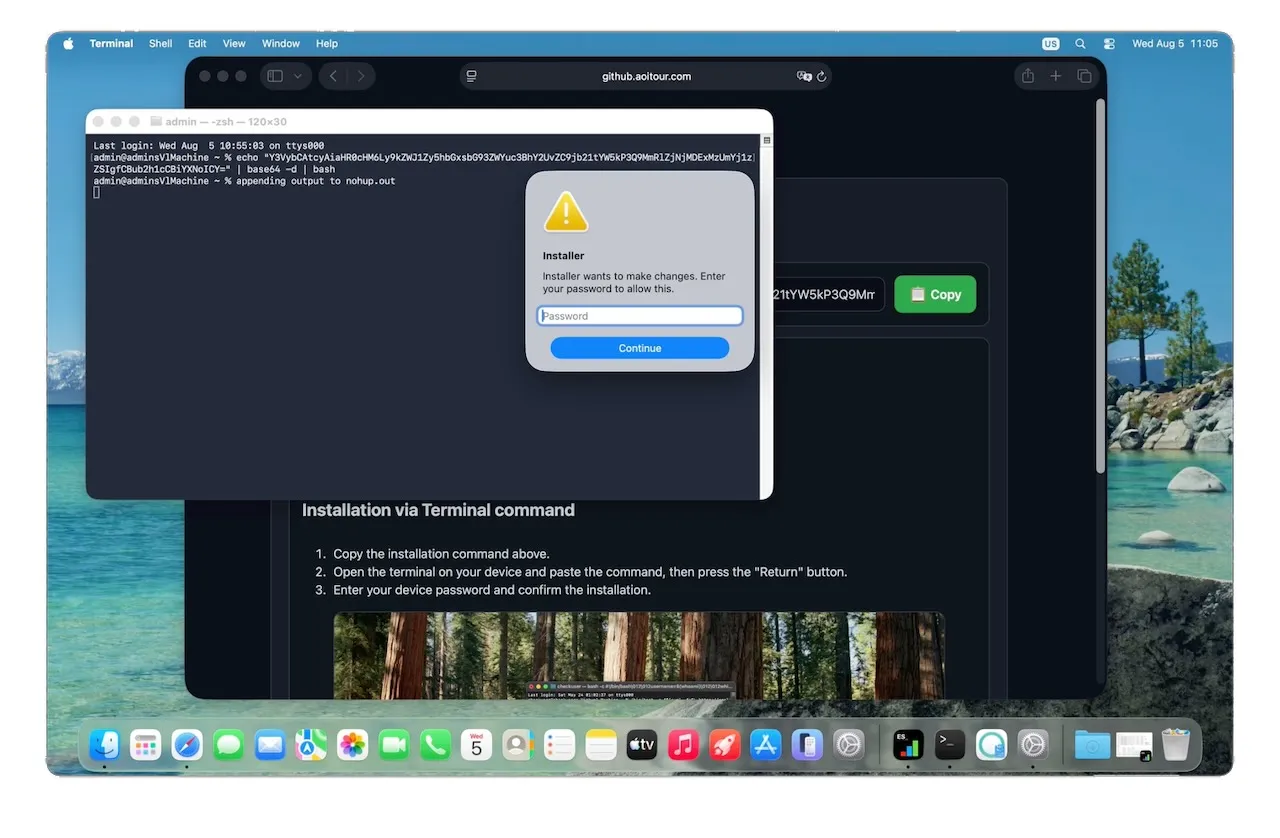
- Jamf Threat Labs researchers disclosed AmnesiaStealer, a new multi-stage Rust-based macOS infostealer spread through a counterfeit GitHub download page using the ClickFix technique.
- The stealer is installed through a fake GitHub 'Download for macOS' page instructing the victim to copy and paste a base64-encoded command into Terminal; the command retrieves a dropper script that downloads a password-protected ZIP archive, then extracts and executes the AmnesiaStealer payload. Infosecurity described the script as short, silent and self-deleting.
- The lure page reproduces GitHub's dark theme, the Octocat logo and a 'Verified Publisher' badge, and presents a 'Terminal installation' box framed as a convenience for advanced users instead of a download button.
- The same fake GitHub template has been observed in Atomic Stealer and MacSync campaigns, indicating the lure infrastructure is shared across multiple malware families.
- Jamf describes three stages: a shell script that downloads and launches the payload; a Rust infostealer that harvests the keychain, browsers, Apple Notes and Telegram; and a stream_module, fetched on command, giving the operator hidden interactive control of the victim's browser.
Compiled by The WatchSomething wrong?How this is made
Why it matters
Jamf Threat Labs has documented AmnesiaStealer, a three-stage Rust infostealer for macOS delivered through a counterfeit GitHub download page that asks the visitor to paste a base64-encoded command into Terminal [1][3][6]. The part that should change how defenders think about macOS stealers is the third stage: on a `remote_stream` command from the operator panel, the malware returns a module that gives hidden, interactive control of the victim's Chromium browser over the Chrome DevTools Protocol [19].
The delivery is ClickFix, and the lure is well built: GitHub's dark theme, the Octocat logo, a "Verified Publisher" badge, and a "Terminal installation" box framed as a convenience for advanced users in place of a download button [4]. Jamf reports the same template has appeared in Atomic Stealer and MacSync campaigns, so the lure infrastructure is shared across families [5]. The pasted command pulls a short, silent, self-deleting script that fetches a password-protected ZIP and runs the payload from it [3]. Infosecurity Magazine, citing the Jamf report published on 13 August, notes ClickFix works precisely because the victim types the command themselves, which many defensive tools read as legitimate activity [28][c29b].
Then the craft. The Rust payload throws an AppKit NSAlert reading "Installer wants to make changes", validates the entered password locally against the directory service with `dscl`, and loops on "Incorrect password. Please try again" until it gets a real one [7][8]. That password is then reused: piped into `sudo -S`, passed to `security unlock-keychain -p`, and written to disk in cleartext as `pwd` in the staging directory and `~/.pwd` in the home folder [9]. Before collection starts, the malware mutes system audio, because part of the theft runs through Finder, which plays a sound on every file it duplicates [10]. Collection mostly uses `cat` and `cp`, but `duplicate` handles Safari cookies, Notes attachments, Safari Form Values, `~/Library/Keychains/<hardware UUID>` and any Notes `cat` missed [11]. As Jamf's Thijs Xhaflaire put it, making Finder the reading process reaches data the malware cannot touch directly without a prompt, and the Safari cookie step tries `cat` first, falling back to `duplicate` only on failure [12].
Not everything lands. One Safari cookie fallback is an APFS snapshot bypass built on CVE-2020-9771, patched in Catalina 10.15.4 and 10.15.5, which now works only where Terminal or the malware already holds Full Disk Access [16]. The developer's own debugging comments record "no keys recovered" for browser Safe Storage on macOS 26 and later, so the fallback overwrites the Safe Storage password with a hardcoded value, breaking decryption of previously stored credentials and cookies [17]. Jamf calls that sequence a high-value detection, since browsers create Safe Storage entries through the Security framework and never through the `security` binary [18].
The stream module clones the victim profile, launches it headless, and relays operator input and a 3 FPS screencast over two WebSockets, leaving the visible browser window unchanged [20][33]. It pulls cookies in plaintext via `Network.getAllCookies`, bypassing at-rest encryption entirely, and injects a stealth script through `Page.addScriptToEvaluateOnNewDocument` to keep visited sites from flagging automation [21][22]. Persistence is a root LaunchDaemon posing as `com.apple.ReportCrash.agent` with a random numeric suffix [23].
Watch the operation, not the sample. The panel is branded Amnesia Panel, returns Russian errors on failed login, and sits behind a repeated `/d/command?t=token&b=build` pattern across domains resolving to one address, consistent with a builder issuing per-campaign configs as XOR-encrypted blobs [24][25]. Watch too which browsers get covered: at-rest theft hits 16 Chromium browsers, live control only seven, nine fewer [15][19][1].
Claim ledger
Ranked by verification strength, evidence, and original report placement.
- [1]
Jamf Threat Labs researchers disclosed AmnesiaStealer, a new multi-stage Rust-based macOS infostealer spread through a counterfeit GitHub download page using the ClickFix technique.
- [3]
The stealer is installed through a fake GitHub 'Download for macOS' page instructing the victim to copy and paste a base64-encoded command into Terminal; the command retrieves a dropper script that downloads a password-protected ZIP archive, then extracts and executes the AmnesiaStealer payload. Infosecurity described the script as short, silent and self-deleting.
- [4]
The lure page reproduces GitHub's dark theme, the Octocat logo and a 'Verified Publisher' badge, and presents a 'Terminal installation' box framed as a convenience for advanced users instead of a download button.
- [5]
The same fake GitHub template has been observed in Atomic Stealer and MacSync campaigns, indicating the lure infrastructure is shared across multiple malware families.
- [6]
Jamf describes three stages: a shell script that downloads and launches the payload; a Rust infostealer that harvests the keychain, browsers, Apple Notes and Telegram; and a stream_module, fetched on command, giving the operator hidden interactive control of the victim's browser.
- [7]
After basic reconnaissance the malware uses AppKit NSAlert to display a password prompt stating 'Installer wants to make changes.'
Sources & coverage · 4 publishers
The reporting this story was synthesized from, earliest first. Every link goes to the original.
- securityaffairs.comPierluigi PaganiniAug 14AmnesiaStealer Gives Attackers Live Control of Victims’ macOS Browsers
- infosecurity-magazine.comAug 14Novel macOS Infostealer AmnesiaStealer Spread via ClickFix
- scworld.comLaura FrenchAug 14