Published Product3 min read
The Space Force put its digital engineering on 74 GPUs, then claimed weeks-to-seconds
Makau is a 2.64-petaflop, six-cabinet HPE Cray XD2000 at the Maui High Performance Computing Center.
Not a builder's beat, but builders have a standing stake in it.See today for builders
What happened
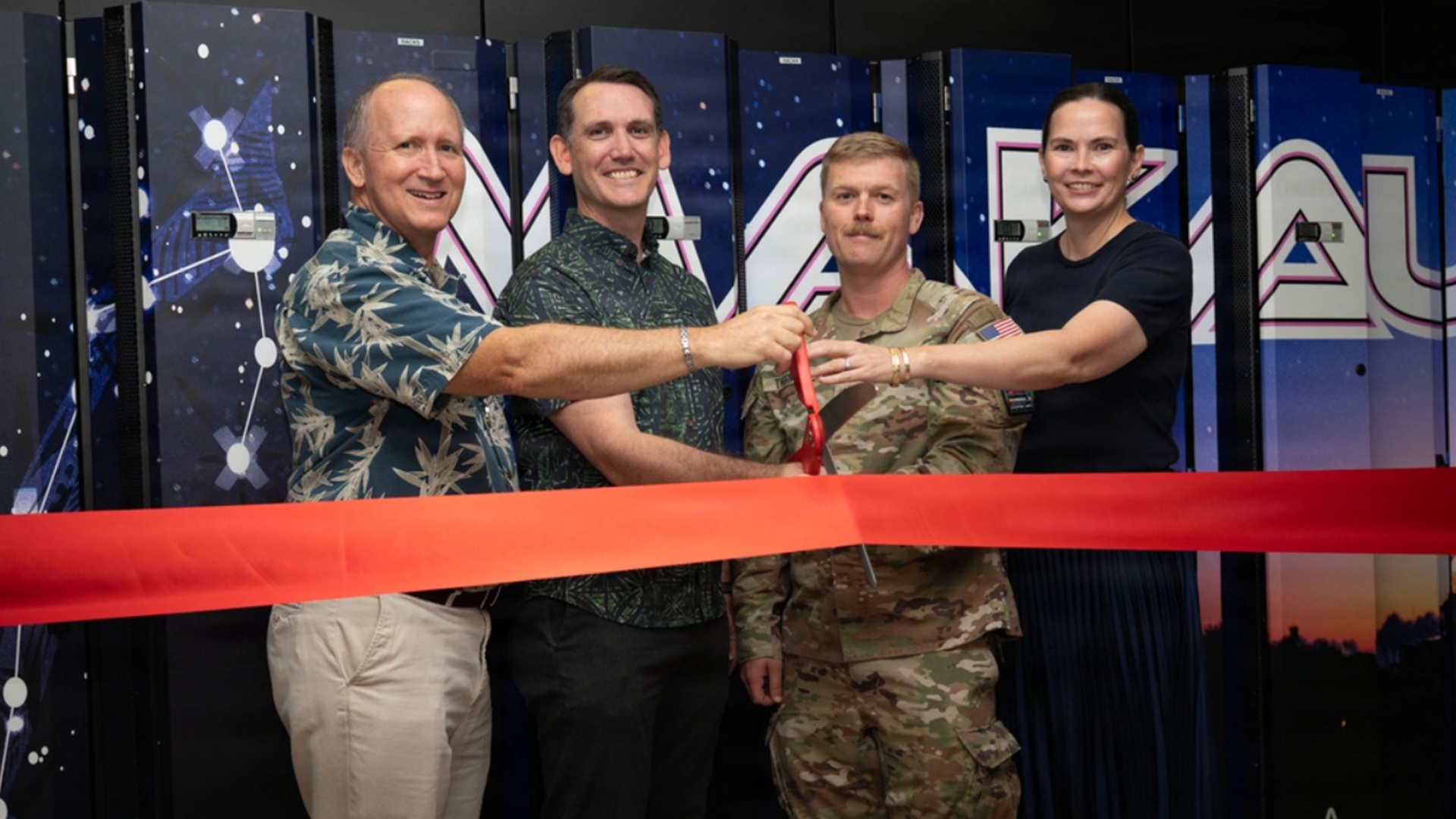
- The US Space Force launched a high-performance computer named Makau, described as its newest premier research asset, intended to address challenges across space, cyber operations and digital engineering.
- Makau can achieve processing speeds of about 2.64 peak petaflops, or approximately 2.64 quadrillion floating-point operations per second.
- Makau was officially unveiled at the Maui High Performance Computing Center in Kihei, Hawaii, in a ribbon-cutting ceremony on Friday, August 7.
- Makau is a six-cabinet Hewlett Packard Enterprise Cray XD2000 system equipped with 74 enterprise-grade GPUs and 19.2 terabytes of usable memory.
- The system uses liquid-cooled, rear-door heat exchangers to manage heat.
Compiled by The Product DeskSomething wrong?How this is made
Why it matters
The US Space Force cut the ribbon on Makau, described as its newest premier research asset, at the Maui High Performance Computing Center in Kihei, Hawaii, on Friday, August 7 [1][3]. The system is a six-cabinet HPE Cray XD2000 rated at 2.64 peak petaflops with 74 enterprise-grade GPUs and 19.2 terabytes of usable memory [2][4], and the configuration matters more than the flop count: a mission set that explicitly includes digital engineering and modeling, simulation and analysis is being stood up on an accelerator cluster, alongside space domain awareness and cyber operations [8].
The arithmetic is worth doing. Seventy-four GPUs across six cabinets is roughly 12 per cabinet [16], and 2.64 petaflops spread across 74 devices is about 35.7 peak teraflops each [15]. Usable memory works out to roughly 259 gigabytes per GPU [17], which is generous and points at data-heavy fusion work rather than large-model training. The material does not say which GPU model, at what numerical precision the 2.64 figure was measured, or which specific workloads sit behind the performance claims [19].
Those claims are strong. MHPCC technical director John Marlia said Makau compresses data analysis timelines "from weeks to seconds," ensuring teams have the right information when they need it most, and that historically such datasets could take weeks to process, delaying decisions [6][7]. One week is 604,800 seconds, so weeks-to-seconds is a five to six order of magnitude reduction [18]. Seventy-four GPUs do not deliver that on the same code [4]. What can deliver it is a change of method, which is what MHPCC director Scott Pierce actually describes: machine learning models automating the fusion of multiple data sources into a timelier, more cohesive operating picture, with AI giving Airmen and Guardians rapid analysis and a course of action [9]. Trained-model inference substituting for an analyst-driven batch pipeline plausibly moves weeks to seconds. The old pipeline is not being accelerated so much as retired, and the comparison is between two different things.
The rest of the picture is consistent with a test-and-evaluation asset rather than a flagship research machine. The Space Force says the system was built for demanding science and technology, test and evaluation workloads, growing data volumes, and faster technological innovation [10], and its press release frames the users as "Department of War science and technology test and evaluation communities" [11]. Cooling is handled by liquid-cooled rear-door heat exchangers [5], a facility-friendly approach for dropping dense GPU cabinets into an existing room. MHPCC employs more than 45 professional staff living locally and is recruiting for additional positions [12]; Pierce credited the local team, local vendors and HPE, and noted that these solutions require constant support from highly technical staff to stay properly configured [14]. The center also runs STEM events with the 15th Space Surveillance Squadron and recruits local students for summer internships [13].
What to watch: whether anyone attaches the weeks-to-seconds figure to a named workload with a documented before-and-after; whether the modeling, simulation and analysis codes in that mission set actually port to GPUs or quietly stay on CPU hosts [8]; and whether staffing keeps pace with the machine, given that the same team maintaining it is still hiring [12][14].
Claim ledger
Ranked by verification strength, evidence, and original report placement.
- [1]
The US Space Force launched a high-performance computer named Makau, described as its newest premier research asset, intended to address challenges across space, cyber operations and digital engineering.
- [2]
Makau can achieve processing speeds of about 2.64 peak petaflops, or approximately 2.64 quadrillion floating-point operations per second.
ReportedView cited source - [3]
Makau was officially unveiled at the Maui High Performance Computing Center in Kihei, Hawaii, in a ribbon-cutting ceremony on Friday, August 7.
ReportedView cited source - [4]
Makau is a six-cabinet Hewlett Packard Enterprise Cray XD2000 system equipped with 74 enterprise-grade GPUs and 19.2 terabytes of usable memory.
ReportedView cited source - [5]
The system uses liquid-cooled, rear-door heat exchangers to manage heat.
ReportedView cited source - [6]
"By compressing data analysis timelines from weeks to seconds, Makau provides a definitive advantage, ensuring that our teams always have the right information precisely when they need it most," said John Marlia, MHPCC technical director.
Sources & coverage · 1 publisher
The reporting this story was synthesized from, earliest first. Every link goes to the original.
- interestingengineering.comGeorgina JedikovskaAug 13US Space Force unveils 2.64-petaflop Makau supercomputer with 74 advanced GPUs
Additional citations
- Interesting Engineering, reporting on the US Space Force
- John Marlia, MHPCC technical director
- Scott Pierce, PhD, MHPCC director
- US Space Force press release, as quoted by Interesting Engineering