Published Product3 min read
The 100 percent drone tariff moves the binding constraint to the bill of materials
Thermal cameras, airframes over 25kg, and every part for a heavy unmanned aircraft now face a doubling of landed cost, with an exemption available to companies that promise to build in the United States.
Not a builder's beat, but builders have a standing stake in it.See today for builders
What happened
- In a presidential action, Trump declared a 100 percent tariff on imports of drones with thermal cameras.
- The 100 percent tariff also applies to imports of drones weighing over 25kg (57 pounds).
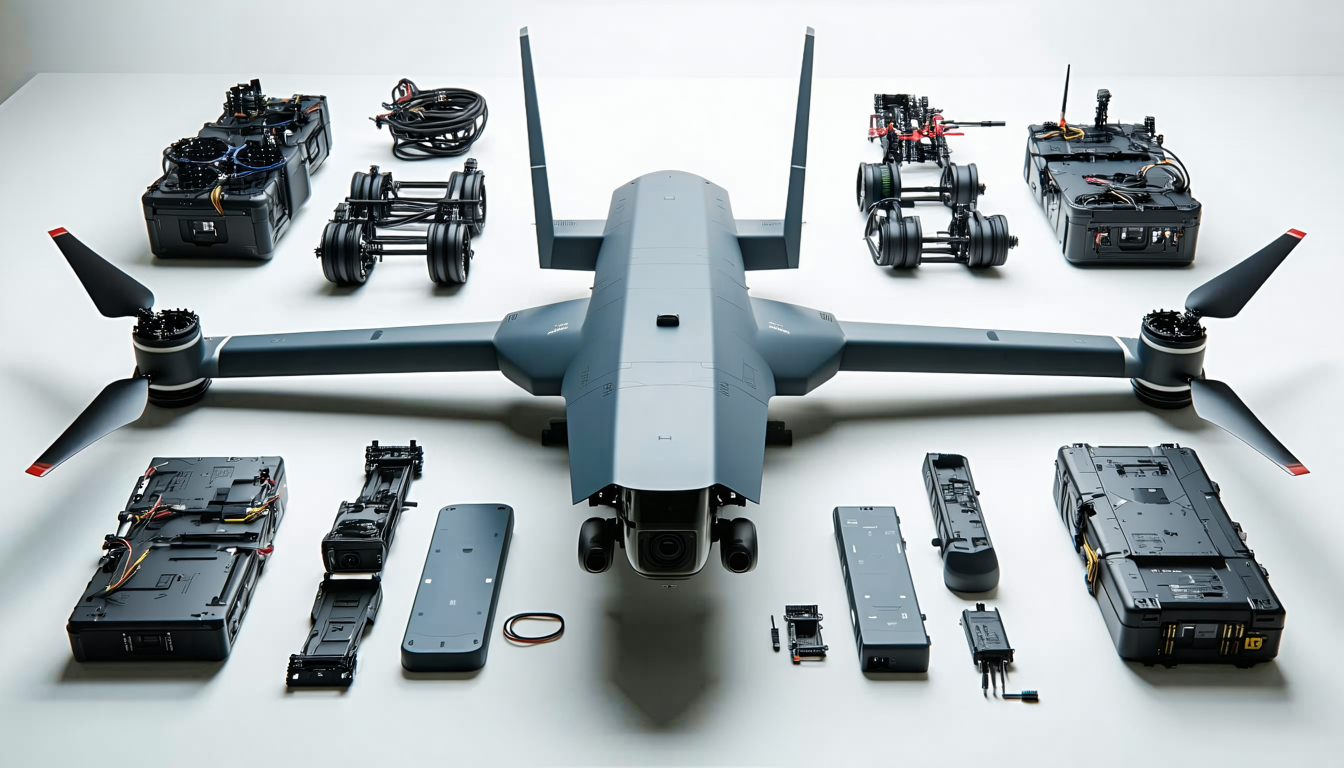
- The 100 percent tariff also applies to any kind of part for any kind of unmanned aircraft weighing over 25kg.
- For all other drones, including sub-250-gram "Mini" consumer drones, Trump declared a 25 percent tariff.
- A stated reason for the tariffs is that "many U.S. commercial manufacturers that produce UAS domestically are highly dependent on foreign sources for critical UAS components, such as motors, electronic speed controllers, lithium-ion batteries, and docking stations, which creates unacceptable national security vulnerabilities."
Compiled by The Product DeskSomething wrong?How this is made
Why it matters
President Trump declared a 100 percent tariff on imports of drones with thermal cameras, drones weighing more than 25kg (57 pounds), and any kind of part for any unmanned aircraft over 25kg, with a 25 percent rate on all other drones including sub-250-gram consumer minis [1][2][3][4]. For anyone running a US drone program, the question that decides whether a platform ships has shifted from whether it can be cleared to what its components cost.
The parts clause is the load-bearing part. The proclamation's own reasoning is that domestic manufacturers depend on foreign sources for motors, electronic speed controllers, lithium-ion batteries, and docking stations, which it calls an unacceptable national security vulnerability [5]. Those four items are line items in essentially every airframe BOM. Because finished heavy drones and the parts for heavy drones sit in the same 100 percent band, the usual mitigation for a finished-goods tariff, importing subassemblies and doing final assembly domestically, does not lower the rate for that class [2]. Parts for a heavy aircraft are taxed at four times the rate of a complete light non-thermal drone [1]. And because the thermal-camera criterion is written separately from the weight criterion, a sensor choice can put a small airframe in the top band on its own [3].
The exemption is where the actual policy lives. A company that commits to making some of its drones or aircraft parts in the United States does not have to pay the tariffs [6], and the Secretary of Commerce is authorized to create a program to incentivize new investment in US production facilities for unmanned aircraft and components [7]. The Verge notes Trump suggested similar deals when he threatened a 100 percent tariff on computer chips last year [8]. So the price of a heavy airframe now depends on a negotiated commitment rather than a published schedule, which is not a number a procurement team can model.
The country carve-outs carry a condition worth reading closely. The EU, Japan, Liechtenstein, South Korea, Switzerland, and Taiwan get 15 percent and the UK gets 10 percent, but only provided that substantially all hardware, software, and technology originates from within those countries and the United States [9]. As written, that is a supply-chain provenance test, not a shipping-origin test, which is a harder thing for a vendor to certify than a country of final assembly.
All of this sits on unstable legal ground. The Supreme Court ruled earlier this year that Trump's global tariffs were illegal, and the US Court of International Trade ruled against them as well [10]. The Verge's read is that companies raise prices to pass tariff costs to customers, later collect refunds when tariffs are struck down, and neither remit the refunds nor cut prices [11].
The regulatory layer has not gone away, it has just stopped being the tightest constraint. The US already bars future foreign drones unless their makers comply with the new regime [12], and the FCC recently threatened to retroactively ban "military-grade" drones using definitions that would also catch drones used by farmers, first responders, and light show operators [13].
Watch the Commerce program's terms: specifically what counts as a qualifying commitment, and whether the incentives keep pointing at war drones, which is where The Verge says the government's drone incentives have been aimed [14]. Watch also for airframes redesigned to land just under 25kg and thermal payloads sold as separate line items.
Claim ledger
Ranked by verification strength, evidence, and original report placement.
- [1]
In a presidential action, Trump declared a 100 percent tariff on imports of drones with thermal cameras.
- [2]
The 100 percent tariff also applies to imports of drones weighing over 25kg (57 pounds).
- [3]
The 100 percent tariff also applies to any kind of part for any kind of unmanned aircraft weighing over 25kg.
- [4]
For all other drones, including sub-250-gram "Mini" consumer drones, Trump declared a 25 percent tariff.
- [5]
A stated reason for the tariffs is that "many U.S. commercial manufacturers that produce UAS domestically are highly dependent on foreign sources for critical UAS components, such as motors, electronic speed controllers, lithium-ion batteries, and docking stations, which creates unacceptable national security vulnerabilities."
- [6]
The tariffs include a carve-out: if a company commits to making some of their drones or aircraft parts in the United States, they do not have to pay tariffs.
Sources & coverage · 1 publisher
The reporting this story was synthesized from, earliest first. Every link goes to the original.
- theverge.comSean HollisterAug 13Trump declares 100 percent tariffs on many drones and all aircraft parts
Additional citations
- The Verge
- quoted from the presidential action via The Verge
- quoted from the proclamation via The Verge
- The Verge, quoting the presidential action
- The Verge (opinion/analysis)