Published · 5d agoProduct3 min read
Tesla's Cybercab hits Austin roads with staff aboard: the metric is days-to-paying-rider
A wheel-free robotaxi carrying employees on public roads is a controlled pilot, not a product. The reported gap to the paid Austin fleet is a few days, and that interval is the thing to time.
Not a builder's beat, but builders have a standing stake in it.See today for builders
What happened
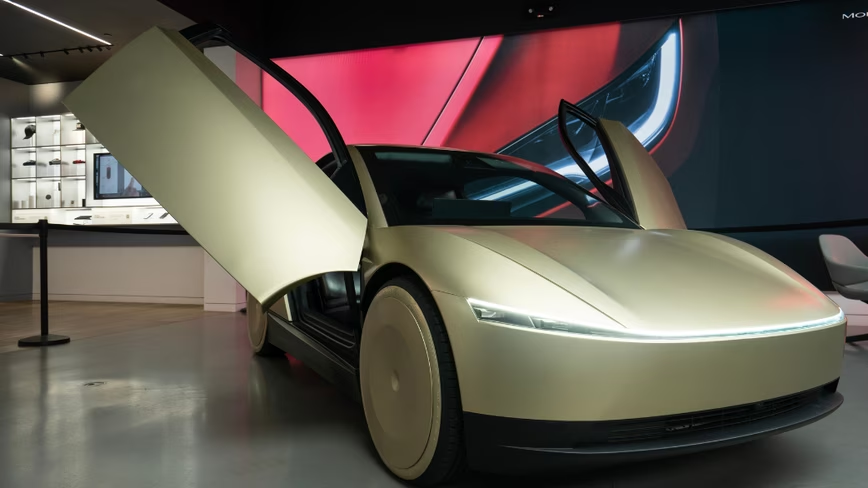
- The Cybercab is a purpose-built two-seat robotaxi with no steering wheel and no pedals.
- Tesla is preparing to put the Cybercab onto public roads in Austin as soon as this month, according to The Information.
- The first people to ride in the Cybercab will be Tesla's own employees, not the public.
- The reported plan is to begin by offering staff rides on public roads and then fold the Cybercabs into Tesla's existing Austin robotaxi service a few days later.
- The internal target is said to be the end of August, though those familiar with the effort caution the timeline could still slip.
Compiled by The Product DeskSomething wrong?How this is made
Why it matters
Tesla is preparing to put the Cybercab, its purpose-built two-seat robotaxi with no steering wheel and no pedals, onto public roads in Austin as soon as this month, according to The Information [1][2]. The first people in the seats will be Tesla employees rather than members of the public [3], which makes the claimed milestone a controlled internal pilot and turns the useful question into a countdown: how many days until those same cars take paying riders.
The reported plan answers that with "a few days." Staff rides on public roads come first, then the Cybercabs are folded into Tesla's existing Austin robotaxi service [4]. The internal target is the end of August, with people familiar with the effort cautioning that it could slip [5]. Everything before this point has been rehearsal in the literal sense: campus test drives on private routes ferrying employees since July [8], public-road testing of the production version starting in June [10], and training sessions last week with local fire, rescue, and police departments so first responders know how the cars behave [9]. That sequencing mirrors the approach Tesla used before opening its first commercial robotaxi hub in the city last year [6].
The manufacturing side is where the asymmetry shows. Tesla has been building Cybercabs at Gigafactory Texas since February, and by July more than 100 had been spotted in factory lots [11]. It cannot legally sell those vehicles or let a customer drive one, because they have no controls and, in most places, no permission [12]. TNW's reading is that the launch is therefore gated by software readiness rather than by the factory, which has been ready for a while [13]. On the numbers, that reading holds: more than 100 built against an unsupervised Austin fleet reported to have shrunk to roughly 17 cars, down from about 25 in the spring [11][16], is roughly six vehicles produced for every one in service [3], and a fleet about 32 percent smaller than it was a few months ago [2].
The mileage comparison sets the scale of what is being launched. Tesla says its robotaxis have covered around 380,000 driverless miles across its hubs, a figure Musk cited approvingly [14]. Waymo passed 220 million rider-only driverless miles some time ago [15], about 580 times Tesla's total [1]. Tesla's service still runs inside carefully mapped geofences in a handful of cities, from Austin to several Florida markets, with human safety monitors close to the operation [17]. Musk has been describing a driverless future since roughly 2016 [7], and the Cybercab itself was unveiled in 2024 [19].
The format is not the weak part. A vehicle with no steering wheel is a harder proposition than a retrofitted Model Y, and regulators are moving: Amazon's Zoox won the first US approval to charge for rides in a wheel-free robotaxi [18].
Watch the interval between the first employee ride and the first paid one, and whether "a few days" holds [4]. Watch whether the Austin unsupervised count recovers past 25 [16] or whether Cybercabs simply replace Model Ys. Watch whether the geofence widens [17]. Employee shuttles are low-risk by design; the paid fleet is the test.
Claim ledger
Ranked by verification strength, evidence, and original report placement.
- [1]
The Cybercab is a purpose-built two-seat robotaxi with no steering wheel and no pedals.
ReportedView cited source - [2]
Tesla is preparing to put the Cybercab onto public roads in Austin as soon as this month, according to The Information.
- [3]
The first people to ride in the Cybercab will be Tesla's own employees, not the public.
ReportedView cited source - [4]
The reported plan is to begin by offering staff rides on public roads and then fold the Cybercabs into Tesla's existing Austin robotaxi service a few days later.
ReportedView cited source - [5]
The internal target is said to be the end of August, though those familiar with the effort caution the timeline could still slip.
ReportedView cited source - [6]
This is broadly the same cautious playbook Tesla followed before opening its first commercial robotaxi hub in Austin last year.
ReportedView cited source
Sources & coverage · 2 publishers
The reporting this story was synthesized from, earliest first. Every link goes to the original.
- thenextweb.comDarius Popa5d agoTesla’s Cybercab is finally launching, and it starts by giving its own staff a lift
- theverge.comAndrew J. Hawkins5d agoTesla is finally launching the Cybercab — let’s hope it’s ready
Additional citations
- The Information, as reported by TNW
- TNW analysis