Published · yesterdayProduct3 min read
Samsung's record payout is a capacity decision, and half of it has no instrument yet
The board approved 90 to 110 trillion won for 2026 but attached figures to only about 45 trillion. The shares fell 2.6% while SK Hynix pointed $720bn at fabs.
Not a builder's beat, but builders have a standing stake in it.See today for builders
What happened
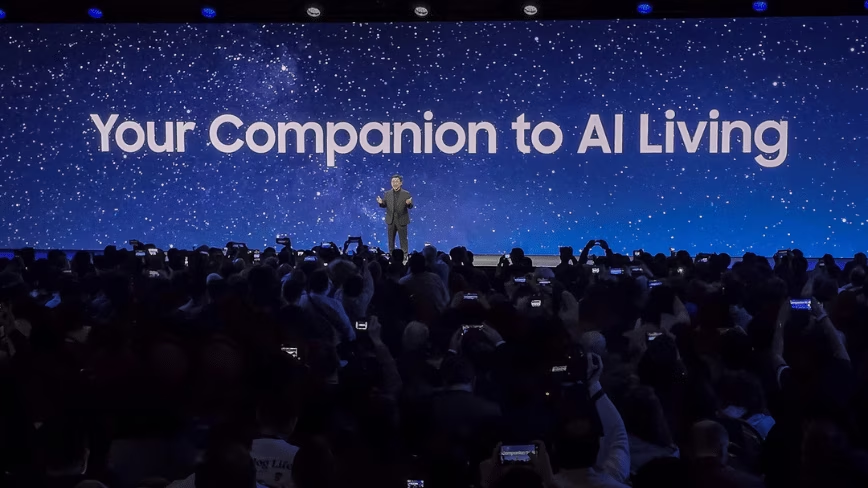
- Samsung Electronics' board approved the largest shareholder return in South Korean corporate history on Friday.
- The board signed off on a shareholder return of between 90 trillion and 110 trillion won for 2026, roughly $65bn to $80bn.
- The programme is about five times Samsung's previous record of 20.3 trillion won, set in 2020.
- Samsung shares fell as much as 2.6% in post-market trading after the approval.
- Samsung's preferred shares had surged more than 8% earlier that day on expectations of a bigger figure.
Compiled by The Product DeskSomething wrong?How this is made
Why it matters
Samsung has put a figure on about 45 trillion won of the programme: roughly 30 trillion won of third-quarter cash dividends, and roughly 15 trillion won of stock bought for employee compensation [6][7]. Against the headline range, that leaves 45 to 65 trillion won, somewhere between half and 59 percent of the total, with no instrument attached to it [1][2].
The instrument is the whole argument. A repurchase followed by cancellation removes shares permanently and lifts earnings per share for everyone still holding, while a dividend is cash out of the door, taxed on receipt, with the share count unchanged [12]. Albert Yong of Petra Capital Management said the real question is how much is incremental and how much comes through buybacks rather than dividends [10], and Jung In Yun of Fibonacci Asset Management Global said the market will now focus on the split between buybacks and special dividends rather than the headline amount [11]. The 2.6% post-market markdown is roughly what an unnamed instrument costs [4]. It did not help that the preferred shares had run more than 8% during the session on expectations of something larger [5], or that the top of the range sits about 40 trillion won, a little over a quarter, below the 150 trillion won some funds had modelled [6].
The money is memory money. Samsung's stock is up around 135% this year on demand for the chips feeding AI systems, according to CNBC's Jenny Lee [14], and in the same week as the payout the company raised foundry prices by as much as 15% for new orders, with Chinese customers facing the steepest increases [15]. Sellers reprice new orders when the book is longer than the line. SK Hynix is answering the same demand by building, with $720bn of memory fabs at Yongin [16], while Samsung is still working to catch it in high-bandwidth memory, the segment that matters most to AI buyers [17]. Yongin is a build commitment and Samsung's is a one-year return, so the nine-to-elevenfold gap in dollars measures intent rather than matched spending [5].
Part of the size comes from the 2024 policy of returning half of free cash flow over three years [18]. On Samsung's own figures, 2024 and 2025 produced 19.6 trillion won of regular dividends, a 1.3 trillion won special dividend and 8.4 trillion won of buybacks for cancellation [19], which is 29.3 trillion won all in. The 2026 commitment alone is three to nearly four times those two years combined [3]. Either the cash forecast is very large, or the first two years ran behind the promise and 2026 is catching up.
Samsung described the result as a virtuous cycle of corporate growth and shareholder value [22]. The comparison it invites does not flatter: Apple authorised $110bn of buybacks in 2024, so the top of Samsung's range comes in roughly $30bn under a single American programme from two years earlier [21][4]. A record return from the company trailing in the product paying for it is a statement about where the next fab is not going.
Claim ledger
Ranked by verification strength, evidence, and original report placement.
- [1]
Samsung Electronics' board approved the largest shareholder return in South Korean corporate history on Friday.
ReportedView cited source - [2]
The board signed off on a shareholder return of between 90 trillion and 110 trillion won for 2026, roughly $65bn to $80bn.
ReportedView cited source - [3]
The programme is about five times Samsung's previous record of 20.3 trillion won, set in 2020.
ReportedView cited source - [4]
Samsung shares fell as much as 2.6% in post-market trading after the approval.
ReportedView cited source - [5]
Samsung's preferred shares had surged more than 8% earlier that day on expectations of a bigger figure.
ReportedView cited source - [6]
About 30 trillion won goes out as cash dividends in the third quarter, including the regular payout, with the detail fixed at an October board meeting.
ReportedView cited source
Sources & coverage · 1 publisher
The reporting this story was synthesized from, earliest first. Every link goes to the original.
- thenextweb.comCristian Dina2d agoSamsung approves a record $80bn shareholder return, and the stock falls
Additional citations
- Kim Minji, Must Asset Management, to Bloomberg
- Albert Yong, Petra Capital Management
- Jung In Yun, Fibonacci Asset Management Global
- Jenny Lee, CNBC