Published Product3 min read
Romania blew up part of a riverbed to keep a reactor cool. It still had to disconnect it.
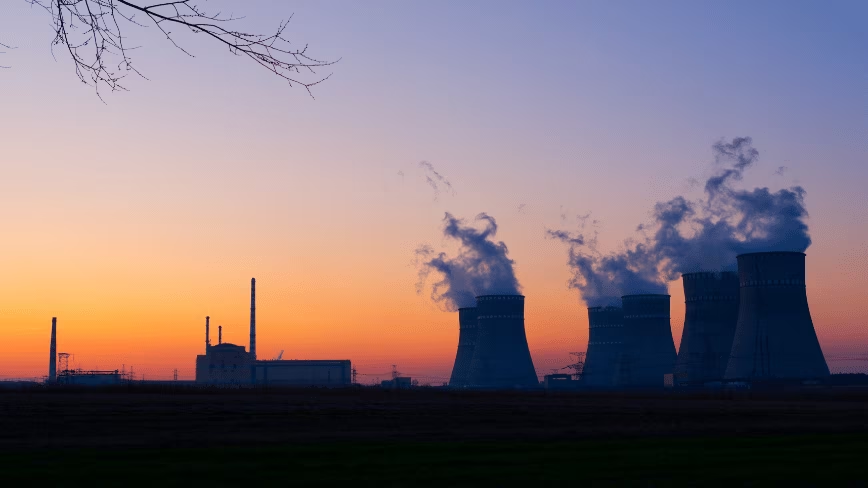
Nuclearelectrica began taking Romania's sole operating reactor offline on Thursday because the Danube is too low.
Not a builder's beat, but builders have a standing stake in it.See today for builders
What happened
- On Thursday, Romania's state-owned Nuclearelectrica began disconnecting the country's sole operating reactor because the Danube is too low to cool it, as reported by CNBC.
- Before the disconnection, Romania dredged the Danube channel and sank rock-filled barges, and its navy detonated a controlled underwater explosion on the riverbed on 3 August, aiming to push more water toward the cooling system at Cernavoda.
- Cernavoda is Romania's only nuclear plant, and its two reactors normally supply about a fifth of Romania's electricity.
- If Cernavoda's two reactors together supply about a fifth of Romania's electricity, one reactor is worth roughly a tenth of national supply on an even split.
- The Romanian measures show the limits of short-term mitigation: dredging, sunken barges and a controlled detonation are the actions of a state with days rather than years to work with, and they have to be repeated the next time the river drops.
Compiled by The Product DeskSomething wrong?How this is made
Why it matters
Romania's state-owned Nuclearelectrica began disconnecting the country's only operating reactor on Thursday because the Danube is too low to cool it, CNBC reported [1]. What makes this more than a local outage is what came before it: the state had already dredged the channel, sunk rock-filled barges, and had its navy carry out a controlled underwater detonation on the riverbed on 3 August, all to push more water toward the cooling system at Cernavoda [2].
Cernavoda is Romania's only nuclear plant, and its two reactors normally supply about a fifth of the country's electricity [3]. On an even split between the units, the reactor coming off is worth roughly a tenth of national supply [4]. That is the price of a river level, and the mitigations tell you how the problem is being managed: dredging, ballast and explosives are the tools of an operator with days to work with, not years, and they have to be repeated the next time the water drops [5].
The same constraint is showing up with different triggers. EDF said on Wednesday it had cut output at several reactors for environmental reasons, and earlier in the week shut three reactors at Gravelines entirely after a massive influx of jellyfish tripped automatic protections [6]. That is the second consecutive year a jellyfish swarm has closed reactors at Gravelines, one of France's largest plants, and Politico noted the arrival fell on the same date both years [7]. France draws about 70 percent of its electricity from nuclear and has reportedly shut a record number of plants this summer across heat, wildfires and drought [8]. In Hungary, rain moved the other way: enough of a lift in the Danube to restart turbines at Paks, which supplies nearly half the country's electricity, with two of its eight turbines running again as of Monday [9].
The rivers are telling the same story off the grid. The Danube runs about 2,850km and is a freight route as well as a coolant [10]. On the Rhine, cargo vessels are picking their way past exposed riverbed at Kaub in Germany [11].
Gareth Remond-King, who heads the international programme at the Energy and Climate Intelligence Unit, told CNBC that treating this as an emergency is "perhaps a little overdue" and that it "is not something that is simply going to pass" [12]. The responses under discussion, upgraded cooling systems and scheduling maintenance around the hottest weeks, do not change which input is binding [13]. The UK's Cobra emergency committee met on Wednesday over heat, wildfires and drought, its second heatwave meeting this year, with temperatures forecast to reach 38C [14].
The macro number is the one to put in a board pack. Dutch bank Triodos published an analysis on 8 August putting the economic cost of this summer's heat at 180bn euros, about 1 percent of EU GDP, attributed mainly to lower labour productivity, with weaker harvests, dearer food, constrained energy production, higher power prices and transport disruption making up the rest [15]. Forecasters expect the EU to grow about 1 percent this year, so on those figures the heat costs the bloc what it expects to gain [16]. The implied denominator is an economy of roughly 18trn euros [17].
Anyone siting compute in Europe is buying into this grid. Data centres need firm power and cooling water in quantity, and both just got less reliable in the places the capacity is going [18]. Nebius has agreed to lease capacity in south Wales as part of about 1.7bn pounds across four UK sites [19]; Uniper is spending 5bn euros on data centres [20]; the UK is preparing to float Nscale at 51bn dollars on contracted compute it has not delivered [21]. Data centres caused none of this summer's shutdowns [22]. They are simply arriving at the same grid, in the same decade, as a supply side whose ratings now carry a weather condition.
Claim ledger
Ranked by verification strength, evidence, and original report placement.
- [1]
On Thursday, Romania's state-owned Nuclearelectrica began disconnecting the country's sole operating reactor because the Danube is too low to cool it, as reported by CNBC.
- [2]
Before the disconnection, Romania dredged the Danube channel and sank rock-filled barges, and its navy detonated a controlled underwater explosion on the riverbed on 3 August, aiming to push more water toward the cooling system at Cernavoda.
ReportedView cited source - [3]
Cernavoda is Romania's only nuclear plant, and its two reactors normally supply about a fifth of Romania's electricity.
ReportedView cited source - [5]
The Romanian measures show the limits of short-term mitigation: dredging, sunken barges and a controlled detonation are the actions of a state with days rather than years to work with, and they have to be repeated the next time the river drops.
ReportedView cited source - [6]
EDF said on Wednesday it had cut output at several reactors for environmental reasons on its production updates page, and earlier in the week shut three reactors at Gravelines entirely after a massive influx of jellyfish triggered automatic protective shutdowns.
- [7]
It is the second year running that a jellyfish swarm has closed reactors at Gravelines, one of France's largest plants, and Politico noted that the jellyfish arrived on the same date two years running.
Sources & coverage · 1 publisher
The reporting this story was synthesized from, earliest first. Every link goes to the original.
- thenextweb.comAlina Maria StanAug 13Europe’s drought is shutting down nuclear reactors
Cited in this coverage: CNBC, via thenextweb.com
Cited in this coverage: statement reported on Monday and relayed by thenextweb.com
Additional citations
- EDF production updates page
- Politico
- Gareth Remond-King, Energy and Climate Intelligence Unit, to CNBC
- Triodos analysis, 8 August