Published Product3 min read
Rice puts a number on graphene's wrinkles, and hands thin-film engineers a second control variable
A team at Rice reports experimental confirmation of flexoelectricity in single-atom-thick graphene, where sharpness of a fold, not doping chemistry, sets the local electrical response.
Not a builder's beat, but builders have a standing stake in it.See today for builders
What happened
- Researchers at Rice University have experimentally proven that extreme, nanoscale wrinkles in graphene generate local electric charges, showing clear evidence of flexoelectricity (electric charge generated by uneven bending) in single-atom-thick materials.
- Altering the physical shape of ultra-thin materials, rather than depending on chemical additives, allows control of electrical properties; the geometry-driven approach is presented as a route to highly sensitive sensors and advanced ultra-thin electronic devices.
- "Our work shows that even an ordinary wrinkle can become an extraordinary electronic feature when viewed at the atomic scale," said Pulickel Ajayan, the Benjamin M. and Mary Greenwood Anderson Professor of Engineering.
- "By demonstrating that geometry alone can reshape electrical behavior in graphene, we open a new pathway for designing materials whose properties can be controlled through structure rather than chemistry," said Ajayan, co-corresponding author of the study.
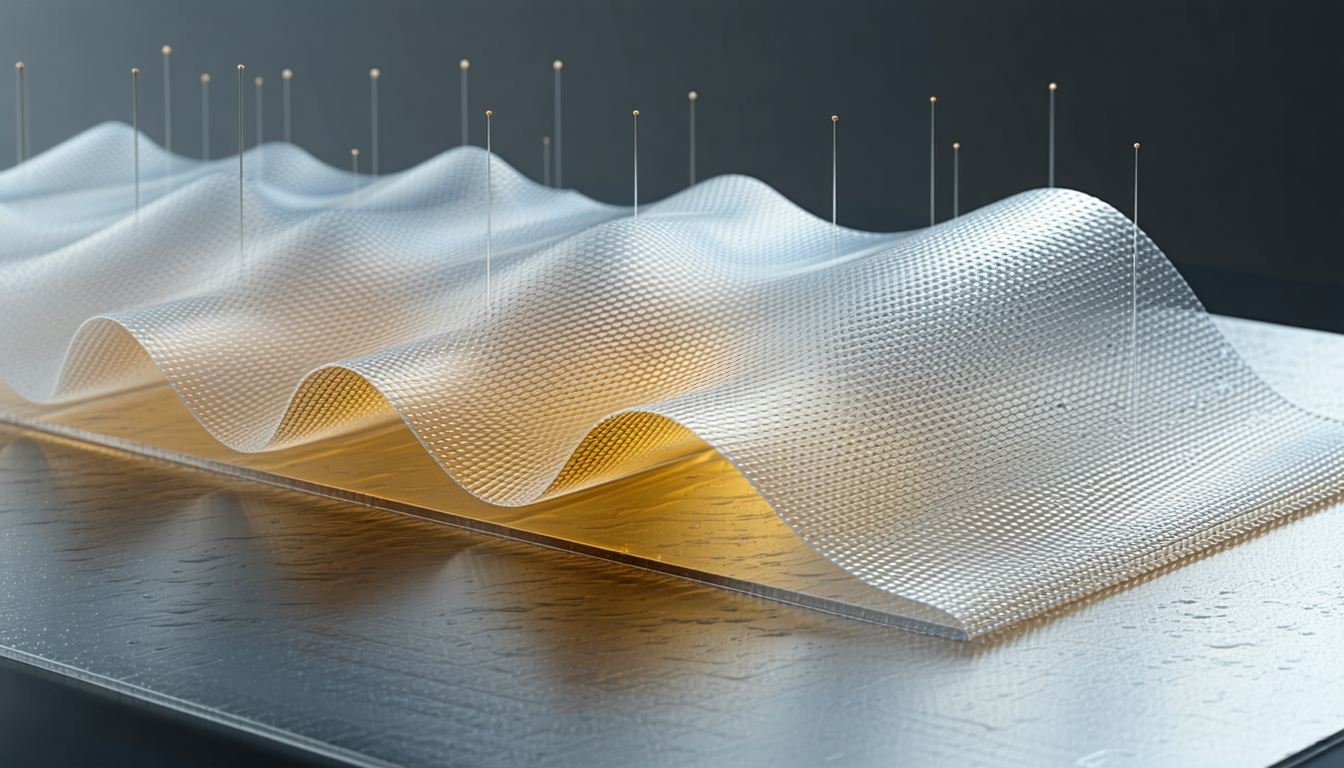
- Extreme nanoscale wrinkles in single-atom-thick graphene cause electrons to shift toward one side, creating opposite electrical charges similar to a tiny battery.
Compiled by The Product DeskSomething wrong?How this is made
Why it matters
Researchers at Rice University say they have experimentally proven that extreme nanoscale wrinkles in graphene generate local electric charges, which they present as clear evidence of flexoelectricity in a single-atom-thick material [1]. For anyone designing thin-film sensors or ultrathin electronics, the consequence is that the geometry of the sheet becomes a candidate control variable alongside chemical additives [2].
The mechanism described is straightforward. At a sharp bend, electrons shift toward one side of the fold, leaving opposite charges on either face, which the team likens to a tiny battery [5]. The wrinkles behave like electrical speed bumps, altering local electrical energy and producing a consistent current under roughly one volt of applied electricity [8].
The measurement design is the part worth reading closely. The team compared sharply curved wrinkles against flat graphene using specialized microscopic probes, laser-based Raman spectroscopy and computer simulations, in order to isolate the effect of extreme curvature [6]. According to lead author Sathvik Ajay Iyengar, a former Rice doctoral student, earlier work looked at gentler bends or applied external pressure, which made the effect hard to separate [7]. That is a differential experiment rather than a new fabrication result, and it matters for how you read the headline number.
That number is the sharpness dependence. The response tracks how tightly the sheet is folded rather than how tall the wrinkle is, and the resulting charge separation is estimated at 100,000 to 10 million times stronger than in much larger flexoelectric systems [9]. The stated range spans a factor of 100 [16], which is what an estimate looks like before anyone has built a device around it. Iyengar's own framing is conditional: sharpness mattered more than size, which suggests electrical behavior could potentially be tuned by controlling curvature at the nanoscale [10].
The provenance is unusually clean for a claim like this. In 2008, theoretical physicist Vincent Meunier predicted that violently curving graphene would force its electrons to realign and generate power, but the instrumentation to measure voltage across a gap a few atoms wide did not exist [11]. Iyengar and colleague Manoj Tripathi later noticed unexplained electrical signals spiking at the sharpest folds while reviewing old dataset measurements [12], and applying roughly one volt to isolated wrinkles produced the behavior the 18-year-old math had predicted [13]. The work was published in Advanced Materials [14].
Two limits should temper the design-path reading. The wrinkles studied were naturally formed, not patterned [15], and the account as reported describes no process for placing a fold of a chosen radius at a chosen location [17]. Co-corresponding author Pulickel Ajayan, the Benjamin M. and Mary Greenwood Anderson Professor of Engineering, puts it as opening a pathway for designing materials whose properties are controlled through structure rather than chemistry [4], and adds that an ordinary wrinkle can become an extraordinary electronic feature at the atomic scale [3]. A pathway is not a process.
What to watch: whether anyone demonstrates deterministic curvature patterning, whether the roughly one volt response survives contacts, encapsulation and thermal cycling, and whether independent groups reproduce the polarization estimate tightly enough to narrow that 100-fold band into something a sensor spec can quote.
Claim ledger
Ranked by verification strength, evidence, and original report placement.
- [1]
Researchers at Rice University have experimentally proven that extreme, nanoscale wrinkles in graphene generate local electric charges, showing clear evidence of flexoelectricity (electric charge generated by uneven bending) in single-atom-thick materials.
ReportedView cited source - [2]
Altering the physical shape of ultra-thin materials, rather than depending on chemical additives, allows control of electrical properties; the geometry-driven approach is presented as a route to highly sensitive sensors and advanced ultra-thin electronic devices.
ReportedView cited source - [3]
"Our work shows that even an ordinary wrinkle can become an extraordinary electronic feature when viewed at the atomic scale," said Pulickel Ajayan, the Benjamin M. and Mary Greenwood Anderson Professor of Engineering.
- [4]
"By demonstrating that geometry alone can reshape electrical behavior in graphene, we open a new pathway for designing materials whose properties can be controlled through structure rather than chemistry," said Ajayan, co-corresponding author of the study.
- [5]
Extreme nanoscale wrinkles in single-atom-thick graphene cause electrons to shift toward one side, creating opposite electrical charges similar to a tiny battery.
ReportedView cited source - [6]
Sharply curved bends were compared with flat graphene using specialized microscopic probes, laser-based Raman spectroscopy and computer simulations, an approach that helped isolate the direct effects of extreme curvature on electronic behavior.
ReportedView cited source
Sources & coverage · 1 publisher
The reporting this story was synthesized from, earliest first. Every link goes to the original.
- interestingengineering.comMrigakshi DixitAug 13Scientists control graphene’s electrical behavior through shape instead of chemistry
Additional citations
- Pulickel Ajayan, Rice University
- Pulickel Ajayan, co-corresponding author
- Sathvik Ajay Iyengar, lead author
- Sathvik Ajay Iyengar