Published Product3 min read
Phage T2's mutation hotspots make evolvability a selection criterion, not a curiosity
Michigan State researchers report in Nature Microbiology that a common gut phage diversifies a defence gene by slipping on repeats. That changes what a good therapy candidate looks like.
Not a builder's beat, but builders have a standing stake in it.See today for builders
What happened
- Researchers at Michigan State University published a study on Aug. 13 in the journal Nature Microbiology.
- The researchers identified a counterdefense used by a group of phages common in the human gut, called Enterobacteria phage T2, that helps them stay ahead of their bacterial hosts.
- These phages have mutation hotspots scattered throughout their genomes that help them modify key defense genes.
- In previous work the researchers identified a set of genes in the bacterium that causes cholera that spot the DNA of invading phages and chop it up before the phages can take over.
- The researchers noticed that this antivirus protection did not last for long.
Compiled by The Product DeskSomething wrong?How this is made
Why it matters
Researchers at Michigan State University reported on Aug. 13 in Nature Microbiology that Enterobacteria phage T2, a group of phages common in the human gut, carries mutation hotspots scattered through its genome that let it modify key defence genes [1][2][3]. The finding is operationally interesting because it separates two things phage therapy programmes usually treat as one: how well a candidate kills a target strain now, and how reliably its offspring stop being copies of it.
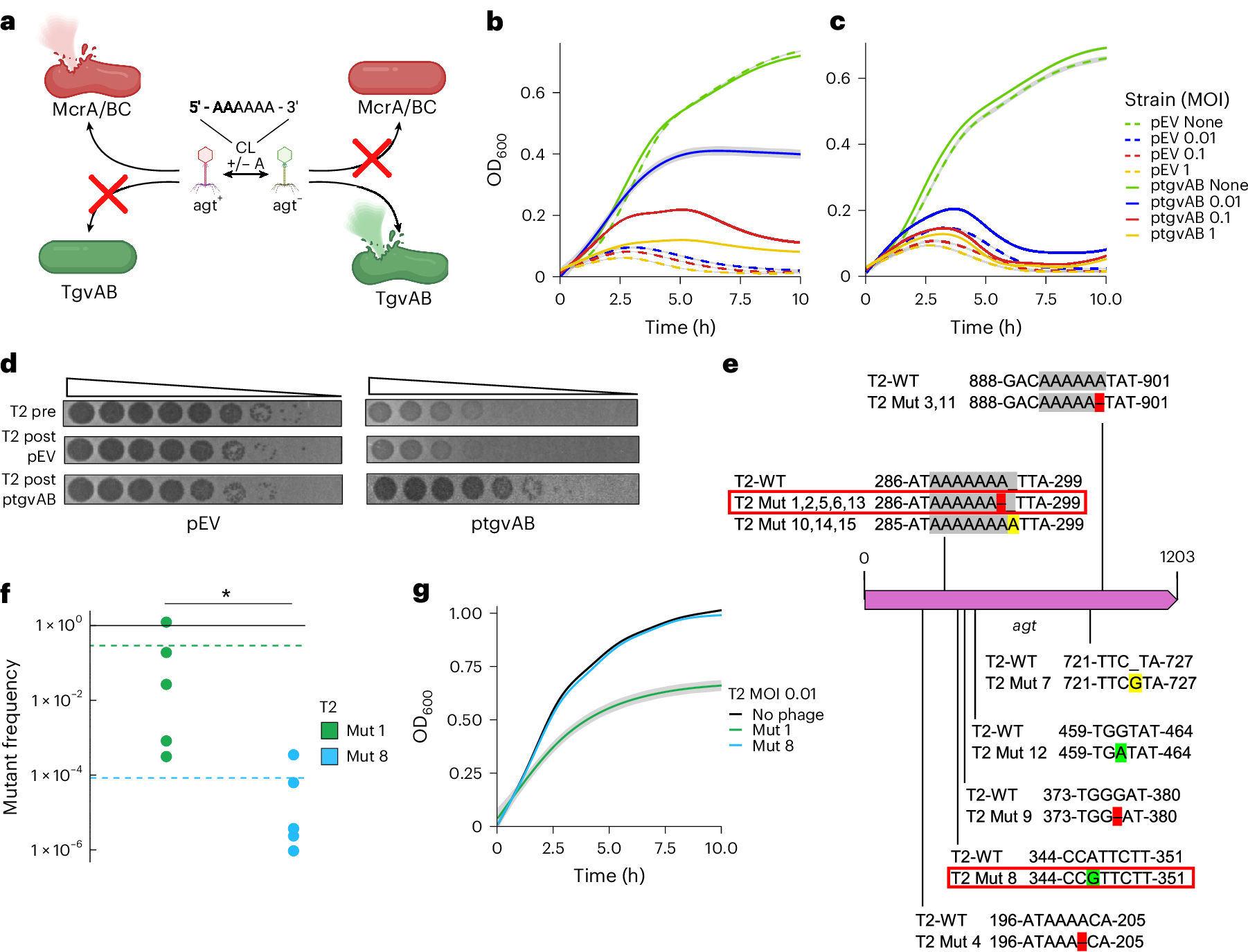
The work started as a study of bacterial defence, not phage offence. The lab had previously identified a set of genes in the bacterium that causes cholera that recognise the DNA of invading phages and cut it up before the phage can take over, and noticed the protection did not last long [4][5]. To test it in a more tractable host, the team moved the cholera DNA encoding the system into E. coli and exposed the engineered bacteria to phages [6]. "Within a few hours, the phages always started to win," said Chris Waters, a co-author and a core faculty member in MSU's Ecology, Evolution, and Behavior program. "We couldn't understand why" [7][8].
Sequencing the resistant phages pointed at a gene called agt, where many carried typos concentrated in a repetitive stretch in which the same nucleotide base appeared multiple times [9]. According to Waters, the region resembled a contingency locus, a class of mutational hotspot well studied in other organisms but not previously shown in phages, where the DNA copying machinery sometimes slips and makes mistakes [10][11]. Some resistant mutants had gained an extra repeat unit in agt and others had lost one, changing how the gene's instructions are read [12]. The practical effect, the researchers report, is that each round of progeny is not a set of exact genetic copies, and the resulting variety means some descendants keep infecting and killing whatever countermeasure the host deploys [13][14]. "They're essentially hedging their bets," Waters said [15].
The consequence for product work follows from the mechanism rather than from any claim in the paper. A potency assay reads one generation. A slippery repeat tract is invisible to that assay, and it is exactly the kind of sequence feature a synthetic-biology team would be tempted to clean up for stability, or that could be lost quietly during passaging and banking. If Waters is right that harnessing these evolutionary tricks could produce more effective therapies [16], then the tract is part of the active ingredient, and a defined, genetically stable batch is not obviously the right specification for a drug whose value partly lies in not copying itself faithfully.
Read the scope narrowly. This is one gene, one hotspot class, and one defence system transplanted out of the cholera bacterium into a surrogate host in the lab [6][9]. It is not a clinical result, and the source material does not report how widely such hotspots occur across therapeutic phage genomes.
The stakes are not speculative. Phys.org frames the underlying problem as a drug-resistant superbug killing someone in the United States every 15 minutes, roughly 35,000 deaths a year on that rate, with antibiotic-resistant infections projected to outpace cancer as the leading cause of death worldwide within a few decades [17][18][19]. Phage cocktails have been used since the 1920s against dysentery, sepsis and pneumonia, notably in France, Poland and parts of the former Soviet Union, before Western interest faded after penicillin arrived in the 1940s [20][21].
Watch for three things: whether contingency loci turn up in the genomes of phages already in compassionate-use pipelines, whether repeat length can be tuned to set a diversification rate deliberately, and how banking and release testing handle a candidate whose sequence is meant to drift.
Claim ledger
Ranked by verification strength, evidence, and original report placement.
- [1]
Researchers at Michigan State University published a study on Aug. 13 in the journal Nature Microbiology.
- [2]
The researchers identified a counterdefense used by a group of phages common in the human gut, called Enterobacteria phage T2, that helps them stay ahead of their bacterial hosts.
- [3]
These phages have mutation hotspots scattered throughout their genomes that help them modify key defense genes.
- [4]
In previous work the researchers identified a set of genes in the bacterium that causes cholera that spot the DNA of invading phages and chop it up before the phages can take over.
- [5]
The researchers noticed that this antivirus protection did not last for long.
- [6]
In their experiments the researchers transferred cholera DNA encoding the protective system to E. coli, a bacterium easier to work with in the lab, and exposed the bacteria to phages; the phages quickly devised a workaround to bypass the hosts' defenses.
Sources & coverage · 1 publisher
The reporting this story was synthesized from, earliest first. Every link goes to the original.
Cited in this coverage: phys.org
Cited in this coverage: Chris Waters, quoted by phys.org