Published Product3 min read
Optimal Transit's Kraaken: firm numbers on the hull, a patent claim in the engine room
A new joint venture is selling floating, self-powered data centers at 10MW to 100MW, plus a variant that exports 40MW and 30 million liters of water a day to shore. The capacity and capex figures are checkable.
Not a builder's beat, but builders have a standing stake in it.See today for builders
What happened
- Optimal Transit is a new company formed as a joint venture between naval systems developer InMar Technologies and power technology firm OptiFuel.
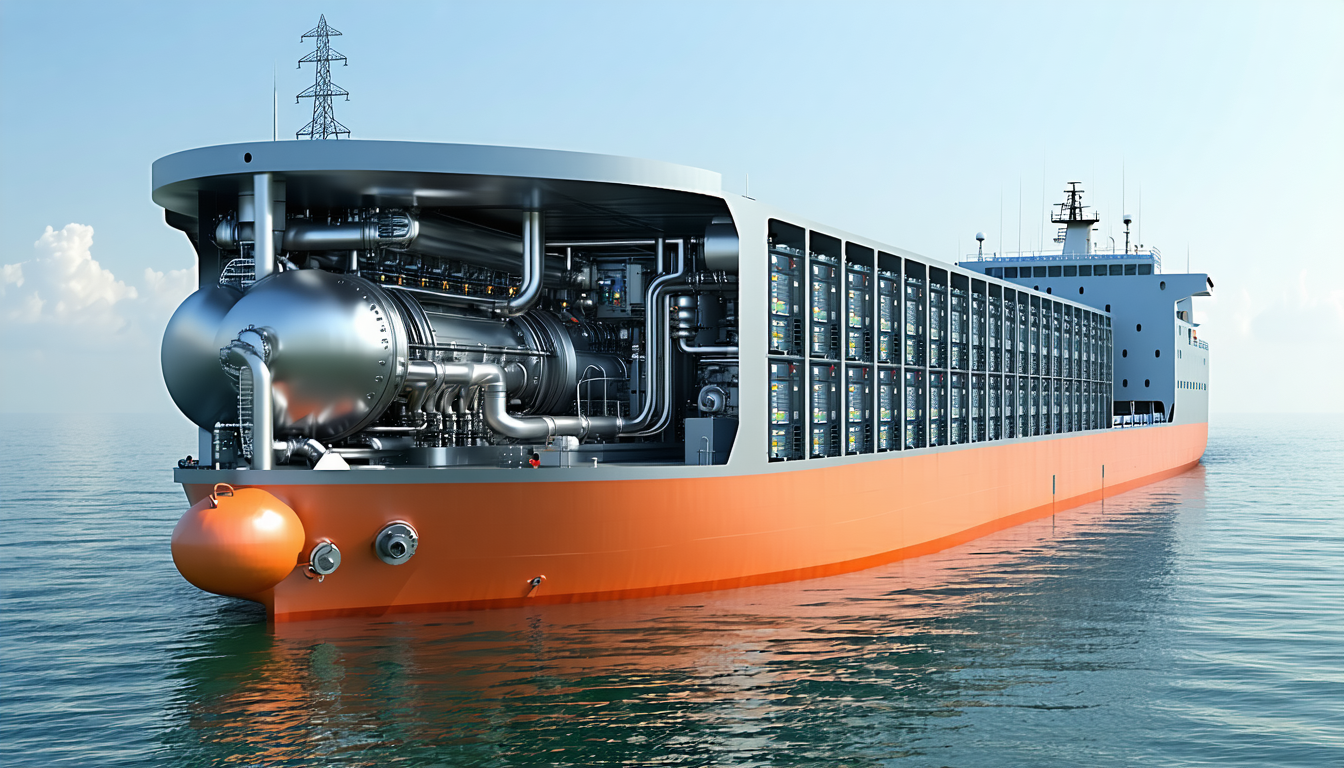
- Optimal Transit has unveiled its Kraaken range of floating data centers, which it says will offer capacity of between 10MW and 100MW.
- Optimal Transit says the 100MW system can be built for less than $500 million, excluding the cost of compute hardware, compared with the $900m to $1.5bn it costs to build a 100MW facility on land.
- Optimal Transit says the Blue Economy Vital 100MW Kraaken, a version of its 100MW floating data center, can provide up to 40MW of continuous clean baseload electricity exported directly to shore, which the company says is enough to reliably serve 32,000 homes.
- The Vital configuration is said to deliver 30 million liters (7.9 million gallons) of fresh water per day, enough to support an estimated 150,000 people, produced using vacuum-flash desalination, a purification process that can use waste heat.
Compiled by The Product DeskSomething wrong?How this is made
Why it matters
Optimal Transit, a joint venture between naval systems developer InMar Technologies and power technology firm OptiFuel, has unveiled a range of floating data centers called Kraaken, sized between 10MW and 100MW [1][2]. The pitch is aimed squarely at the two constraints slowing land-based buildouts, grid interconnection and water, and the capacity and cost numbers are specific enough to audit; the power source underneath them is a vendor assertion about a patented engine.
Start with the part that can be checked. Optimal Transit says a 100MW system can be built for less than $500 million excluding compute hardware, against $900 million to $1.5 billion for a 100MW facility on land [3]. That is under $5 million per MW versus $9 million to $15 million per MW [1], a claimed reduction of roughly 44 to 67 percent [2]. The comparison basis on the land side is not stated in the announcement, which matters: shell-and-core capex, substation work and land are not the same line items.
The second configuration, the Blue Economy Vital 100MW Kraaken, splits the platform's output. Optimal Transit says it can export up to 40MW of continuous baseload electricity to shore, which it describes as enough for 32,000 homes [4], and 30 million liters (7.9 million gallons) of fresh water per day via vacuum-flash desalination driven by waste heat, enough for an estimated 150,000 people [5]. That leaves 60MW for AI compute, with power, water and compute all routed ashore through a quick-disconnect umbilical [6]. The allocation adds up: 40MW exported plus 60MW of compute equals the nameplate 100MW [3]. The implied household draw is 1.25kW average [4] and the water figure works out to 200 liters per person per day [5]. Both are plausible planning numbers rather than aggressive ones.
The hull story is conventional marine engineering. The design uses small waterplane area twin-hull blueprints for stability while supporting high-bandwidth optical and satellite links [7], and the platform can sit permanently moored or disconnect and relocate under its own propulsion at speeds approaching 16 knots to avoid storms, reconnecting within hours when conditions clear [8][6].
The engine is where the roadmap begins. Optimal Transit says Kraaken generates its own continuous power by combining thermal energy stored in the ocean with the data center's own waste heat, using a patented multi-stage Digital Ocean Thermal engine [9]. The company describes that engine as combining multiple-stage Rankine cycle technology, enthalpy recovery logic, supercharging and green ammonia synthesis to deliver carbon-free baseload power [10], operating 365 days a year from equatorial waters to the Arctic without conventional fuel deliveries [11]. Company president Scott Myers says the approach "is not dependent on new scientific breakthroughs" and instead integrates commercially proven technologies into a standardized platform [12]. Jeff Kline, president of InMar Technologies, says the Vital configuration can serve the equivalent of a small city indefinitely with no connection to the existing grid [13].
None of that has been independently verified in the material released so far, which names no deployment site, no customer, no delivery date and no built unit [14]. The partners have relevant track records: InMar is a Maryland firm supplying advanced marine technology to clients including the US Navy, and South Carolina-based OptiFuel builds zero-emission energy systems for rail, marine and power generation [15][16].
Two things to press on. First, a heat engine's output is bounded by the temperature difference it can access, so the equatorial-to-Arctic operating envelope deserves a stated output curve by water temperature rather than a single baseload figure. Second, the sub-$500 million figure needs a like-for-like scope definition before anyone models it against a land site.
Claim ledger
Ranked by verification strength, evidence, and original report placement.
- [1]
Optimal Transit is a new company formed as a joint venture between naval systems developer InMar Technologies and power technology firm OptiFuel.
ReportedView cited source - [2]
Optimal Transit has unveiled its Kraaken range of floating data centers, which it says will offer capacity of between 10MW and 100MW.
ReportedView cited source - [3]
Optimal Transit says the 100MW system can be built for less than $500 million, excluding the cost of compute hardware, compared with the $900m to $1.5bn it costs to build a 100MW facility on land.
- [4]
Optimal Transit says the Blue Economy Vital 100MW Kraaken, a version of its 100MW floating data center, can provide up to 40MW of continuous clean baseload electricity exported directly to shore, which the company says is enough to reliably serve 32,000 homes.
- [5]
The Vital configuration is said to deliver 30 million liters (7.9 million gallons) of fresh water per day, enough to support an estimated 150,000 people, produced using vacuum-flash desalination, a purification process that can use waste heat.
- [6]
The Vital configuration leaves 60MW spare for AI compute capacity, and all three outputs (power, water and compute) flow to shore through a quick-disconnect umbilical system; if conditions require it the vessel disconnects and relocates within hours, then reconnects when conditions clear.
Sources & coverage · 1 publisher
The reporting this story was synthesized from, earliest first. Every link goes to the original.
- datacenterdynamics.comAug 13Optimal Transit pitches Kraaken floating data center than can generate power and provide clean drinking water
Cited in this coverage: Optimal Transit, via datacenterdynamics.com
Cited in this coverage: Absence of such detail in the datacenterdynamics.com report
Additional citations
- Optimal Transit
- Scott Myers, president, Optimal Transit
- Jeff Kline, president, InMar Technologies