Published · 5h agoProduct2 min read
Nvidia's 2027 rack hike is a floor above 15%, and memory makers set it
Bloomberg-sourced notifications put the increase on systems shipping in early 2027 above 15 per cent, with DRAM suppliers, not Nvidia, holding the pen.
Not a builder's beat, but builders have a standing stake in it.See today for builders
What happened
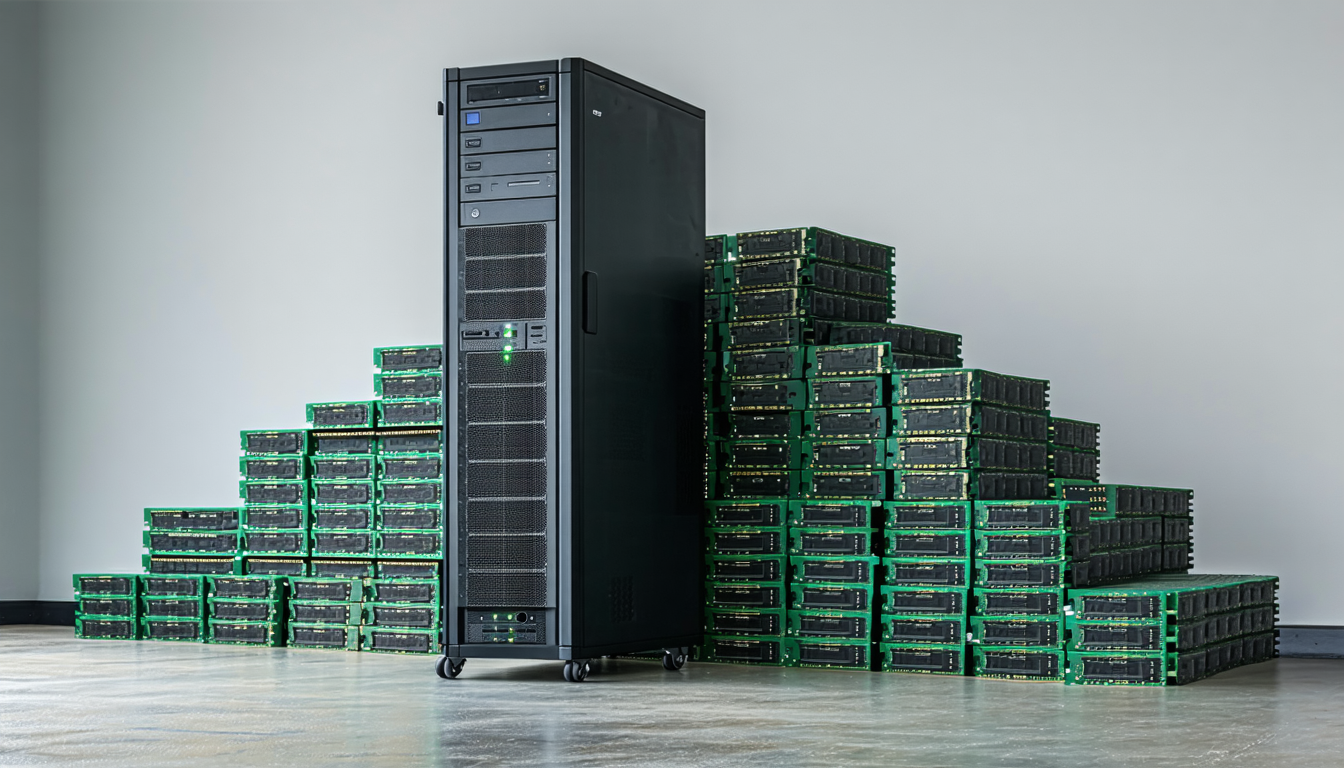
- Some of Nvidia's biggest customers have been told that prices of servers containing its AI chips are in many cases going up by more than 15 per cent, effective on systems shipped in early 2027, including systems with Vera Rubin and Grace Blackwell chips, according to people familiar with the process who asked not to be identified.
- The increases will depend on the generation of Nvidia chips and the memory configurations.
- Companies that build the servers under contract for large data-centre operators such as Microsoft, Alphabet's Google and Oracle have recently notified their customers of the forthcoming increases.
- Nvidia representatives did not respond to requests for comment.
- Memory chip costs are soaring; Samsung Electronics, SK Hynix and Micron Technology account for most of the world's DRAM production and, while increasing output, have not caught up with surging demand, driving component prices up massively.
Compiled by The Product DeskSomething wrong?How this is made
Why it matters
Run the pass-through backwards and the memory move gets a size. Nvidia's gross margin is 75 per cent [6], so production cost is about a quarter of the price. If a 15-point price rise is memory cost handed on dollar for dollar, the cost side has moved roughly 60 per cent, and gross margin on that system lands near 65 [13]. That is a company-wide margin held against a system-level price, so read it as a scale check rather than a P&L. Nvidia did not respond to requests for comment [4], and the reporting rests on people who asked not to be identified [1].
Anything more precise than the floor is interpolation. The increase varies by chip generation and by memory configuration [2], so a single figure such as 17 per cent is a midpoint inside a range that is open at the top.
Where it lands is easier to cost. Exponential View priced serving Kimi K3, 2.8 trillion parameters and 1.4TB of weights, on a 72-GPU GB200 NVL72 rack: $3-4 million to buy and install, 120kW running continuously, or about $7 million a year if rented [9]. The weights are free, the rack holding them is not [17].
That runs against the way the demand side has been growing. The same research puts token elasticity at 12 to 18 per cent more volume for each 10 per cent price cut, with Demirer et al measuring about 11 per cent, an elasticity of -1.11 [10]. Total spend rises on a price cut, but thinly. Cheaper tokens have to be funded from somewhere, and from early 2027 the hardware line moves the other way [1], at a level set by the three DRAM suppliers [5] that the hyperscalers' own accelerator programmes also depend on [8].
Claim ledger
Ranked by verification strength, evidence, and original report placement.
- [1]
Some of Nvidia's biggest customers have been told that prices of servers containing its AI chips are in many cases going up by more than 15 per cent, effective on systems shipped in early 2027, including systems with Vera Rubin and Grace Blackwell chips, according to people familiar with the process who asked not to be identified.
- [2]
The increases will depend on the generation of Nvidia chips and the memory configurations.
ReportedView cited source - [3]
Companies that build the servers under contract for large data-centre operators such as Microsoft, Alphabet's Google and Oracle have recently notified their customers of the forthcoming increases.
ReportedView cited source - [5]
Memory chip costs are soaring; Samsung Electronics, SK Hynix and Micron Technology account for most of the world's DRAM production and, while increasing output, have not caught up with surging demand, driving component prices up massively.
ReportedView cited source - [6]
Nvidia has a gross margin, the percentage of sales remaining after deducting the cost of production, of 75 per cent.
ReportedView cited source
Sources & coverage · 2 publishers
The reporting this story was synthesized from, earliest first. Every link goes to the original.
- straitstimes.com5h agoNvidia raises AI chip prices by over 15% from 2027 | The Straits Times
- exponentialview.co5h ago🔮 The state of the AI economy
- exponentialview.co5h ago🔮 Will Kimi K3 change the economics of AI?