Published · 2d agoProduct3 min read
Nevada writes a 8,000-robotaxi ceiling, and Tesla says at the hearing it can't reach it
Clark County regulators approved permits for Tesla, Uber, and Waymo in one sitting. The headline capacity number is a policy signal, not a deployment plan.
Not a builder's beat, but builders have a standing stake in it.See today for builders
What happened
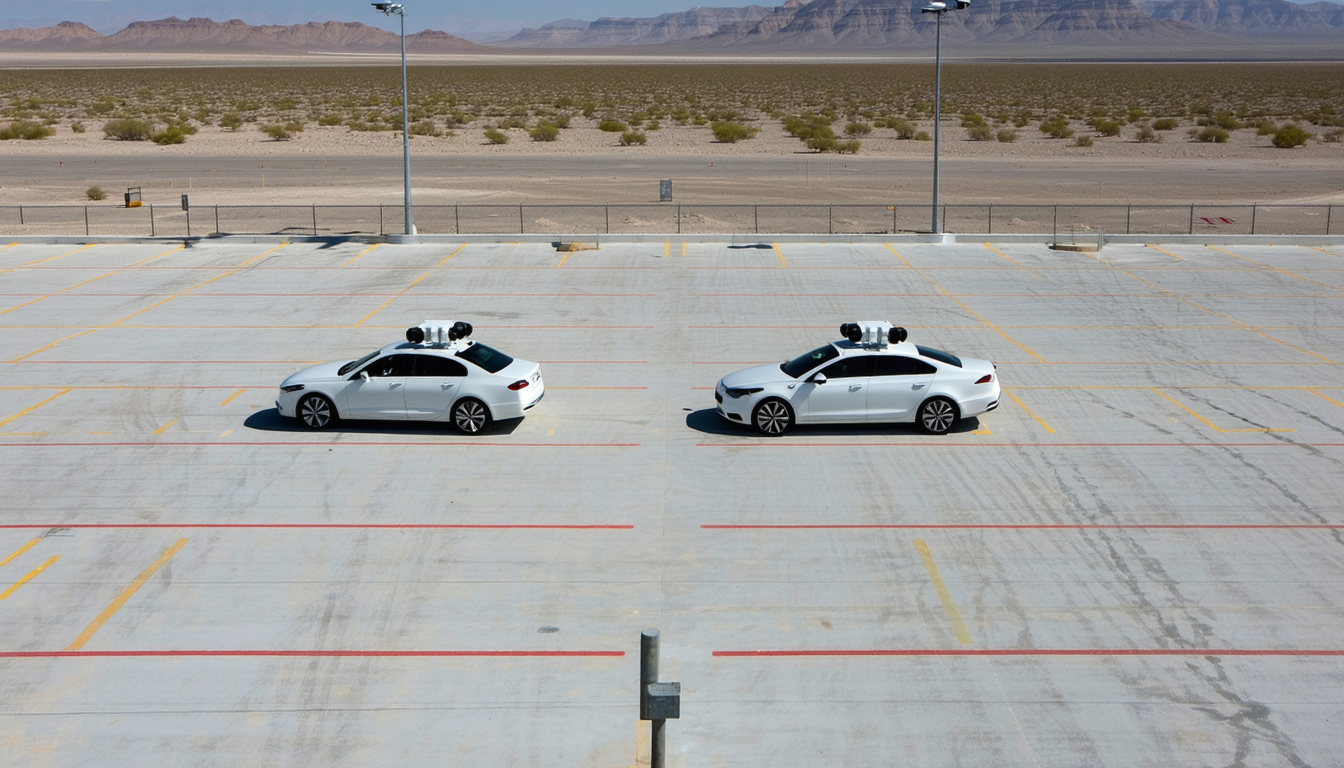
- The Nevada Transportation Authority unanimously approved three permits on Thursday allowing Tesla, Uber, and Waymo to operate commercial robotaxi services in Clark County, home to Las Vegas.
- Together, the three permits would deploy up to 8,000 robotaxis across Clark County over the next 12 months.
- Tesla's permit allows it to deploy up to 5,000 robotaxis.
- Waymo is allowed to operate up to 1,000 autonomous vehicles over the next year.
- Uber was approved for 1,000 robotaxis, which it will operate through partnerships with Hyundai subsidiary Motional and with Zoox.
Compiled by The Product DeskSomething wrong?How this is made
Why it matters
The Nevada Transportation Authority unanimously approved three commercial robotaxi permits on Thursday, clearing Tesla, Uber, and Waymo to run paid service in Clark County, home to Las Vegas [1]. The permits are written to allow up to 8,000 vehicles across the county over the next 12 months [2], and at the same hearing Tesla's own engineer said his company will not come near its allocation [6].
The itemization: Tesla up to 5,000, Waymo up to 1,000, and Uber up to 1,000 operated through partnerships with Hyundai subsidiary Motional and with Zoox [3][4][5]. Zoox already holds a separate autonomous vehicle network company permit good for 100 robotaxis [7]. Two things stand out about those figures. Tesla's number alone is 62.5 percent of the aggregate [17]. And the three itemized caps sum to 7,000, which is 1,000 short of the 8,000 total reported by TechCrunch [16] - a gap the account does not explain.
Then the ceiling was talked down by the party holding most of it. "The 5,000 has always been a ceiling for us," said Eric Early, Tesla's Cybercab chief engineer, at the meeting, adding that he does not expect to be in a position to deploy 5,000 vehicles by this time next year, and that the constraint is not the technology; he said Tesla would be "extremely happy and satisfied" to reach roughly 2,500 [6]. That aspiration is half the permitted figure [15]. If Tesla lands there and the other two hit their caps exactly, Clark County sees 4,500 vehicles, or about 56 percent of the headline number [18]. TechCrunch reported that whether the companies can launch the permitted volumes is unanswered, and that testimony from Tesla and the others suggests they cannot [8].
That is the useful reading. A cap set well above what any applicant claims it can build is a statement about what the regulator will tolerate later, not a forecast of vehicles on the road next August.
The incumbents read it the same way. The Livery Operators Association and local taxi companies opposed the permits as moving too far, too fast [9]. Kimberly Maxson-Rushton, a lawyer for the association, told the hearing the applications raise two concerns: oversaturation of Nevada's commercial transportation industry, and overcrowding of the roadways, specifically the Golden Triangle [10]. That area, between the airport and Las Vegas Boulevard, is where most AV testing has happened so far, while Motional is also testing downtown and at the Town Square shopping district [11][12]. The workforce question splits along predictable lines: either a new class of maintenance, charging, and cleaning jobs, or the erasure of human taxi and gig driving [13].
Uber used the meeting to press its hybrid line, arguing that mixing robotaxis with human drivers lets cities absorb capacity gradually to meet peak demand instead of flooding the market [14]. It has lobbied for rules requiring robotaxis to operate on networks that also use human drivers, a position that puts it against Waymo and hedges its own autonomy program [14].
What to watch: the actual fleet counts against these caps, whether the NTA treats large unused headroom as a reason to tighten or to leave the numbers alone, whether the Golden Triangle draws a geographic limit of its own, and whether Uber's human-driver mandate surfaces in Nevada rulemaking rather than only in testimony.
Claim ledger
Ranked by verification strength, evidence, and original report placement.
- [1]
The Nevada Transportation Authority unanimously approved three permits on Thursday allowing Tesla, Uber, and Waymo to operate commercial robotaxi services in Clark County, home to Las Vegas.
ReportedView cited source - [2]
Together, the three permits would deploy up to 8,000 robotaxis across Clark County over the next 12 months.
ReportedView cited source - [4]
Waymo is allowed to operate up to 1,000 autonomous vehicles over the next year.
ReportedView cited source - [5]
Uber was approved for 1,000 robotaxis, which it will operate through partnerships with Hyundai subsidiary Motional and with Zoox.
ReportedView cited source - [6]
Eric Early, Tesla's Cybercab chief engineer, said during the meeting: "The 5,000 has always been a ceiling for us. I don't think we'll be in a position by this time next year to deploy 5,000 vehicles, and it's not [because of] the technology. ... I think we would be extremely happy and satisfied if we could get ourselves up to 2,500, maybe a bit higher than that in the next year."
Sources & coverage · 2 publishers
The reporting this story was synthesized from, earliest first. Every link goes to the original.
- techcrunch.comKirsten Korosec2d agoTesla, Uber, and Waymo all get the OK to operate thousands of robotaxis in Nevada
Additional citations
- Eric Early, Tesla Cybercab chief engineer, at the NTA meeting
- TechCrunch
- Kimberly Maxson-Rushton, lawyer for the Livery Operators Association