Published Product3 min read
Nebius grew revenue 454%. The number that binds its customers is on the balance sheet
Deferred revenue went from roughly $1.6bn in December to almost $6bn, which means buyers are paying years ahead for capacity from a single supplier that lost $190.4m in the quarter.
Not a builder's beat, but builders have a standing stake in it.See today for builders
What happened
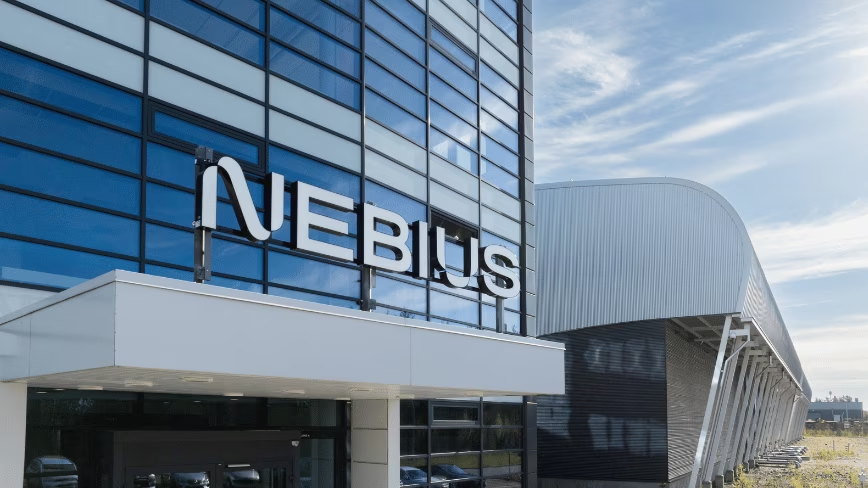
- Nebius rents out computing power: it buys Nvidia chips, installs them in data centres, and charges companies to train and run AI models on them, a business the trade calls a neocloud.
- Nebius is based in Amsterdam, listed on Nasdaq, and was spun out of the Russian internet company Yandex in 2024.
- Nebius reported second-quarter results on Wednesday and the shares closed 34% higher.
- Nebius second-quarter revenue reached $582.3m, up 454% on a year earlier.
- The AI cloud unit, which is most of the business, grew 514% to $575m, Bloomberg reported.
Compiled by The Product DeskSomething wrong?How this is made
Why it matters
Nebius reported second-quarter revenue of $582.3m, up 454% on a year earlier, and the shares closed 34% higher [4][3]. The more consequential figure sits further down: deferred revenue has gone from roughly $1.6bn at the end of December to almost $6bn, an increase of about $4.4bn in six months [10][1].
Deferred revenue is cash customers have handed over for capacity they have not used [9]. Nebius generated $2.2bn from operations in the quarter, of which about $1.2bn was deferred revenue and another $1.2bn was collection of invoices already issued [7][9]. Over the same three months it lost $190.4m [8], and the operating loss widened to $175.9m from $111.2m a year earlier [14]. Adjusted EBITDA turned positive for the first time, at $236.2m [15].
The Amsterdam-based, Nasdaq-listed company, spun out of Yandex in 2024 [2], expects to take more than $9bn in customer prepayments this year and says it holds over $40bn in customer commitments [11]. On those figures the nearly $6bn already on the balance sheet represents about 15% of the committed book [2]. Deferred revenue is also now equal to roughly 70% of the $8.5bn of long-term debt, which has doubled since December [16][4]. Deposits are cheaper than debt, and Nebius has been raising the expensive kind too: a $775m facility secured against its own GPUs in July, which it says it will keep using, following the same pattern as Lambda's $917m leveraged loan [17][18].
What gets less attention is the position this creates for the buyer. A prepayment for 2027 capacity is an unsecured claim on a company that spent about $5.7bn on chips, equipment and data centres in three months against analyst expectations of $4.7bn [12], burned $3.4bn of cash versus $678m a year earlier [13], and guides to full-year revenue of $3bn to $3.4bn on capital spending of $20bn to $25bn, roughly seven dollars out for every dollar in [19]. Second-quarter operating cash of $2.2bn covered less than half the quarter's capital spending [3]. Customers who prepay are financing that gap and taking supplier concentration risk in exchange for reserved silicon.
Chief executive Arkady Volozh gave analysts the price of what they are buying: medium-term leases earn $20m to $25m per megawatt per year, short-term leases of up to six months earn $40m to $50m, so renting by the month costs roughly double renting by the year [20][21]. He also said Nebius could sell its entire planned 2027 capacity today at current terms and is choosing not to [22]. That is a supplier telling prepaying customers their locked-in rate is below what the spot market would bear.
The buyer side is thin. Total contract value won in the quarter roughly quadrupled and included four agreements averaging more than $1bn each, so at least $4bn came from four counterparties [25][5], with new-customer contract values up more than ninefold [26]. Microsoft and Meta are already customers, and Nvidia is both supplier and shareholder [27]. Emarketer analyst Jacob Bourne told Reuters that demand keeps rising despite more competitors, but the open question is how diversified and durable it proves beyond the AI industry itself [28].
Watch the CME Group futures on Nvidia GPU rental prices, which start trading on 5 October and will give prepaid contracts a public mark against spot [23]. Watch whether deferred revenue keeps outrunning recognised revenue next quarter, and whether the first announced tenancy in the South Wales AI Growth Zone, leased from Vantage Data Centers at Newport, lands on schedule [31].
Claim ledger
Ranked by verification strength, evidence, and original report placement.
- [1]
Nebius rents out computing power: it buys Nvidia chips, installs them in data centres, and charges companies to train and run AI models on them, a business the trade calls a neocloud.
ReportedView cited source - [2]
Nebius is based in Amsterdam, listed on Nasdaq, and was spun out of the Russian internet company Yandex in 2024.
ReportedView cited source - [3]
Nebius reported second-quarter results on Wednesday and the shares closed 34% higher.
ReportedView cited source - [4]
Nebius second-quarter revenue reached $582.3m, up 454% on a year earlier.
ReportedView cited source - [5]
The AI cloud unit, which is most of the business, grew 514% to $575m, Bloomberg reported.
- [6]
Analysts had expected total revenue of $572.75m, according to LSEG data.
Sources & coverage · 1 publisher
The reporting this story was synthesized from, earliest first. Every link goes to the original.
- thenextweb.comCristian DinaAug 13Nebius revenue grew 454%. Most of the cash came from customers paying in advance
Additional citations
- Bloomberg
- LSEG
- Visible Alpha
- The Information
- Arkady Volozh, Nebius CEO, on the earnings call
- Arkady Volozh, Nebius CEO
- Jacob Bourne, Emarketer, to Reuters
- CNBC