Published Product3 min read
Ions in a solid cathode both speed up and slow down, and one diffusion coefficient cannot describe it
A UChicago and TU Delft team says its tracer exchange measurements in lithium iron phosphate show diffusion switching modes inside the same material.
Not a builder's beat, but builders have a standing stake in it.See today for builders
What happened
- A team led by researchers at UChicago Pritzker School of Molecular Engineering and Delft University of Technology pioneered a new way to study coupled multi-ion and electron transport in solids, showing that the picture in solids is more complicated than previously assumed.
- The team's results were published in Nature Communications.
- The team included researchers from the Massachusetts Institute of Technology and the University of Illinois at Urbana-Champaign.
- The team created a 'tracer exchange' technique similar to the isotope tracking used to follow individual atoms through chemical reactions or cellular processes.
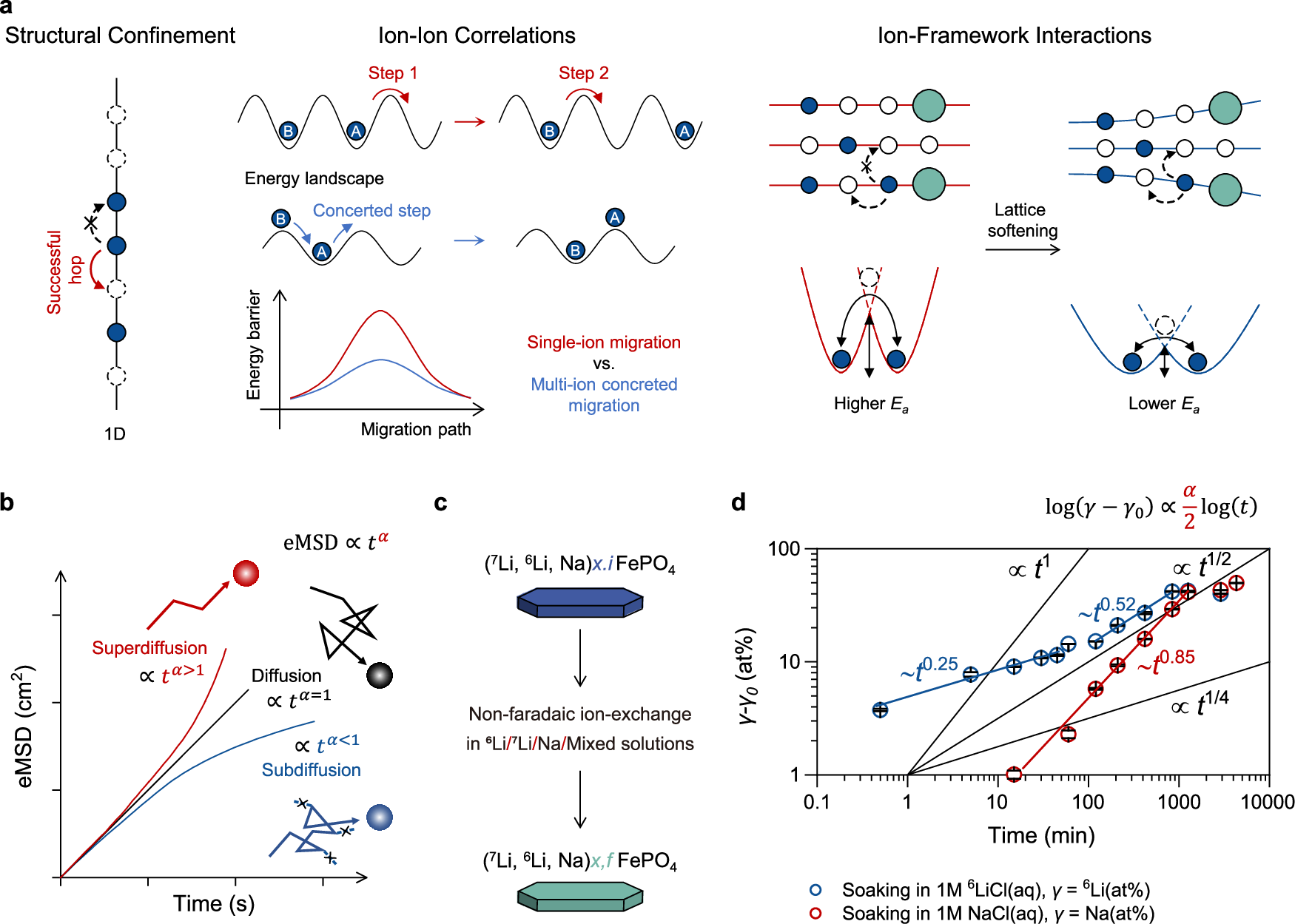
- By tracing the paths of sodium and lithium ions as they passed through solid lithium iron phosphate, the team found traditional 'Fickian' diffusion, but also a web of nanoscale confinement, structural dynamics, regions where one-dimensional channels forced ions to march in single file, regions where chemical reactions or lattice softening rushed ions down the path, and other complexities previous models missed.
Compiled by The Product DeskSomething wrong?How this is made
Why it matters
Researchers led by the University of Chicago Pritzker School of Molecular Engineering and Delft University of Technology, with collaborators at MIT and the University of Illinois at Urbana-Champaign, reported in Nature Communications that they measured coupled multi-ion and electron transport inside a solid and found it does not reduce to the traditional diffusion model [1] [2] [3]. That matters because Brownian motion is often taken as the default movement for ions in solids, according to UChicago PME associate professor Chong Liu, and the Fickian description it underpins has been the working model since 1855 [7] [8].
The method is a tracer exchange technique, which the team describes as similar to the isotope tracking used to follow individual atoms through chemical reactions or cellular processes [4]. Tracing sodium and lithium ions through solid lithium iron phosphate, the group did find traditional Fickian diffusion [5]. It also found nanoscale confinement, structural dynamics, regions where one-dimensional channels forced ions to march single file, and regions where chemical reactions or lattice softening rushed ions along the path [5]. Liu says the work identified anomalous diffusion, meaning subdiffusion or superdiffusion, rather than plain Brownian motion [7]. Co-first author Gangbin Yan puts the failure mechanistically: the assumptions break because self-exclusion and cross-channel hopping are different in highly confined materials, and the traditional diffusion model cannot describe that [6]. TU Delft professor Marnix Wagemaker, a co-corresponding author with Liu, says diffusion can transition between different modes [10].
The design consequence is not that ions move faster or slower than expected. It is that a single fitted diffusion coefficient, the parameter that goes into electrode models, rate-capability estimates and fast-charge simulations, is being asked to stand in for several distinct transport regimes coexisting in one material [5] [10]. Co-first author Pierfrancesco Ombrini of TU Delft says the methodology can distinguish between surface ionic reactions, electronic limitations and solid diffusion in LFP [11]. Those three are exactly what a cell-level fit blends together, and Liu notes that solids impose far more constraints than liquids, which is why diffusion there is less well studied [9].
Two limits on how far to push this. The material is lithium iron phosphate, a conventional intercalation cathode widely used in batteries and, more recently, in lithium extraction, not a solid electrolyte in an all-solid cell [12]. And the report carries no diffusion coefficients, no magnitude for how wrong a Fickian fit is, and no claim about any specific commercial design [18]. The honest reading is that a modeling default has lost its justification, not that shipping cells are mis-specified.
What to watch: whether the tracer exchange platform gets turned on solid electrolytes and interfaces rather than cathodes, since that is where the assumption carries the most design weight [14]. Watch also for mode maps as a function of state of charge, and for the group's stated extensions to hydrogen inclusion in metals and in catalysts [13].
Claim ledger
Ranked by verification strength, evidence, and original report placement.
- [1]
A team led by researchers at UChicago Pritzker School of Molecular Engineering and Delft University of Technology pioneered a new way to study coupled multi-ion and electron transport in solids, showing that the picture in solids is more complicated than previously assumed.
ReportedView cited source - [3]
The team included researchers from the Massachusetts Institute of Technology and the University of Illinois at Urbana-Champaign.
ReportedView cited source - [4]
The team created a 'tracer exchange' technique similar to the isotope tracking used to follow individual atoms through chemical reactions or cellular processes.
ReportedView cited source - [5]
By tracing the paths of sodium and lithium ions as they passed through solid lithium iron phosphate, the team found traditional 'Fickian' diffusion, but also a web of nanoscale confinement, structural dynamics, regions where one-dimensional channels forced ions to march in single file, regions where chemical reactions or lattice softening rushed ions down the path, and other complexities previous models missed.
ReportedView cited source - [6]
Co-first author Gangbin Yan, UChicago PME Ph.D. '25: 'Those assumptions break because the self-exclusion and the cross-channel hopping are different for highly confined materials. You cannot describe this just using the traditional diffusion model.'
Sources & coverage · 1 publisher
The reporting this story was synthesized from, earliest first. Every link goes to the original.
Additional citations
- Gangbin Yan, co-first author, UChicago PME Ph.D. '25
- Chong Liu, associate professor, UChicago PME
- Marnix Wagemaker, professor, TU Delft, co-corresponding author
- Pierfrancesco Ombrini, co-first author, TU Delft