Published Product3 min read
India's heat risk is moving into the monsoon, where work calendars do not expect it
A new AGU Advances paper places India's "uncompensable" heat stress in the monsoon months and projects it overtaking the dry summer peak at 4C. The caveats matter as much as the numbers.
Not a builder's beat, but builders have a standing stake in it.See today for builders
What happened
- In a new paper in AGU Advances, researchers in India and the United States characterize the extent of India's "uncompensable heat stress" and project how the problem could worsen in the future.
- In India, heat stress is at times becoming uncompensable, meaning incapable of being mitigated, especially during its monsoon season from June to September.
- The frequency of uncompensable heat stress and the areas affected have both increased significantly over recent decades.
- During uncompensable heat stress the human body struggles to cool down because of extreme heat and high humidity, or simply cannot cool down sufficiently to prevent major bodily harm; this is true not only for the elderly but also for young, healthy children and adults.
- A wet-bulb temperature is the lowest temperature that can be reached by a surface through evaporative cooling, primarily a function of air temperature, ambient pressure and humidity; at wet-bulb 37C (98.6F), the limit for human existence, a human cannot cool down even in the shade.
Compiled by The Product DeskSomething wrong?How this is made
Why it matters
Researchers in India and the United States have published a paper in AGU Advances mapping how often heat and humidity in India combine into "uncompensable heat stress" - conditions the body cannot offset, because sweating stops working - and finding that the problem is concentrated in the June to September monsoon [1][2]. Both the frequency of these events and the area they cover have risen significantly over recent decades [3], which puts the sharpest physiological risk inside months that a dry-season heat plan treats as the recovery period [3].
The physics is not new. A wet-bulb temperature is the lowest temperature a surface can reach through evaporative cooling, set by air temperature, pressure and humidity; at wet-bulb 37C, sweat buys nothing and a person cannot cool down even in shade [5]. During uncompensable heat stress the body either struggles to shed heat or cannot shed enough to avoid major harm, and the paper is explicit that this applies to young, healthy adults and children, not only the elderly [4].
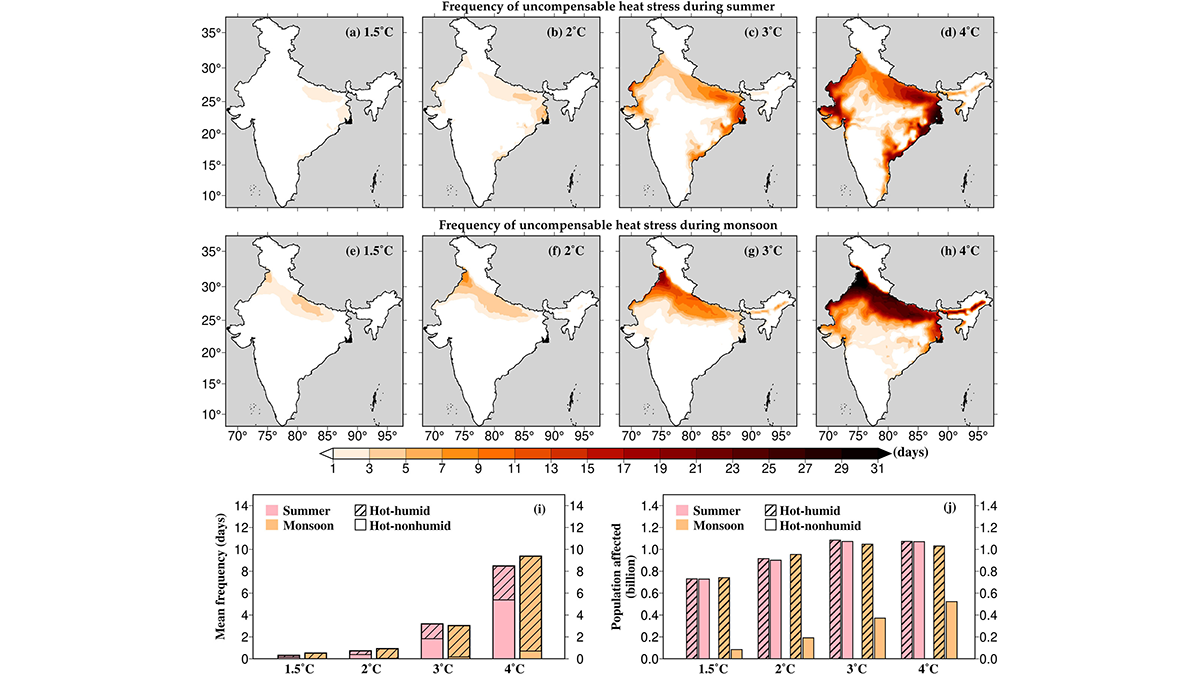
What is new is where the load falls. Over the 1979 to 2021 baseline, uncompensable heat stress touched about 9% of India's population, with one to 15 days of extreme concern per year [10], while the affected area quadrupled from 10,000 square kilometres in the 1980s to 40,000 square kilometres by 2020 [11]. Under 2.0C of warming the projections cover 63% of the country in summer and 53% in the monsoon [12]. At 4C the monsoon figure surpasses summer, driven by a steep projected rise in hot and humid extremes [13]. Central and southern India, which the authors say do not currently experience uncompensable heat stress at all, are expected to at 3C [14]. Note that the 2C summer and monsoon numbers are ten percentage points apart and that the ordering flips at higher warming [1]; also that the baseline is stated as a share of population and the projections as a share of land area, so the two sets of figures are not the same quantity [2].
The caveats are load-bearing. The projections run on SSP5-8.5, a high-emission scenario the IPCC has retired as global emissions approach a plateau, which the report treats as a point of contention and a reason to read the results as an upper limit [9]. The critical threshold comes from experiments on young, healthy, optimally hydrated North American adults, and the authors concede it may not represent South Asian heat tolerance; future population growth, ageing and adaptive technology were not modelled [8]. The bias-correction motivation is itself instructive: the authors argue dry-bulb and wet-bulb temperatures both misestimate heat stress, and misestimate it differently between the dry March-to-June summer and the humid monsoon [6]. The same write-up gives the monsoon as June to September in one place and July to October in another, so anyone building a calendar off this work should check the paper's own definition [4].
Worth tracking: whether follow-up work reruns these maps on mid-range scenarios, and the rural-urban split the report flags as relevant but does not quantify in the material available [18]. Context for the stakes: over 30,000 excess deaths in India this summer during a five-day stretch above 45C [16].
Claim ledger
Ranked by verification strength, evidence, and original report placement.
- [1]
In a new paper in AGU Advances, researchers in India and the United States characterize the extent of India's "uncompensable heat stress" and project how the problem could worsen in the future.
- [2]
In India, heat stress is at times becoming uncompensable, meaning incapable of being mitigated, especially during its monsoon season from June to September.
ReportedView cited source - [3]
The frequency of uncompensable heat stress and the areas affected have both increased significantly over recent decades.
ReportedView cited source - [4]
During uncompensable heat stress the human body struggles to cool down because of extreme heat and high humidity, or simply cannot cool down sufficiently to prevent major bodily harm; this is true not only for the elderly but also for young, healthy children and adults.
ReportedView cited source - [5]
A wet-bulb temperature is the lowest temperature that can be reached by a surface through evaporative cooling, primarily a function of air temperature, ambient pressure and humidity; at wet-bulb 37C (98.6F), the limit for human existence, a human cannot cool down even in the shade.
ReportedView cited source - [6]
The authors write that both commonly used dry-bulb temperature and wet-bulb temperature are prone to biases in heat stress estimation, and that the biases differ between India's hot, dry summer from March to June and its wet, humid monsoon season from July to October, as well as across geographic regions.
ReportedView cited source
Sources & coverage · 1 publisher
The reporting this story was synthesized from, earliest first. Every link goes to the original.
Cited in this coverage: phys.org report on AGU Advances paper