Published · 4d agoProduct3 min read
IBM cools and links its first two quantum fridge modules, with Starling still dated 2029
The milestone is packaging, not qubits: box-shaped cryostats that pack in rows, a cold volume 12 times larger, and a coupler meant to knit hundreds of chips into one machine.
Not a builder's beat, but builders have a standing stake in it.See today for builders
What happened
- IBM said it has successfully linked and cooled down the first pair of modules based on a new, highly scalable cryogenic architecture, announced in a story published 19 August 2026.
- IBM's stated goal is delivering the world's first fault-tolerant quantum computer by 2029.
- IBM said the achievement is a key milestone on its roadmap toward IBM Quantum Starling, a system currently under development and slated to launch in three years.
- IBM envisages that Starling will perform about 20,000 times more calculations than today's existing quantum computers.
- The new cryogenic modules are cooled to below 15 millikelvin, which the source describes as more than 180 times colder than deep space.
Compiled by The Product DeskSomething wrong?How this is made
Why it matters
IBM said it has linked and cooled the first pair of modules built on a new cryogenic architecture, taking them below 15 millikelvin at its site in Poughkeepsie, New York [1][5][6]. That matters because the company's stated 2029 date for a fault-tolerant machine has until now rested on drawings of how the refrigeration would scale, and this is the first pair physically joined and brought to temperature [1][2].
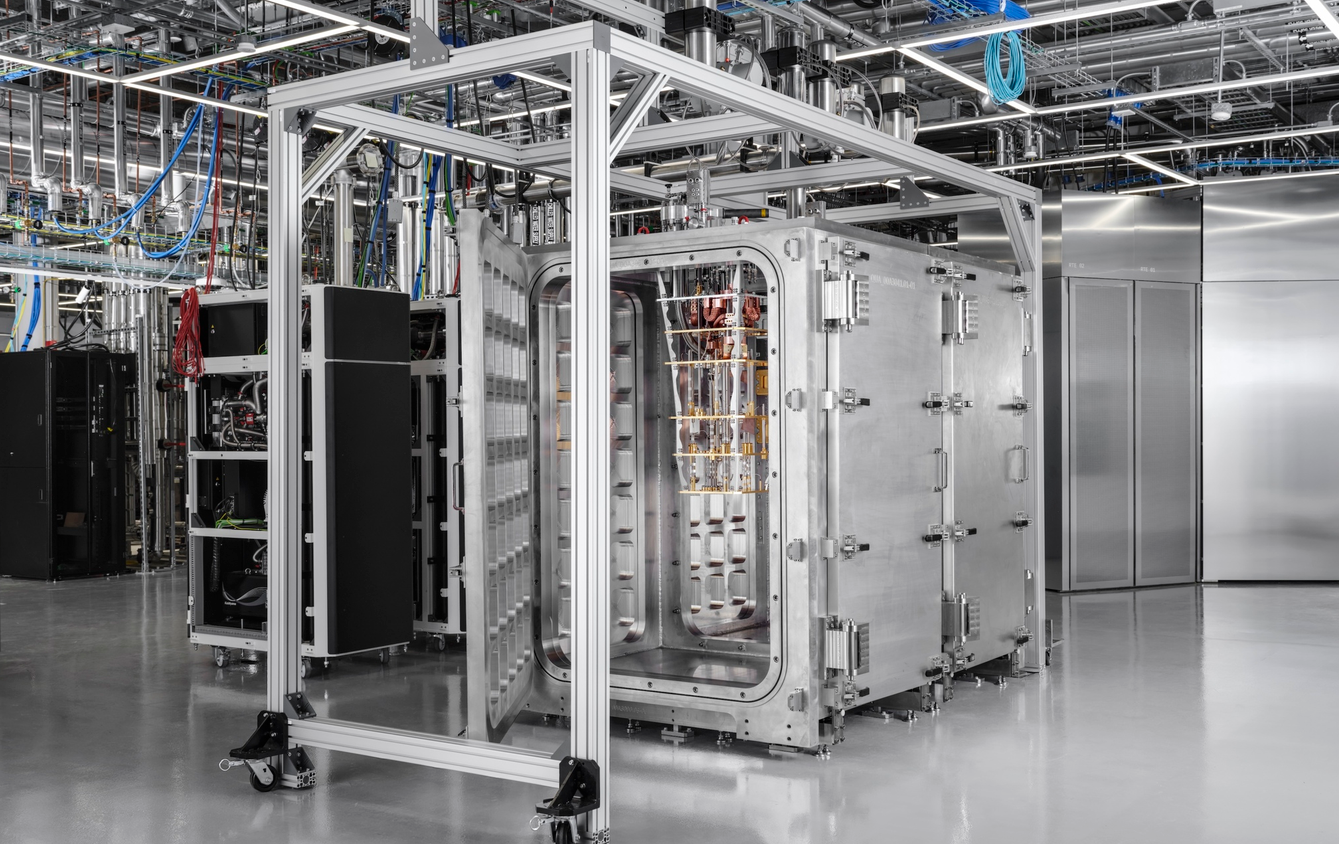
The engineering content here is mechanical, and that is the point. Existing dilution refrigerators are cylinders; the new modules are boxes, so they can be pushed together in tight rows rather than losing floor space to curvature [7]. Each one is eight feet tall and eight feet wide [6], and the cold enclosure inside is 12 times larger than existing systems, which IBM says leaves room to connect hundreds of quantum processors [8]. Chips are joined using what IBM calls L-Coupler technology, linking individual processors into clusters that share information and behave as one larger processor [9]; the report likens the arrangement to GPU clusters in AI data centres [10]. IBM also says individual processors can be maintained or upgraded without degrading the cluster around them [11], which is the difference between a physics instrument and something an operations team can run.
The forcing function is error correction. Qubits decohere in response to almost any disturbance, from electromagnetic interference to vibration to fluctuations in the Earth's magnetic field, and a disturbed qubit loses its state and corrupts the calculation [14]. IBM's answer is logical qubits: bundles of physical qubits plus error-correcting codes that behave as one reliable qubit [13]. Redundancy on that scale means thousands of physical qubits operating together, sharing space, held near absolute zero [16]. So the refrigerator stops being plumbing and becomes the architecture. Hundreds of processors in one cold cluster is the capability IBM says the new design unlocks [17].
On the target, IBM describes Starling as under development and slated to launch in three years [3], which from an August 2026 announcement lands on the 2029 date the company has been giving [19]. The performance claim attached to it is IBM's own projection: roughly 20,000 times more calculations than today's existing quantum computers, which IBM frames as enough to cross into quantum advantage, the point at which these machines solve real problems classical supercomputers cannot [4][15]. Treat the multiplier as a design goal rather than a measurement. Jay Gambetta, IBM's research director, said the module connection is one of several fundamental advances still required, calling it "a leap forward in that direction" [12]. That is a more honest framing than the headline number, and it is worth holding IBM to the word "several".
What to watch: the numbers that were not part of this announcement. Coupling two boxes proves the mechanical and thermal design; it does not yet establish the fidelity of links across an L-Coupler join, the heat load when the enclosure is actually filled with hundreds of processors, or the cycle time to swap a module without warming its neighbours. Also watch cadence. Two modules in 2026 against a machine that needs hundreds by 2029 implies a build rate IBM has not yet demonstrated [8][3], and no one has yet built a functional quantum computer at a scale that changes outcomes [18].
Claim ledger
Ranked by verification strength, evidence, and original report placement.
- [1]
IBM said it has successfully linked and cooled down the first pair of modules based on a new, highly scalable cryogenic architecture, announced in a story published 19 August 2026.
ReportedView cited source - [2]
IBM's stated goal is delivering the world's first fault-tolerant quantum computer by 2029.
ReportedView cited source - [3]
IBM said the achievement is a key milestone on its roadmap toward IBM Quantum Starling, a system currently under development and slated to launch in three years.
ReportedView cited source - [4]
IBM envisages that Starling will perform about 20,000 times more calculations than today's existing quantum computers.
ReportedView cited source - [5]
The new cryogenic modules are cooled to below 15 millikelvin, which the source describes as more than 180 times colder than deep space.
ReportedView cited source - [6]
The first pair of modules, at IBM's facility in Poughkeepsie, New York, stand eight feet tall and eight feet wide.
ReportedView cited source
Sources & coverage · 3 publishers
The reporting this story was synthesized from, earliest first. Every link goes to the original.
- siliconangle.comMike Wheatley4d agoIBM moves a step closer to fault-tolerant quantum computing by linking its first modular cryogenic fridges
- interestingengineering.comAmeya Paleja4d agoIBM’s cryogenic system can link hundreds of quantum chips, 180 times colder than deep space