Published Product3 min read
Heart Aerospace's 25,000-pound electric demonstrator flew. The $5 electricity bill needs an asterisk.
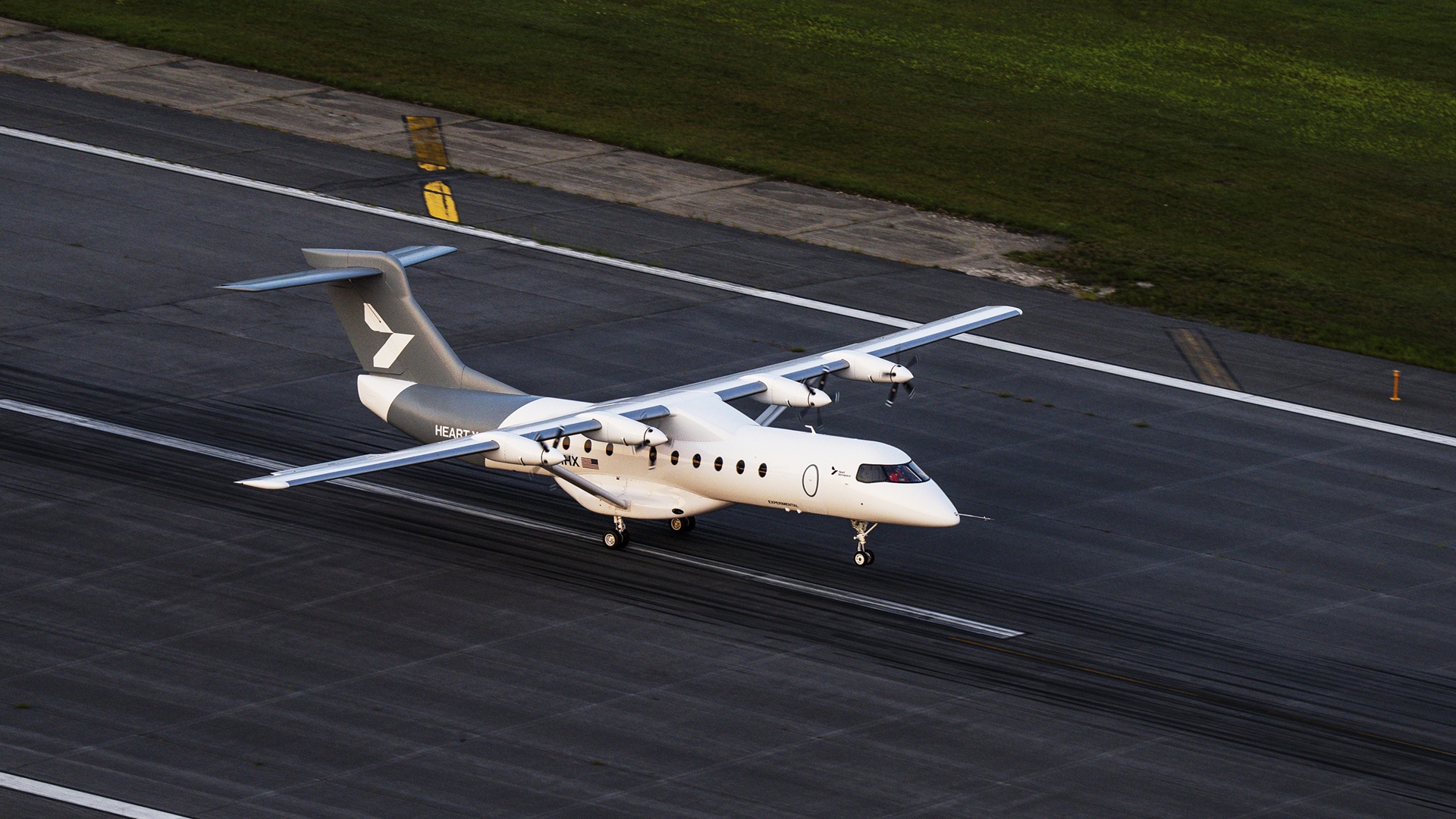
The X1 flew 27 minutes out of Plattsburgh under an FAA experimental certificate. The headline energy cost implies electricity at roughly a penny per kilowatt-hour.
Not a builder's beat, but builders have a standing stake in it.See today for builders
What happened
- Heart Aerospace's X1 demonstrator is described as the world's largest battery-electric aircraft ever flown and completed its maiden flight in the US.
- The X1 lifted off from Plattsburgh International Airport in New York on Wednesday, August 12, and the aircraft was piloted.
- The aircraft remained airborne for about 27 minutes and reached 1,100 feet above ground level.
- The X1 has a wingspan of 106 feet (32 meters), a length of 76 feet (23 meters), and a takeoff weight exceeding 25,000 pounds (11,340 kilograms).
- The aircraft reportedly delivered more than one megawatt of power during the flight.
Compiled by The Product DeskSomething wrong?How this is made
Why it matters
Heart Aerospace flew its X1 demonstrator for about 27 minutes out of Plattsburgh International Airport in New York on August 12, reaching 1,100 feet above ground level with a pilot aboard [2][3]. The airframe has a 106-foot wingspan, measures 76 feet long, and takes off above 25,000 pounds [4], which puts battery propulsion in the size class where regional airline economics are actually decided.
The certificate matters more than the wingspan. The flight was conducted under an FAA Special Airworthiness Certificate in the Experimental Category [8], and the profile covered taxi, takeoff, climb, maneuvering and landing [9]. That is a real test article with real paperwork rather than a rendering, and the company reports the aircraft delivered more than one megawatt of power in flight [5]. Founder and CEO Anders Forslund said the first flight demonstrated "electric flight at the scale of a commercial airliner" [7].
Then there is the $5. Heart says the electricity for the entire mission cost no more than five dollars [6]. Take the two figures together and the arithmetic is awkward: one megawatt sustained across 27 minutes is 450 kilowatt-hours, and $5 for 450 kWh implies about 1.1 cents per kilowatt-hour [1]. That is not a tariff any airport hangar pays. The likelier reading is that the megawatt was a peak draw and average consumption over a short, low-altitude sortie was a fraction of it, which would make the $5 accurate and the implied comparison much less impressive than it sounds.
The fuel comparison the coverage offers does not help. Interesting Engineering cites global jet fuel averaging $3.50 a gallon in the first week of August and calls that "a 63-percent increase from 2025" [16], a sentence that does not parse against a flight dated August 12 and which cannot be reconciled without a fuel burn figure for a comparable mission. A dollar-per-flight number is only useful next to gallons consumed doing the same work.
The program behind it is more concrete than the energy math. X1 is a demonstrator representative of the ES-30 [10], a conventional fixed-wing hybrid-electric regional airliner for up to 30 passengers targeted at service entry in 2031 [11]. The first pre-production aircraft is being built at a pilot manufacturing plant in Los Angeles, with flight testing scheduled to begin in 2028 [12] - a three-year window between first flight and revenue service [2]. United Airlines, Air Canada and JSX have made commitments [13]. Forslund expects the ES-30 to cut operating costs by more than 40 percent against legacy regional aircraft, from energy, simpler maintenance and higher reliability [14]. CTO Benn Stabler framed X1 as proof of full-stack design, build and test capability being carried into the production aircraft [17].
Two gaps to watch. X1 flew on battery power alone [15] while the ES-30 is hybrid-electric [11], so the demonstrator validated structure, integration and high-power propulsion, not the turbogenerator side of the product. And the 40 percent claim [14] is a composite; energy is the easiest component to model and maintenance and dispatch reliability are the ones that decide whether a 30-seat aircraft pencils out. Watch whether the 2028 test date holds as the Los Angeles line produces hardware [12], and whether airline commitments [13] convert into firm orders with delivery positions.
Claim ledger
Ranked by verification strength, evidence, and original report placement.
- [1]
Heart Aerospace's X1 demonstrator is described as the world's largest battery-electric aircraft ever flown and completed its maiden flight in the US.
- [2]
The X1 lifted off from Plattsburgh International Airport in New York on Wednesday, August 12, and the aircraft was piloted.
ReportedView cited source - [3]
The aircraft remained airborne for about 27 minutes and reached 1,100 feet above ground level.
ReportedView cited source - [4]
The X1 has a wingspan of 106 feet (32 meters), a length of 76 feet (23 meters), and a takeoff weight exceeding 25,000 pounds (11,340 kilograms).
- [5]
The aircraft reportedly delivered more than one megawatt of power during the flight.
ReportedView cited source - [6]
The electricity used for the entire mission cost no more than five dollars.
Sources & coverage · 1 publisher
The reporting this story was synthesized from, earliest first. Every link goes to the original.
- interestingengineering.comGeorgina JedikovskaAug 13US: World’s largest electric aircraft takes to the skies with over 1MW of power
Additional citations
- Heart Aerospace, via Interesting Engineering
- Heart Aerospace
- Anders Forslund
- Interesting Engineering
- Benn Stabler, Heart Aerospace CTO