Published Product3 min read
Google's five-device Pixel launch is a distribution plan for Gemini Intelligence
A foldable, three phones and a watch all ship with the same AI layer, which moves on-device models from selling point to table stakes.
Not a builder's beat, but builders have a standing stake in it.See today for builders
What happened
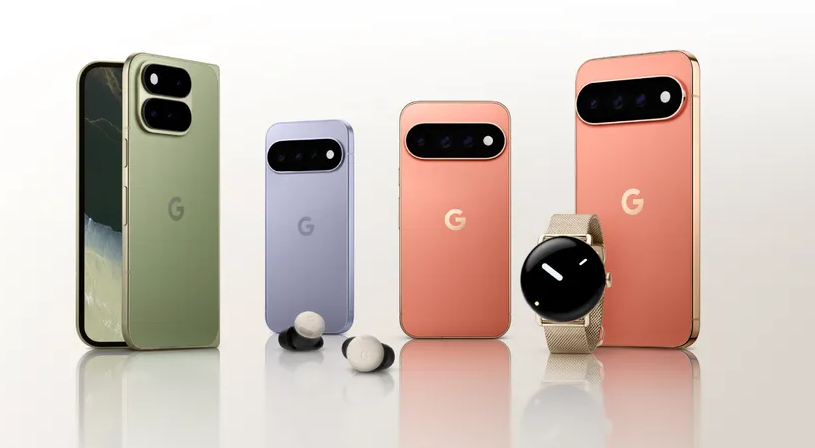
- Google LLC expanded its Pixel consumer hardware line with a foldable handset, three smartphones and a smartwatch, announced in coverage dated August 12, 2026.
- The devices ship with an upgraded version of Gemini Intelligence, a set of AI features for the mobile market that Google introduced earlier this year.
- The family is headlined by the Pixel 11 Pro Fold, an 8-inch handset that folds like a book and activates a 6.5-inch external screen of what Google describes as ultra-strong ceramic cover glass when closed.
- Google product manager Justin Savich wrote that the Pixel 11 Pro Fold has improved crease performance thanks to the new hinge's larger bend radius and a thicker glass layer on the inner display, and that both displays are 20% brighter than last year at 3600 nits.
- The smartphone lineup includes two 6.3-inch devices, the Pixel 11 and Pixel 11 Pro, which differ in resolution and frame rate, plus a 6.8-inch Pixel 11 Pro XL.
Compiled by The Product DeskSomething wrong?How this is made
Why it matters
Google announced five new Pixel devices on August 12 - a foldable, three smartphones and a smartwatch - all shipping with an upgraded version of the Gemini Intelligence feature set it introduced earlier in the year [1][2]. The hardware deltas are ordinary; the notable thing is that a whole product line, from a $399 watch to a $1,899 foldable, now exists to put one software layer in more hands [15].
Start with the silicon, because everything else is downstream of it. All four handsets carry the Tensor G6, which Google says includes an AI accelerator with 50% more compute than the previous generation and can run on-device models up to 3.5 times faster while using less energy [6]. That is four of the five new devices sharing the same inference budget [17]. The watch gets its own smaller bump: 50% more memory and a 12% faster CPU, enough to run a feature called Gemini Intelligence Proactive Suggestions that pulls information out of apps and surfaces it on the display [14].
The feature list reads like a tour of what the accelerator makes affordable. Imaging models push zoom to 30x on the Pixel 11 and the Pixel 11 Pro Fold, and to 120x on the Pro and Pro XL, which have a better telephoto lens [7]. Magic Capture records two-minute clips and saves the best frames as stills [8]. Glanceable cards appear inside some apps at what Google judges to be opportune moments, offering a one-tap restaurant reservation, for example [11]. A location feature in the Gemini app, still in preview, puts data about where you are standing on the lock screen, such as the popular dishes at the restaurant you are sitting in [12].
The most consequential item is the least glamorous. The entry-level Pixel 11 ships with a Gboard update built on SL2T, a model that transcribes sign language into text and lets owners use sign language to talk to Gemini or search the web [9]. Google DeepMind researchers say SL2T is the most capable sign language translation model to date on benchmarks including FLEURS-ASL, with a zero-shot score of 70 BLEURT that they describe as significantly higher than any previously reported result [10]. That is a single-source benchmark claim, and worth treating as such. But note the placement: the accessibility feature debuts on the cheapest phone in the family, not the most expensive, with wider rollout promised later [9]. AI capability is no longer the thing you climb the price ladder to reach.
Which is the strategic point. The comparisons Google offers are against its own last-generation parts, not against competitors [6][14], and the same assistant layer is present across a lineup where the phones alone span $899 to $1,299 and the Pro Fold sits $600 above the most expensive phone [15][16]. When a feature set is uniform across a range, it stops being a differentiator inside that range and becomes the floor buyers expect from any handset.
Three things to watch. Whether the lock-screen location feature leaves preview intact or quietly narrows [12]. Whether SL2T actually reaches devices beyond the Pixel 11 [9]. And whether the Pro Fold's claimed crease improvement, from a larger hinge bend radius and thicker inner glass, survives a year of hands [4].
Claim ledger
Ranked by verification strength, evidence, and original report placement.
- [1]
Google LLC expanded its Pixel consumer hardware line with a foldable handset, three smartphones and a smartwatch, announced in coverage dated August 12, 2026.
ReportedView cited source - [2]
The devices ship with an upgraded version of Gemini Intelligence, a set of AI features for the mobile market that Google introduced earlier this year.
ReportedView cited source - [3]
The family is headlined by the Pixel 11 Pro Fold, an 8-inch handset that folds like a book and activates a 6.5-inch external screen of what Google describes as ultra-strong ceramic cover glass when closed.
ReportedView cited source - [4]
Google product manager Justin Savich wrote that the Pixel 11 Pro Fold has improved crease performance thanks to the new hinge's larger bend radius and a thicker glass layer on the inner display, and that both displays are 20% brighter than last year at 3600 nits.
- [5]
The smartphone lineup includes two 6.3-inch devices, the Pixel 11 and Pixel 11 Pro, which differ in resolution and frame rate, plus a 6.8-inch Pixel 11 Pro XL.
ReportedView cited source - [6]
All four Pixel 11 series handsets use a custom system-on-chip called Tensor G6, which according to Google includes an integrated AI accelerator with 50% more computing power than the previous-generation silicon, an upgraded CPU, and can run on-device AI models up to 3.5 times faster than its predecessor while using less energy.
Sources & coverage · 1 publisher
The reporting this story was synthesized from, earliest first. Every link goes to the original.
- siliconangle.comMaria DeutscherAug 12Google launches five new Pixel devices, array of Gemini Intelligence features
Additional citations
- Justin Savich, Google product manager, in a blog post
- Google DeepMind researchers, in a blog post