Published Product3 min read
China fuels its first VVER-1200 at Tianwan, and a Russian export design reaches commissioning
Unit 7 has started taking its 163 fuel assemblies, the first time China has loaded fuel into the Russian-designed reactor model. Commercial operation is targeted for 2026.
Not a builder's beat, but builders have a standing stake in it.See today for builders
What happened
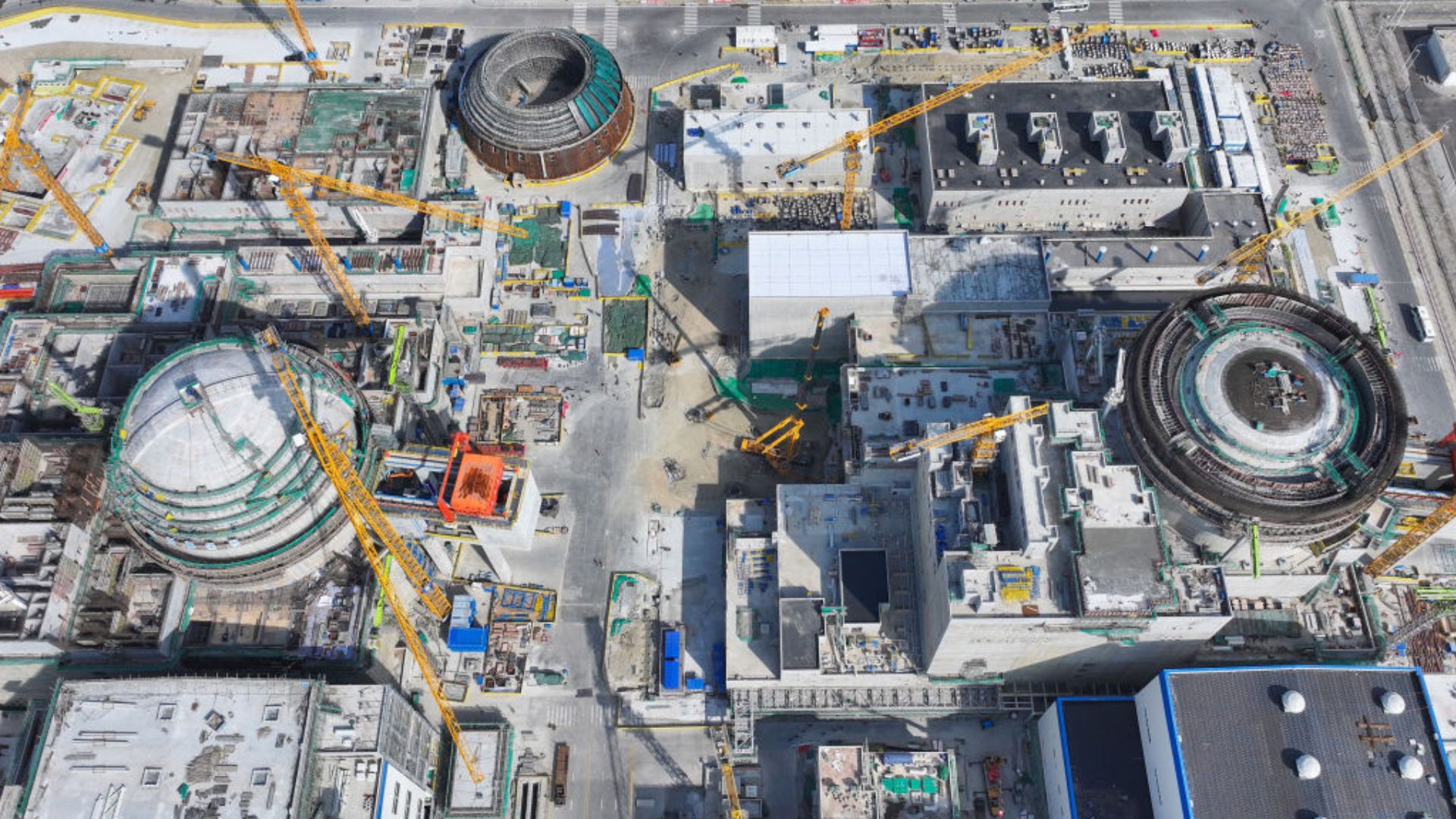
- Operators at China's Tianwan Nuclear Power Plant in Jiangsu Province have started loading nuclear fuel into Unit 7, marking the transition from heavy construction to nuclear commissioning.
- Unit 7 uses a Russian-designed VVER-1200 third-generation pressurized water reactor, and this is the first time engineers in China are loading fuel into this specific reactor model.
- The VVER-1200 core requires 163 fuel assemblies; per a People's Daily report, the process is divided into three parts: fuel assembly transfer, fuel loading into the reactor core, and verification of the loading's correctness.
- Workers first move the fuel assemblies into the containment building, an automated remote-control handling system then lowers each assembly into the reactor core, and engineers verify that every component sits in its correct position.
- Operators work from a control room located 30 meters above the reactor floor and monitor the automated equipment as it positions each assembly within millimetre-level tolerances.
Compiled by The Product DeskSomething wrong?How this is made
Why it matters
Operators at the Tianwan plant in Jiangsu Province have begun loading fuel into Unit 7, the step that moves a reactor out of heavy construction and into nuclear commissioning [1]. It is the first time engineers in China have loaded fuel into a VVER-1200, the Russian-designed third-generation pressurised water reactor [2], which makes this a completion datapoint rather than an announcement: a Russian export design is arriving at the point where fuel goes in the core.
The mechanics are unglamorous and exacting. The core takes 163 fuel assemblies, and according to a People's Daily report the operation splits into three stages: transferring the assemblies, lowering them into the core, and verifying that the loading pattern is correct [3]. Assemblies are moved into the containment building, then placed by an automated remote-handling system, then checked position by position [4]. Operators run the sequence from a control room 30 metres above the reactor floor, holding millimetre-level tolerances [5]. When all 163 are seated, Unit 7 enters nuclear testing, which leads to initial criticality and then generation [6].
Unit 8 is a step behind on the same path. It completed cold functional testing in early August and, according to China Science, entered its debugging stage [7]. Cold testing pressure-checks the primary circuit before any nuclear material is present, covering the reactor pressure vessel, the pressuriser and the main circulation piping [8]. Unit 7 is scheduled for commercial operation in 2026 and Unit 8 in 2027 [9], a one-year stagger between twin units [4].
The scale claims deserve separating from the schedule. Units 1 through 6 are already online and have supplied close to 500 billion kilowatt-hours [10]. Each of the two new units is rated above 1.2 million kilowatts [11], so the pair adds more than 2.4 million kilowatts [1]. A Tianwan official, quoted by People's Daily, says the completed base will exceed 9 million kilowatts installed, supply more than 70 billion kilowatt-hours of clean power a year, and cut carbon dioxide emissions by 57.4 million tonnes annually [12]. That last figure implies roughly 820 grams of CO2 avoided per kilowatt-hour [2], which only holds if the output displaces coal-fired generation close to one for one. On the same official's numbers, the 500 billion kilowatt-hours already delivered by Units 1 to 6 amount to about seven years of the full base running at its projected annual output [3]. The publisher describes Tianwan as the largest nuclear base of its kind under construction worldwide [13]; that superlative is the publisher's, not a measured claim.
What the source material does not address is worth stating plainly: it says nothing about how Units 7 and 8 were financed, who supplied the fuel assemblies, or what sanctions exposure the Russian design entails. The observable fact is a fuel load, not a policy verdict.
Watch for criticality and first grid synchronisation at Unit 7, and whether the 2026 commercial operation target survives the testing phase [9]. Watch Unit 8's progression from debugging to its own fuel load [7]. And watch whether the 163-assembly load at Unit 7 completes without a reported hold, since verification is where pattern errors surface [3].
Claim ledger
Ranked by verification strength, evidence, and original report placement.
- [1]
Operators at China's Tianwan Nuclear Power Plant in Jiangsu Province have started loading nuclear fuel into Unit 7, marking the transition from heavy construction to nuclear commissioning.
ReportedView cited source - [2]
Unit 7 uses a Russian-designed VVER-1200 third-generation pressurized water reactor, and this is the first time engineers in China are loading fuel into this specific reactor model.
ReportedView cited source - [3]
The VVER-1200 core requires 163 fuel assemblies; per a People's Daily report, the process is divided into three parts: fuel assembly transfer, fuel loading into the reactor core, and verification of the loading's correctness.
- [4]
Workers first move the fuel assemblies into the containment building, an automated remote-control handling system then lowers each assembly into the reactor core, and engineers verify that every component sits in its correct position.
ReportedView cited source - [5]
Operators work from a control room located 30 meters above the reactor floor and monitor the automated equipment as it positions each assembly within millimetre-level tolerances.
ReportedView cited source - [6]
Once all 163 assemblies are inside, Unit 7 will begin its nuclear testing phase, which leads directly to initial reactor criticality and power generation.
ReportedView cited source
Sources & coverage · 1 publisher
The reporting this story was synthesized from, earliest first. Every link goes to the original.
- interestingengineering.comAman TripathiAug 13China loads first fuel into new 1.2GW reactor at world’s largest nuclear plant
Additional citations
- People's Daily, as reported by Interesting Engineering
- China Science, as reported by Interesting Engineering
- unnamed Tianwan Nuclear Power official quoted by People's Daily
- Interesting Engineering