Published · 4h agoProduct3 min read
Chang'e 7 slips to 2027, and "does not meet the conditions" is doing a lot of work
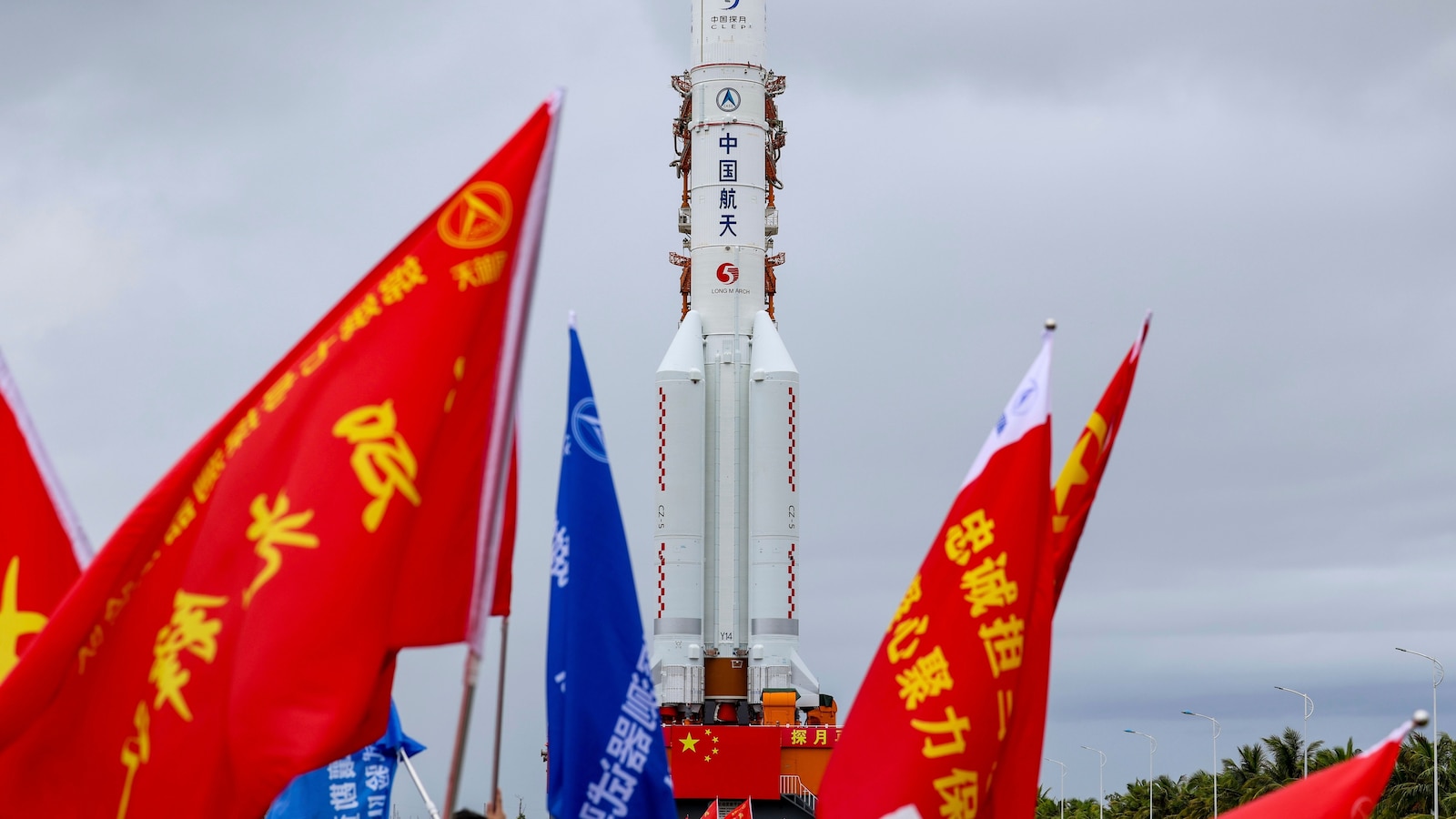
China's lunar south pole mission loses its 2026 window to a storm forecast to clear in days. The notice names no cause, and the recovery may not come until February.
Not a builder's beat, but builders have a standing stake in it.See today for builders
What happened
- China's "Manned Space" program said in a terse announcement on Sunday: "In keeping with the principle of proceeding prudently and reliably, and ensuring absolute success, after a comprehensive assessment it has been determined that the Chang'e 7 mission does not meet the conditions for launch and therefore cannot be carried out during the planned launch window this year."
- Chang'e 7 consists of a lunar orbiter, a lander, a rover, and a mini-hopper probe, and is intended to land at the Moon's South Pole.
- The mission was due to launch as early as Sunday on a Long March 5 rocket from the Wenchang Space Launch Site, on an island in the South China Sea.
- The Chinese message offered no explanation for the cause of the delay.
- Typhoon Narra had 45-mph winds, equivalent to a moderate tropical storm, and continued to meander in the waterway separating Hainan island from mainland China.
Compiled by The Product DeskSomething wrong?How this is made
Why it matters
The Joint Typhoon Warning Center expected Narra to keep drifting around the Hainan channel for another two or three days, with poor weather at Wenchang for the duration [6]. Trading two or three days of that for the rest of the calendar only adds up if the window was already down to a sliver. That is a fact about orbital geometry and polar lighting rather than about the rocket, and it is the part worth filing: on this trajectory, the schedule has no recovery room inside a year.
Then the arithmetic on the far side. The February-or-March figure comes from social media chatter, with no Chinese source confirming it [8], but take it as the working assumption and the gap from the lost window is roughly six to seven months [1]. The mission plan adds more on top, because the profile calls for 90 days of lunar orbit reconnaissance before the lander commits, alongside the sunlight constraints in the candidate polar zones [9]. A February or March launch therefore puts a landing no earlier than about May or June 2027 [2], before any surface work begins. Anyone whose milestone depended on Chinese measurements from the pole is now waiting on data from the middle of 2027 at the earliest.
The wording is the other reason to widen the error bars. The notice invokes proceeding prudently and reliably and ensuring absolute success, and says a comprehensive assessment determined the mission does not meet the conditions for launch [1]. No cause was given [4]. An agency waiting out a storm generally says it is waiting out a storm, and the absence of that sentence is what makes a weather scrub and a finding indistinguishable from the outside, even though they imply very different dates.
Ars Technica's reading is that the typhoon is the likely explanation, and that Chinese forecasters plausibly concluded the weather would not break in time [7]. It also notes that the Long March 5 uses the YF-100 engine, which flies on the Long March 7A lost during ascent two weeks earlier, and judges an engine problem unlikely here because the campaign had been moving toward launch in the days before the announcement [10][11]. That logic holds for Sunday. It says nothing about February, since a failure investigation that eventually touches YF-100 hardware would land on the Long March 5 regardless of how smoothly this particular count was going.
What raises the stakes is the packaging. Orbiter, lander, rover and the hopping probe all ride one Long March 5 out of Wenchang [2][3], so there is no partial credit and no way to fly the cheap half early to hold a place in the queue. The only officially established constraint right now is "not this year" [1]. The next official date, whenever it appears, is the first hard input anyone downstream actually gets.
Claim ledger
Ranked by verification strength, evidence, and original report placement.
- [1]
China's "Manned Space" program said in a terse announcement on Sunday: "In keeping with the principle of proceeding prudently and reliably, and ensuring absolute success, after a comprehensive assessment it has been determined that the Chang'e 7 mission does not meet the conditions for launch and therefore cannot be carried out during the planned launch window this year."
- [2]
Chang'e 7 consists of a lunar orbiter, a lander, a rover, and a mini-hopper probe, and is intended to land at the Moon's South Pole.
ReportedView cited source - [3]
The mission was due to launch as early as Sunday on a Long March 5 rocket from the Wenchang Space Launch Site, on an island in the South China Sea.
ReportedView cited source - [5]
Typhoon Narra had 45-mph winds, equivalent to a moderate tropical storm, and continued to meander in the waterway separating Hainan island from mainland China.
ReportedView cited source - [6]
According to the Joint Typhoon Warning Center, the storm was expected to keep tracking in that general area for the next two or three days, likely bringing inclement weather to the Wenchang launch site.
Sources & coverage · 1 publisher
The reporting this story was synthesized from, earliest first. Every link goes to the original.
- arstechnica.comEric Berger5h agoDue to need for 'absolute success,' China delays critical Moon launch to 2027
Additional citations
- China's Manned Space program, quoted by Ars Technica
- Joint Typhoon Warning Center, via Ars Technica
- Ars Technica
- social media chatter reported by Ars Technica