Published · 4d agoProduct3 min read
Auradine becomes Velaura: $110M at over $1bn for selling watts, not throughput
A Bitcoin-mining chip designer has rebranded as an AI silicon IP vendor, and the pitch it raised on is power per matrix multiply rather than peak performance.
Not a builder's beat, but builders have a standing stake in it.See today for builders
What happened
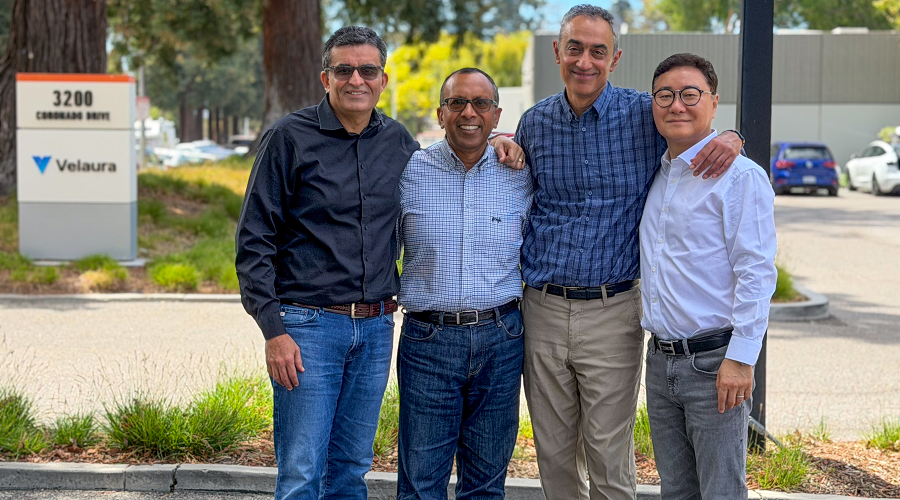
- Velaura AI Inc., a developer of low-power AI chips, announced it raised $110 million in funding; Seligman Ventures led the Series A round, joined by Samsung Catalyst Fund, Mayfield and more than a half-dozen others.
- Velaura is now valued at over $1 billion. The company was earlier known as Auradine and developed Bitcoin mining chips.
- Titan Core is a suite of processor building blocks and professional services designed to help customers develop AI chips, with an emphasis on energy efficiency.
- The funding deal comes six months after the company changed its market focus and brand.
- In March, Velaura shifted its focus from crypto accelerators to Titan Core.
Compiled by The Product DeskSomething wrong?How this is made
Why it matters
Auradine, which built Bitcoin mining processors, has renamed itself Velaura AI and raised $110 million in a Series A led by Seligman Ventures, with Samsung Catalyst Fund, Mayfield and more than half a dozen others joining, at a valuation above $1 billion [1][2]. What it is selling is not a chip but the low-voltage building blocks other companies use to make one [3], which says something about which axis of accelerator design currently has buyers.
The round comes six months after the company changed its market focus and brand [4]. In March it moved off crypto accelerators and onto Titan Core, a suite of processor building blocks plus professional services for customers designing their own AI chips [3][5]. The contents are conventional IP-vendor fare: a cell library of pre-packaged designs that Velaura says are optimised to run at low voltage [6], custom low-voltage circuits for teams that supply only an RTL description of the processor they want [7], and what the company calls a proprietary toolflow aimed at reliability and manufacturing yield [8]. Titan Core supports several manufacturing processes including the three- and two-nanometre nodes [9], and Velaura says it is working with multiple hyperscalers on projects at those nodes, without naming them [10]. It also expects edge-device customers [11].
The commercial argument is arithmetic rather than architecture. According to Velaura, matrix multiplications and certain related operations can account for up to 70% of an AI chip's power draw [12], and it claims Titan Core cuts the energy those calculations need by a factor of two to four, worth up to $1,300 per chip over three years [13]. That is roughly $433 per chip per year [14], which only matters at fleet scale, and it is the vendor's own figure with no named customer attached [10][13]. Chief Executive Rajiv Khemani framed the market the same way, saying the next era of AI will be defined not only by better models but by better compute economics [15].
The lineage is visible in the old product. The liquid-cooled Teraflux AH3880 mining chip topped out at 600 trillion computations per second [16], and carried a feature called EnergyTune that lowered its energy use when grid capacity was constrained [17]. A company that spent years selling into an industry where electricity is the dominant input cost has repackaged that instinct for buyers whose constraint is now the same. The pivot is less a change of business than a change of customer.
At $110 million against a valuation above $1 billion, the round represents no more than about 11% of the post-money company [18], so the founders have sold the story cheaply for a firm with no disclosed AI revenue. The money goes to engineering and customer-facing headcount [19].
Watch for whether any of the unnamed hyperscalers becomes a named tapeout, because IP vendors live on reference designs. Watch too for a third-party measurement of the two-to-four-times claim in shipped silicon, and for whether the savings figure survives contact with a stated baseline process and design.
Claim ledger
Ranked by verification strength, evidence, and original report placement.
- [1]
Velaura AI Inc., a developer of low-power AI chips, announced it raised $110 million in funding; Seligman Ventures led the Series A round, joined by Samsung Catalyst Fund, Mayfield and more than a half-dozen others.
ReportedView cited source - [2]
Velaura is now valued at over $1 billion. The company was earlier known as Auradine and developed Bitcoin mining chips.
ReportedView cited source - [3]
Titan Core is a suite of processor building blocks and professional services designed to help customers develop AI chips, with an emphasis on energy efficiency.
ReportedView cited source - [4]
The funding deal comes six months after the company changed its market focus and brand.
ReportedView cited source - [5]
In March, Velaura shifted its focus from crypto accelerators to Titan Core.
ReportedView cited source - [6]
Titan Core includes a cell library, a collection of pre-packaged cell designs that removes the need for customers to develop everything from scratch; Velaura says the modules are optimized to operate at low voltage.
ReportedView cited source
Sources & coverage · 2 publishers
The reporting this story was synthesized from, earliest first. Every link goes to the original.
- siliconangle.comMaria Deutscher4d agoVelaura AI raises $110M to develop power-efficient AI chips
- thenextweb.comCristian Dina4d agoVelaura raises $110mn to sell AI chips that cut the power bill, not the clock speed
Additional citations
- Rajiv Khemani, CEO of Velaura, quoted by SiliconANGLE