Published · yesterdayProduct3 min read
Astromech's $3.8bn mark is a price on Colossal's data, set by a cheque worth half a percent
The $20mn round buys roughly 0.53 per cent of the company, and no product exists yet. Read the number as a reference price for pre-revenue bio-AI, not a verdict on the science.
Not a builder's beat, but builders have a standing stake in it.See today for builders
What happened
- Astromech raised $20mn at a $3.8 billion valuation to build AI that predicts how living systems will change.
- Astromech's total funding now stands at $60mn.
- Bob Nelsen led the round, with Peak 6, NeoGenesis Capital, Builders VC and CAZ Investments taking part.
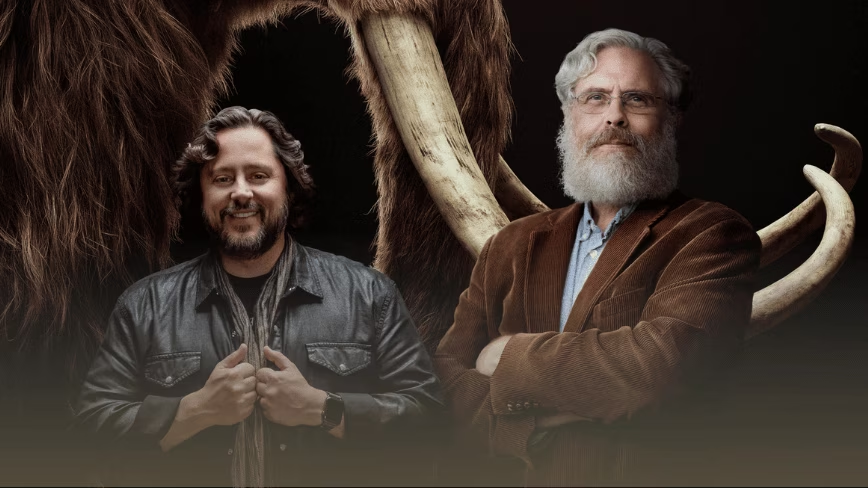
- Astromech was founded by Ben Lamm and George Church, the pair behind Colossal Biosciences.
- The Dallas startup gestated inside Colossal and inherited its data: a genome bank of extinct and living species, tooling built for large biological datasets, and ancient-DNA capability that compares old genomes with living ones.
Compiled by The Product DeskSomething wrong?How this is made
Why it matters
The valuable part of Astromech predates Astromech. The genome bank of extinct and living species, the tooling built for large biological datasets and the ancient-DNA capability that compares old genomes against living ones all came out of Colossal, where the company gestated before spinning out [5]. That is a real and unusual asset. It is also an inheritance, so the $3.8bn is largely a price on transferred data plus the track record of two founders who have raised against a long wait before [4].
Then there is the size of the cheque. Twenty million dollars against a $3.8bn valuation is about 0.53 per cent of the company [2], and the total raised to date sits at roughly 63 times below the mark [1]. Whatever conviction the round represents was expressed in a slice thin enough that this reads as a marking exercise rather than a market test.
Compare the other company sitting at exactly the same figure. TNW reported in July that Chai Discovery reached $3.8bn on a $400mn round [12], which is about 10.5 per cent of itself sold, roughly twenty times Astromech's slice [3]. Identical headline, wildly different amounts of capital standing behind it. The headline number, on its own, tells you almost nothing about what anyone committed.
The speed benchmark that will get quoted is internal, and it measures tree inference against maximum-likelihood methods [9]. That is a claim about compute cost, not about whether a forecast holds. The retrospective run recovered genes that published research had already established and flagged further candidates [10], which shows the pipeline works on known answers. Divide the valuation by the 46 genes mapped so far and you get about $83mn each [4]. Unfair to the science, fair to the pricing.
The strongest material in the public record is Church's argument about timing. Most variation that matters for complex traits such as morphology and longevity is regulatory rather than coding, he says, so reconstructing the ancestral regulatory state rather than only the ancestral protein is where the explanatory power sits [15]. He adds that this needs functional data across many species and reconstruction cheap enough to run genome-wide, and that neither held ten years ago [16]. The pipeline reconstructs chromatin accessibility, gene expression and functional annotation, then passes it through a Bayesian framework that returns calibrated confidence instead of single-point predictions [17]. Calibrated confidence is the right output for anything sold as a forecast, because it can be scored against outcomes. Nothing has been scored yet.
Patience is the part with precedent. Tech Funding News notes that Colossal spent five years and hundreds of millions without producing a de-extinct animal and kept raising [13]. Astromech is currently in what it calls a deep research and development phase [7], with the near-term plan being more staff, more comparative genomic infrastructure and more species [19]. Further down the stack, Insitro has taken more than $700mn for machine-learning drug discovery and Isomorphic Labs sits inside Alphabet [14]. Astromech's contribution for now is the number itself: a usable reading of what an inherited dataset and a coherent mechanism story fetch when there is no revenue to discount.
Claim ledger
Ranked by verification strength, evidence, and original report placement.
- [1]
Astromech raised $20mn at a $3.8 billion valuation to build AI that predicts how living systems will change.
ReportedView cited source - [3]
Bob Nelsen led the round, with Peak 6, NeoGenesis Capital, Builders VC and CAZ Investments taking part.
ReportedView cited source - [4]
Astromech was founded by Ben Lamm and George Church, the pair behind Colossal Biosciences.
ReportedView cited source - [5]
The Dallas startup gestated inside Colossal and inherited its data: a genome bank of extinct and living species, tooling built for large biological datasets, and ancient-DNA capability that compares old genomes with living ones.
ReportedView cited source - [6]
Astromech says its models learn from 3.8 billion years of biological history; the valuation and the training window are the same number, and nobody has said whether that is a coincidence.
ReportedView cited source
Sources & coverage · 2 publishers
The reporting this story was synthesized from, earliest first. Every link goes to the original.
- siliconangle.comMike Wheatley2d agoAstromech raises $20M to build a biological operating system that can forecast evolutionary change
- thenextweb.comCristian Dina2d agoAstromech raised $20mn at $3.8bn to forecast how biology breaks
Additional citations
- TNW
- Tech Funding News
- George Church
- Ben Lamm, to Inc.com