Published Product3 min read
A Cheap Sensor, an Expensive Loss: What the F-15E Account Changes About Air Defense
A US military official says Iranian drones passed the fighter's location, speed and direction to commanders before it was shot down in April.
Not a builder's beat, but builders have a standing stake in it.See today for builders
What happened
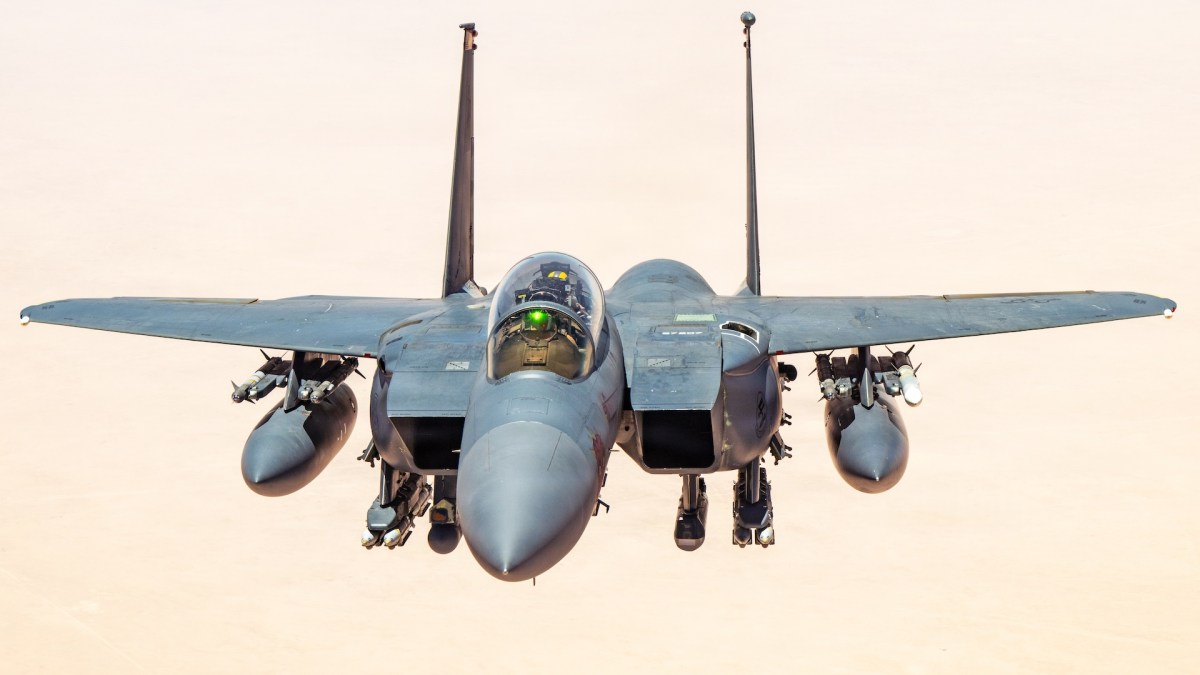
- A new account of the April shootdown of a US Air Force F-15E Strike Eagle over Iran suggests drones may have played a role in locating and tracking the fighter before it was engaged, potentially giving Iranian forces information needed to cue an air-defense weapon.
- The claim was reported by The New York Times and subsequently discussed by other outlets, and comes from a US military official familiar with the assessment.
- According to the US military official, Iranian drones provided commanders with the F-15E's location, speed and direction, helping them target the aircraft.
- The account has not been independently confirmed in public by the Pentagon.
- A drone does not necessarily need sophisticated radar to contribute to an air-defense engagement; a small unmanned aircraft with an electro-optical or infrared camera could detect an aircraft and report its approximate position and movement.
Compiled by The Product DeskSomething wrong?How this is made
Why it matters
A new account of the April shootdown of a US Air Force F-15E Strike Eagle over Iran holds that drones helped locate and track the fighter before it was engaged [1]. According to a US military official cited by The New York Times, Iranian drones gave commanders the aircraft's location, speed and direction, helping them target it [2][3]. That matters less as a novelty than as an arithmetic problem for anyone planning to operate over a country whose radars have already been hit.
Start with what is not established. The Pentagon has not publicly confirmed the account [4]. The available reporting does not say what sensors the drones carried, or how the tracking information reached the missile unit [9].
What the reporting does describe is a chain with no expensive link in the sensing half. A small drone with an electro-optical or infrared camera can detect an aircraft and report an approximate position and heading [6]. Several of them spread across an area produce multiple observations, from which a command network can assemble a more useful track [7]. More capable drones can carry electronic-support sensors that pick up an aircraft's radar or radio-frequency emissions [8]. Neither of those detection paths requires a working ground-based radar [1], which is the specific reason the assumption that suppressing fixed and mobile sensors clears the sky is weaker than it looks. The War Zone's analysis made the same point in reverse: a simple network of airborne spotters becomes more valuable, not less, if the more expensive fixed and mobile sensors have been heavily attacked [10].
The shooter end is consistent with the cheap read. The War Zone reported that the missile may have been a shoulder-launched infrared-guided weapon, though the exact weapon has not been publicly established [18]. The F-15E carries sophisticated electronic warfare and defensive systems, and those systems do not make it immune to short-range threats [17]. So the reported engagement pairs consumable airborne sensors [19] with a man-portable missile against a crewed multirole fighter [2]. The sequence described is unremarkable: a drone spots or detects the aircraft, passes its position to a command element, and that cues a shooter already sitting along the route [16].
This is the Ukraine lesson applied to air defense rather than artillery. Drones there have become routine for reconnaissance, spotting, target tracking and battle-damage assessment [14]. The requirement is not an exquisite sensor but enough sensors, communications and weapons wired together to close a kill chain [15].
Two cautions on the more colorful version of this story. In June, CNN reported that the pilot described a "jellyfish-like" formation of drones, smaller aircraft beneath larger ones, which sources familiar with the account likened to an airborne minefield [11]. There is no public evidence that this formation was the same system that produced the targeting information [12]. The pilot had also suffered a concussion, US intelligence reportedly had not previously assessed Iran as having the coordinated capability described, and officials were still working out what he encountered [13].
Watch whether the Pentagon confirms any part of the drone-cueing assessment, whether the weapon type is ever established publicly, and whether route planning and infrared countermeasure practice change for crews operating over degraded but not disarmed air defenses.
Claim ledger
Ranked by verification strength, evidence, and original report placement.
- [1]
A new account of the April shootdown of a US Air Force F-15E Strike Eagle over Iran suggests drones may have played a role in locating and tracking the fighter before it was engaged, potentially giving Iranian forces information needed to cue an air-defense weapon.
- [2]
The claim was reported by The New York Times and subsequently discussed by other outlets, and comes from a US military official familiar with the assessment.
- [3]
According to the US military official, Iranian drones provided commanders with the F-15E's location, speed and direction, helping them target the aircraft.
- [4]
The account has not been independently confirmed in public by the Pentagon.
ReportedView cited source - [6]
A drone does not necessarily need sophisticated radar to contribute to an air-defense engagement; a small unmanned aircraft with an electro-optical or infrared camera could detect an aircraft and report its approximate position and movement.
ReportedView cited source - [7]
Several drones operating across an area could provide multiple observations, allowing a command network to build a more useful track.
ReportedView cited source
Sources & coverage · 1 publisher
The reporting this story was synthesized from, earliest first. Every link goes to the original.
- interestingengineering.comKaif ShaikhAug 13US F-15E may have been tracked by Iranian drones before being shot down: Reports
Cited in this coverage: interestingengineering.com, summarising reporting
Cited in this coverage: interestingengineering.com citing The New York Times
Cited in this coverage: The War Zone analysis, via interestingengineering.com
Cited in this coverage: CNN, via interestingengineering.com
Cited in this coverage: The War Zone, via interestingengineering.com
Additional citations
- US military official, via The New York Times