Published Product3 min read
A 19,144-gene screen turns CRISPR delivery failure into a map
University of Wisconsin-Madison researchers knocked out nearly every human gene to find the ones that block Cas9 editing, and landed on two that, when depleted, raised base-editing efficiency more than sixfold.
Not a builder's beat, but builders have a standing stake in it.See today for builders
What happened
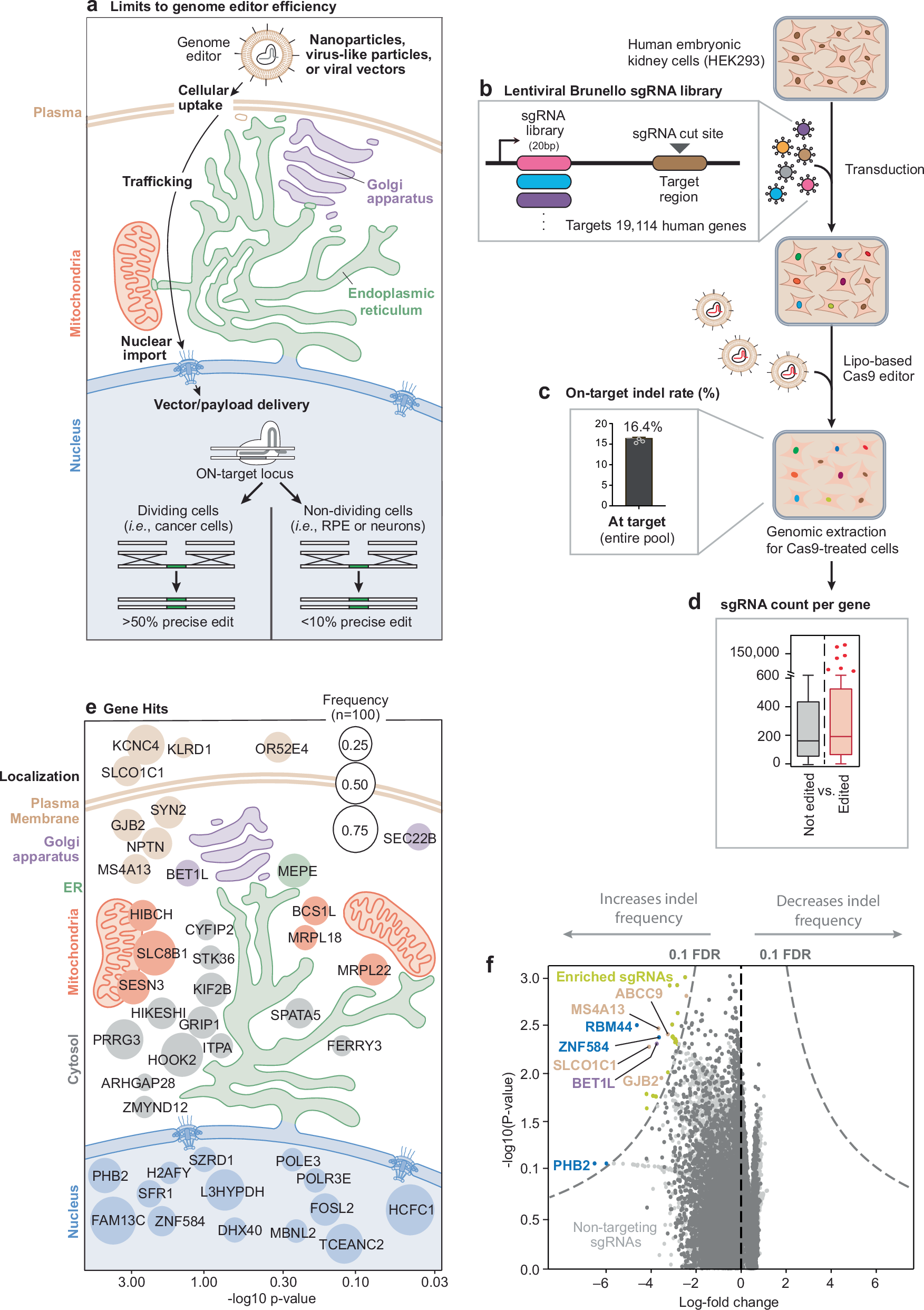
- University of Wisconsin-Madison researchers developed a platform to screen nearly all genes in the human genome, more than 19,000 genes (19,144), linking disruption of individual genes to improved genetic outcomes in human cells.
- The researchers, led by biomedical engineering professor Krishanu Saha, published their results in the journal Nature Communications; the work could provide a roadmap for identifying potential detours in different cell types when gene editors like CRISPR-Cas9 are applied to cells in the lab or to tissues in the body.
- A gene-therapy-carrying lipid nanoparticle must first enter the cell's plasma membrane, then navigate around organelles including the Golgi apparatus, mitochondria and endoplasmic reticulum, all of which can errantly absorb the particle's payload, rendering it ineffective at best or harmful at worst, before the particle enters the nucleus and makes a genetic change.
- Saha: "We essentially knock out each gene one by one in different cells. It's a massive undertaking if you were to try to do that in 19,144 different cell cultures, for instance. Here we do it in essentially a few dishes of cells that have 100 million cells in them."
- Saha says the team uses a precise sequencing strategy to find which genes matter the most, "essentially the needles in this genomic haystack."
Compiled by The Product DeskSomething wrong?How this is made
Why it matters
A group at the University of Wisconsin-Madison built a screening platform that knocked out more than 19,000 human genes one at a time and looked for the ones whose loss made Cas9 edit better, publishing the result in Nature Communications [1][2]. That reframes a familiar failure mode: when a lipid nanoparticle payload does not produce edits, the question is no longer only what the particle is made of, but which host-cell genes are diverting it.
The detour list is physical. A nanoparticle has to cross the plasma membrane, then get past organelles including the Golgi apparatus, mitochondria and the endoplasmic reticulum, any of which can absorb the payload and leave it ineffective or harmful, all before anything reaches the nucleus [3].
The screen itself is the interesting engineering. Rather than running 19,144 separate cultures, the team pooled the work into a few dishes holding roughly 100 million cells and used a sequencing readout to find which knockouts mattered, according to lead investigator and biomedical engineering professor Krishanu Saha [4][5]. Over six years the list narrowed from 19,144 genes to 26 that increased Cas9 editing efficiency when knocked out, then to six, then to two validated in human model cell systems [1][6][7]. That is a hit rate of about 0.14 percent, which is the honest cost of this kind of map [8].
The two survivors are GJB2 and BET1L. Depleting either improved editing efficiency more than sixfold with base editors, which chemically alter individual DNA bases instead of cutting [9][10]. In patient-derived retinal cells carrying Leber congenital amaurosis, inhibiting the same two genes raised editing efficiency more than three-and-a-half times [11]. That is roughly 58 percent of the lift seen in the model systems, which is the number operators should hold onto: the effect transferred to a disease-relevant cell type, but smaller [12].
Why these genes impede editing is unresolved, and the team says so [13]. The logic of the assay is inferential rather than mechanistic: more correct edits in a population where a candidate gene is knocked down means the gene was somehow blocking the process, per first author Shivani Saxena, now a postdoctoral researcher at UC San Francisco [14][15].
The near-term product implication is not a new particle. It is pretreatment, temporarily muting the blocking genes, and cell-type triage, since Saha notes the other flagged genes may matter more in other cell types and diseases [16][17]. The group frames the same approach as relevant to mRNA vaccines, mRNA cancer vaccines, CAR T-cell therapies and immunotherapies [17][18]. The eye work sits inside the CRISPR Vision Program, whose UW-Madison leads include Saha, David Gamm, Bikash Pattnaik and Shaoqin Gong, and which produced a personalized CRISPR drug on demand in 2025 [19][20].
What to watch: whether other labs rerun the screen in hepatocytes, T cells and muscle, since the value of this work is a per-cell-type roadblock atlas rather than two gene names [16]. Watch for mechanism papers on GJB2 and BET1L, because a transient knockdown pretreatment is only a candidate therapy once you know what the gene was doing [13]. And watch whether the 3.5x figure survives the move from patient-derived cells to tissue in the body, which is the transition the authors describe as the point of the roadmap [2][11].
Claim ledger
Ranked by verification strength, evidence, and original report placement.
- [1]
University of Wisconsin-Madison researchers developed a platform to screen nearly all genes in the human genome, more than 19,000 genes (19,144), linking disruption of individual genes to improved genetic outcomes in human cells.
- [2]
The researchers, led by biomedical engineering professor Krishanu Saha, published their results in the journal Nature Communications; the work could provide a roadmap for identifying potential detours in different cell types when gene editors like CRISPR-Cas9 are applied to cells in the lab or to tissues in the body.
ReportedView cited source - [3]
A gene-therapy-carrying lipid nanoparticle must first enter the cell's plasma membrane, then navigate around organelles including the Golgi apparatus, mitochondria and endoplasmic reticulum, all of which can errantly absorb the particle's payload, rendering it ineffective at best or harmful at worst, before the particle enters the nucleus and makes a genetic change.
ReportedView cited source - [4]
Saha: "We essentially knock out each gene one by one in different cells. It's a massive undertaking if you were to try to do that in 19,144 different cell cultures, for instance. Here we do it in essentially a few dishes of cells that have 100 million cells in them."
- [5]
Saha says the team uses a precise sequencing strategy to find which genes matter the most, "essentially the needles in this genomic haystack."
- [6]
Over the course of the six-year project, the researchers culled a list of 19,144 genes down to 26 that, when knocked out, increased the editing efficiency of the Cas9 gene-editing protein.
ReportedView cited source
Sources & coverage · 1 publisher
The reporting this story was synthesized from, earliest first. Every link goes to the original.
Cited in this coverage: phys.org report on the UW-Madison study
Additional citations
- Krishanu Saha
- Shivani Saxena