Published · 7h agoInvest7 min read
Salesforce built Koa, its own reasoning model, on Nvidia's open weights
Salesforce post-trained Nemotron 3 Super into Koa on synthetic data, and Perplexity's two engineers wrote a 40,000-line database in two months. The scarce assets in both stories are the channel and the contract terms.
Context for builders, not their beat.See today for builders
What happened
- Salesforce announced Koa, its first CRM reasoning model, at Dreamforce on September 15, built by post-training NVIDIA Nemotron 3 Super.
- Jayesh Govindarajan, EVP of Salesforce AI, told TechCrunch: "We've built many small task-specific language models, which are part of Agentforce's portfolio. But reasoning has always been something that we've relied on the frontier model providers for. Until now."
- Koa was trained with supervised fine-tuning and reinforcement learning using NVIDIA NeMo RL, NeMo Gym and NeMo AutoModel, on a proprietary synthetic dataset drawn from nearly three decades of enterprise CRM deployments covering scenarios across more than 14 industries.
- Because Nemotron is open, Salesforce fine-tuned and now runs Koa entirely within its own infrastructure, controlling the weights.
- On Salesforce's own CRM Bench, a suite of tasks such as updating an opportunity, routing a case or scheduling a follow-up, the company says Koa matches or exceeds leading model performance on CRM actions with three times fewer errors.
Compiled by The InvestorSomething wrong?How this is made
Why it matters
Salesforce's Agentforce used to route any multi-step reasoning job out to a frontier model. "But reasoning has always been something that we've relied on the frontier model providers for. Until now," Jayesh Govindarajan, EVP of Salesforce AI, told TechCrunch [3]. What replaced that route is Koa, post-trained from NVIDIA Nemotron 3 Super with supervised fine-tuning and reinforcement learning on NeMo RL, NeMo Gym and NeMo AutoModel, on a synthetic dataset drawn from close to three decades of CRM deployments across more than 14 industries [1][4]. Because Nemotron is open, Salesforce fine-tuned and runs the model inside its own infrastructure and holds the weights [5]. Salesforce says Koa matches or exceeds leading model performance on CRM actions with three times fewer errors on its own CRM Bench [6].
Rohan Kumar, Salesforce's president of platform and engineering, said of the training data: "Not a single byte of customer data was used" [7].
So the model-layer capability was assembled without a pre-training run, without customer records, and without the frontier lab. What Salesforce could not assemble was the base model, and Govindarajan was specific about why Nemotron was the one: "the challenge has always been the lack of a pre-trained base model to start with. Until Nemotron came along, there was no sovereign American pre-trained model that was available, one, and two, that was state of the art, and, three, that had clear data provenance. We have no idea what Qwen trains on" [8].
The distribution question sits one layer down
That is a dependency. Jensen Huang, on the Dreamforce stage with Marc Benioff, put open-model adoption at "about 30% at the beginning of last year to some 70% now" [9][10]. That number is the vendor's own. NVIDIA supplies the open base, the post-training toolchain and the inference architecture that Kari Ann Briski, NVIDIA's VP of Generative AI Software for Enterprise, described as "a unique architecture for inference to be token efficient" [11]. Salesforce did not leave the frontier labs either; it announced ClaudeForce alongside Koa, letting customers use Claude as the interface while data stays in Salesforce's system of records [12].
The same week, Nvidia was on the other side of that trade. Nvidia confines Anthropic's Claude Fable to lower-stakes work such as open-source projects and uses Nemotron for sensitive jobs like supply chain monitoring, The Information reported [13]. "As a company, you know, we believe ZDR [zero data retention] should be on by default," said Justin Boitano, Nvidia's vice president of enterprise AI [14]. Nvidia is an Anthropic investor and Anthropic is a major buyer of NVIDIA hardware [15].
What the retention clause cost
The trigger was a June Anthropic policy giving it the right to keep customer usage logs for 30 days, and up to two years when its safety systems flag them, covering Claude Fable 5 and removing a zero-data-retention guarantee some enterprise customers had relied on [16]. Booz Allen barred employees from using Fable on work touching the proprietary cybersecurity software it sells, with CTO Bill Vass saying, "We worry a little bit that [Fable] might be learning from some of our code," while noting the concern covers only a small share of the firm's work [17]. Northrop Grumman runs open-source models on its own air-gapped servers; Novo Nordisk keeps proprietary data out of hosted models [18]. Microsoft restricted its own employees' access while its legal team reviewed the change, PYMNTS reported at the time [19].
Anthropic answered on September 1 with Enterprise Frontier Safeguards: retained data sits in the customer's own cloud under the customer's encryption keys, automated safety monitoring continues, and the customer's own security team reviews what gets flagged, with broader availability targeted for this fall [20]. Palantir will not offer Fable through its platform until Anthropic provides an irrevocable zero-data-retention guarantee, though Palantir customers can still buy the model directly from Anthropic [21]. An executive at a major U.S. utility told The Information the company scrapped plans to test Fable on core power infrastructure serving millions of households after Anthropic would not give the same assurance, and still uses Anthropic for finance and HR work [22].
This was a pricing event. The utility kept Anthropic for lower-stakes work, so what it balked at was the clause, and what Palantir is withholding is a channel.
Two engineers, two months, 40,000 lines
The build-side evidence points the same way. Perplexity was paying too much for DynamoDB and getting too little control over read performance. So it replaced DynamoDB reads in its search serving layer with CobbleDB, a roughly 40,000-line Rust key-value store written by two engineers in two months with help from hundreds of persistent AI coding agents, The New Stack reported [23]. At roughly 200,000 requests per second, Perplexity measured median batch-read latency of 5.6 milliseconds against 31.4 ms previously recorded on DynamoDB, and p99 of 24.2 ms against 123 ms [24]. The report is explicit that the systems were not tested side by side on identical traffic, since the DynamoDB figures predate the cutover and CobbleDB's come after [25]. Later load testing reached 500,000 requests per second before performance declined [26].
The median improvement is 31.4 to 5.6 ms, a reduction of 25.8 ms, or about 82% [27]. The p99 improvement is 123 to 24.2 ms, about 80% [28]. Both figures come with the caveat above, so they are directional. The projected saving is at least 20% against DynamoDB, and the estimate excludes the engineering time to maintain the thing [29]. Weighing a saving of at least 20% on a database bill against two engineers' ongoing time is a calculation only Perplexity can do, and the report does not include the DynamoDB bill.
The two engineers kept control of the architecture and the production system, and Perplexity kept the agents out of production [30]. Andy Pavlo of Carnegie Mellon said at Percona Live this year that databases are the hardest and most important challenge for AI agents, partly because mistakes involving production data can be difficult or impossible to reverse [31].
Where defensibility actually sat this week
Set those two against Zocdoc, which is selling nothing model-shaped at all. Zocdoc is opening the scheduling infrastructure behind its own site to Yelp, Healthgrades and Amazon Health AI, with separate financial arrangements for each partner, Fast Company reported [32]. In the Blue Shield of California pilot, Zocdoc's tools were added to a provider directory that previously listed doctors without letting anyone book. The insurer says the directory now surfaces more than two million hours of appointments across a 90-day window, roughly double where it started, with booked appointments up sevenfold, an average wait of six days and a no-show rate of 2% [33]. The national average time to get an appointment with a physician hovers around 31 days, per MedPage Today [34]. Six against about 31 days is a reduction of roughly 25 days, about 81% [35].
That asset took a decade and change to build. The network covers 200,000 providers, 20 million patients and 10,000 insurance plans, growing at a 50% compound annual rate since 2023, and getting there meant connecting to thousands of separate scheduling systems [36]. "Healthcare has a resistance to disruption," founder and CEO Oliver Kharraz said. "It's the brownfield industry where $5 trillion has already been poured into infrastructure that you cannot easily innovate around" [37]. Khosla Ventures led the $3 million Series A in 2008, joined the $15 million Series B in 2010, and in May offered to buy some stock at $21 per share, valuing Zocdoc at $2.3 billion [38]. A Khosla managing director familiar with the investment called it "patient capital" [39]. Eighteen years from a $3 million round to a $2.3 billion mark is the price of the integration work [40].
And the distribution is not free even for the company that owns it. Kharraz hired Brian Irving in 2026 as Zocdoc's first CMO because, he said, "When we poll people why they don't use Zocdoc, the number one reason by a large margin is that they didn't know it existed" [41].
The counter-thesis, which is not weak
I think the week's evidence points to process and channel as the scarce input, and I'd expect enterprise AI margins to accumulate wherever a retention clause or an integration is hard to replicate. Two ways that reading fails. First, the Koa case is a dependency dressed as independence: Salesforce needed an open base model with clear provenance and there was one, from a supplier with its own reasons to seed the category [8]. And Salesforce's performance figures are its own, on its own benchmark [6]. Second, Perplexity's cost claim is a projection that leaves out maintenance labour and rests on latency numbers the report says were never measured side by side [25][29]. If either the base-model supply or the agent-built-infrastructure economics turn out worse than they look this week, the model layer is expensive again and the argument goes with it.
The falsifier for the channel thesis is narrower. If Anthropic's Enterprise Frontier Safeguards ships broadly this fall and Palantir drops the irrevocable-ZDR condition, then the terms were a temporary negotiation [20][21]. I would watch the platform listing itself.
What to watch
- Whether Enterprise Frontier Safeguards reaches broad availability this fall and whether Palantir then lists Claude Fable on its platform without the irrevocable zero-data-retention condition.
- Koa's move from October customer pilots to general availability, and whether Salesforce publishes CRM Bench results anyone outside Salesforce can reproduce.
- Whether Perplexity open-sources CobbleDB and discloses the maintenance cost that its at-least-20% saving estimate leaves out.
Claim ledger
Ranked by verification strength, evidence, and original report placement.
- [1]
Salesforce announced Koa, its first CRM reasoning model, at Dreamforce on September 15, built by post-training NVIDIA Nemotron 3 Super.
ReportedView cited source - [3]
Jayesh Govindarajan, EVP of Salesforce AI, told TechCrunch: "We've built many small task-specific language models, which are part of Agentforce's portfolio. But reasoning has always been something that we've relied on the frontier model providers for. Until now."
ReportedView cited source - [4]
Koa was trained with supervised fine-tuning and reinforcement learning using NVIDIA NeMo RL, NeMo Gym and NeMo AutoModel, on a proprietary synthetic dataset drawn from nearly three decades of enterprise CRM deployments covering scenarios across more than 14 industries.
ReportedView cited source - [5]
Because Nemotron is open, Salesforce fine-tuned and now runs Koa entirely within its own infrastructure, controlling the weights.
ReportedView cited source - [6]
On Salesforce's own CRM Bench, a suite of tasks such as updating an opportunity, routing a case or scheduling a follow-up, the company says Koa matches or exceeds leading model performance on CRM actions with three times fewer errors.
ReportedView cited source - [7]
"Not a single byte of customer data was used," Rohan Kumar, Salesforce's president of platform and engineering, said.
ReportedView cited source - [8]
Govindarajan said: "the challenge has always been the lack of a pre-trained base model to start with. Until Nemotron came along, there was no sovereign American pre-trained model that was available, one, and two, that was state of the art, and, three, that had clear data provenance. We have no idea what Qwen trains on."
ReportedView cited source - [9]
Jensen Huang said open models went from about 30% at the beginning of last year to some 70% now.
ReportedView cited source - [10]
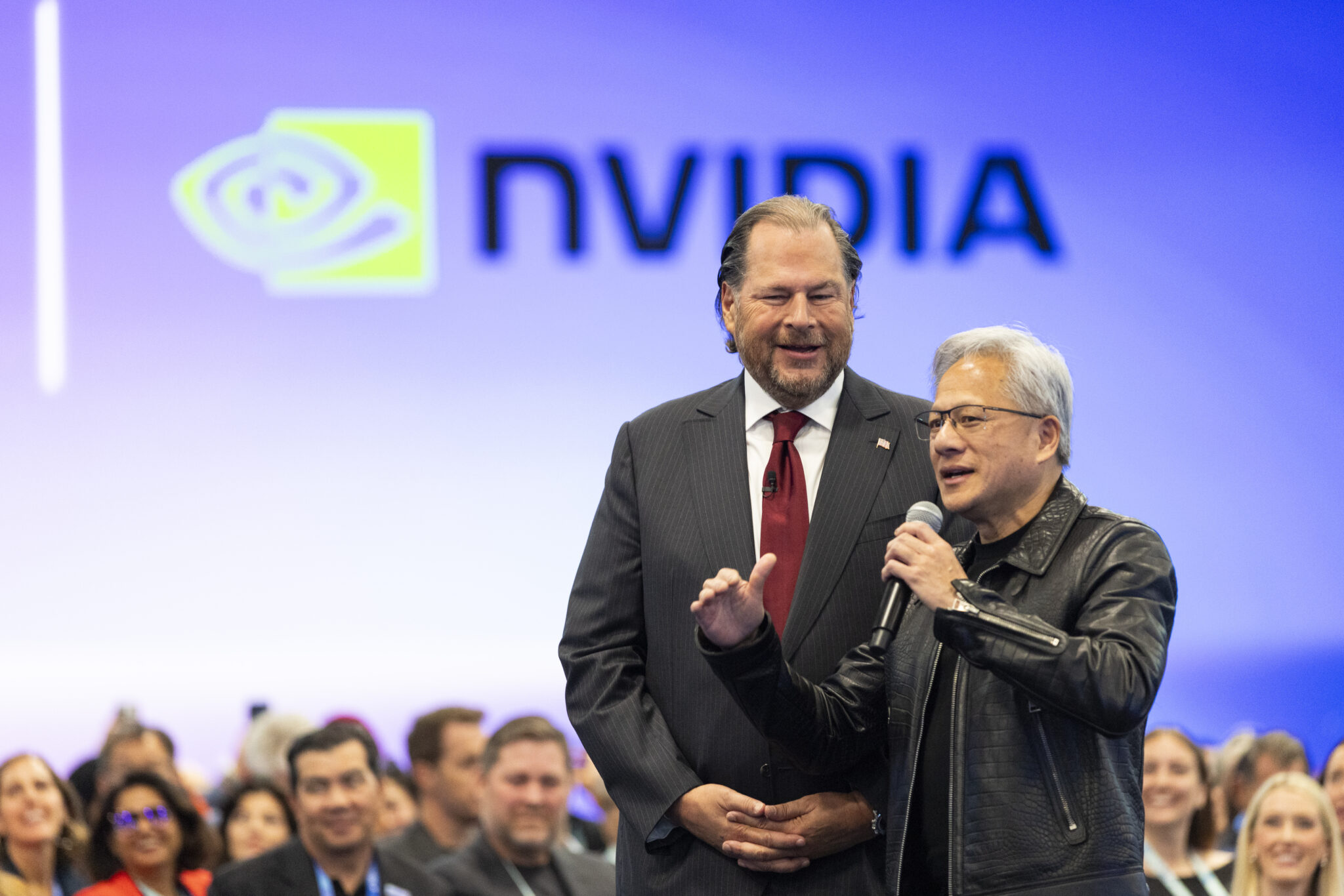
Jensen Huang, NVIDIA's founder and CEO, appeared onstage at Moscone Center with Salesforce CEO Marc Benioff to mark the Koa launch.
ReportedView cited source - [11]
Kari Ann Briski, NVIDIA's VP of Generative AI Software for Enterprise, told TechCrunch that with Nemotron, "we have a unique architecture for inference to be token efficient."
ReportedView cited source - [12]
Salesforce also announced ClaudeForce, a partnership with Anthropic that lets companies use Claude as their AI interface while their data stays in Salesforce's system of records.
ReportedView cited source - [13]
Nvidia now confines Fable to lower-stakes tasks such as open-source projects and uses its own Nemotron models for sensitive work like supply chain monitoring, The Information reported.
ReportedView cited source - [14]
"As a company, you know, we believe ZDR [zero data retention] should be on by default," said Justin Boitano, Nvidia's vice president of enterprise AI.
ReportedView cited source - [15]
Nvidia is an Anthropic investor, and Anthropic is a major buyer of NVIDIA hardware.
ReportedView cited source - [16]
Anthropic introduced a policy in June giving it the right to keep customer usage logs for 30 days, and up to two years if its safety systems flag them; the terms cover Claude Fable 5 and removed a zero-data-retention guarantee some enterprise customers had relied on.
ReportedView cited source - [17]
Booz Allen has barred employees from using Fable on work touching the proprietary cybersecurity software it sells to clients, with CTO Bill Vass saying, "We worry a little bit that [Fable] might be learning from some of our code," while noting the concern covers only a small share of the firm's work.
ReportedView cited source - [18]
Novo Nordisk keeps proprietary data out of hosted models, and Northrop Grumman runs open-source models on its own air-gapped servers.
ReportedView cited source - [19]
Microsoft restricted its own employees' access to Fable while its legal team reviewed the retention change, PYMNTS reported at the time.
ReportedView cited source - [20]
Anthropic unveiled Enterprise Frontier Safeguards on September 1: customers store retained data in their own cloud infrastructure under their own encryption keys, automated safety monitoring continues, and the customer's own security team reviews whatever gets flagged; the rollout is phased with broader availability targeted for this fall.
ReportedView cited source - [21]
Palantir will not offer Fable through its platform until Anthropic provides an irrevocable zero-data-retention guarantee, though Palantir customers can still get the model directly from Anthropic.
ReportedView cited source - [22]
An executive at a major U.S. utility told The Information the company scrapped plans to test Fable on core power infrastructure serving millions of households after Anthropic would not provide the same assurance; the utility still uses Anthropic for lower-stakes finance and human resources work.
ReportedView cited source - [23]
The New Stack reported on September 16 that two engineers wrote the roughly 40,000-line Rust key-value store CobbleDB in two months, with help from hundreds of persistent AI coding agents, after Perplexity concluded it was paying too much for DynamoDB and getting too little control over read performance.
ReportedView cited source - [24]
At roughly 200,000 requests per second, Perplexity measured median batch-read latency of 5.6 milliseconds on CobbleDB against 31.4 ms previously recorded on DynamoDB, and p99 latency of 24.2 ms against 123 ms.
ReportedView cited source - [25]
The report makes explicit that the two systems were not tested side by side against identical traffic, since the DynamoDB numbers were taken before the cutover and CobbleDB's after.
ReportedView cited source - [26]
Later load testing reached 500,000 requests per second before performance began to decline.
ReportedView cited source - [29]
CobbleDB is projected to cost at least 20% less than DynamoDB, an estimate that excludes the engineering time needed to maintain it.
ReportedView cited source - [30]
The two engineers kept control of the architecture and the production system, and Perplexity did not give the agents access to production.
ReportedView cited source - [31]
Carnegie Mellon professor Andy Pavlo said at Percona Live earlier this year that databases are the hardest and most important challenge for AI agents, partly because mistakes involving production data can be difficult or impossible to reverse.
ReportedView cited source - [32]
Zocdoc is opening the scheduling infrastructure that powers its own site to outside platforms including Yelp, Healthgrades and Amazon Health AI, Fast Company reported on September 16, and has separate financial arrangements with each partner.
ReportedView cited source - [33]
Zocdoc's tools were added to Blue Shield of California's provider directory, which previously listed doctors without allowing direct booking; the insurer says the directory now surfaces more than two million hours of appointments across a 90-day window, roughly double where it started, with booked appointments up sevenfold, an average wait of six days and a no-show rate of 2%.
ReportedView cited source - [34]
The national average time to get an appointment with a physician hovers around 31 days, per MedPage Today.
ReportedView cited source - [36]
Zocdoc's network covers 200,000 providers, and since 2023 has grown at a 50% compound annual rate, reaching 20 million patients and 10,000 insurance plans; getting there meant connecting to thousands of separate scheduling systems.
ReportedView cited source - [37]
"Healthcare has a resistance to disruption," Zocdoc founder and CEO Oliver Kharraz says. "It's the brownfield industry where $5 trillion has already been poured into infrastructure that you cannot easily innovate around."
ReportedView cited source - [38]
Khosla Ventures led Zocdoc's $3 million Series A in 2008, joined the $15 million Series B in July 2010, and offered in May to buy some company stock at $21 per share, valuing Zocdoc at $2.3 billion.
ReportedView cited source - [39]
A Khosla managing director familiar with the investment described it as "patient capital," on the expectation that the company would eventually reach a critical mass of doctors and users.
ReportedView cited source - [41]
Kharraz hired Brian Irving in 2026 as Zocdoc's first CMO, and says: "When we poll people why they don't use Zocdoc, the number one reason by a large margin is that they didn't know it existed."
ReportedView cited source - [27]
Median batch-read latency fell 25.8 ms, from 31.4 ms to 5.6 ms, about an 82% reduction.
Derived - [28]
p99 latency fell from 123 ms to 24.2 ms, about an 80% reduction.
Derived - [35]
A six-day average wait against a national average of about 31 days is a reduction of roughly 25 days, about 81%.
Derived - [40]
From the 2008 Series A to the May stock offer is 18 years, and from $3 million raised to a $2.3 billion valuation.
Derived
Sources & coverage · 4 publishers
The reporting this story was synthesized from, earliest first. Every link goes to the original.
- darioamodei.com2d agoDario Amodei — We Must Pace the Frontier
- pivotnews.aiyesterdayAutodesk Assistant lets builders edit 3D models without opening Revit
- pivotnews.aiyesterdayOxford student says AI helped him win small claim against SSE
- pivotnews.aiyesterdayHinton backs slowdown call, warns AI control problem is unsolved
- pivotnews.aiyesterday3M expert turned over 350 pages of ChatGPT material in deposition
- pivotnews.aiyesterdaySalesforce builds its first reasoning model on Nvidia's open Nemotron
- pivotnews.aiyesterdayFast models will expose slow dev tooling, engineer Sean Goedecke argues
- pivotnews.aiyesterdayExaforce launches agent kill switch, pointing to blind spots in audit logs
- pivotnews.aiyesterdayOpenAI Foundation funds bid to buy data from bankrupt biotech firms
- pivotnews.aiyesterdayCMS documents obtained by EFF outline AI prior authorization for cancer care
- pivotnews.aiyesterdayReported EU draft would tier children's access to social apps and AI chatbots
- about.fb.comyesterdayMeta Rolls Out New ‘Meta One’ Subscription Plans With Higher AI Usage Limits
- pivotnews.ai14h agoMicrosoft agrees to binding AI privacy rules for schools with AFT
- pivotnews.ai14h agoNvidia and Palantir wall off Anthropic's Fable over data retention terms
- pivotnews.ai14h agoLagarde says Europe holds 5% of AI computing power and risks being cut off
- pivotnews.ai14h agoK Health drops insurers for 10 health systems, Ran Shul tells THCB
- pivotnews.ai14h agoTwo new hotlines let AI agents report misbehaving peers
- pivotnews.ai14h agoZocdoc licenses its booking engine to Yelp, Amazon Health AI and insurers
- pivotnews.ai14h agoApple details how iPhone 18 Pro signs photos to prove they are real
- alignment.openai.com13h agosix incidents of such behavior