Published Invest3 min read
Lenovo's 43% quarter is a component-cost warning dressed as a growth story
AI revenue at $9.3 billion and 35% of the mix shows the buildout has spread from GPUs into servers, networking and devices. The same spread is what pushes memory, and then PC prices, up.
Context for builders, not their beat.See today for builders
What happened
- Lenovo announced Q1 FY2026/27 quarterly revenue of $26.94 billion.
- Lenovo's quarterly revenue jumped 43% compared with the same quarter a year earlier, beating analyst estimates.
- Lenovo's AI-related revenue, across both enterprise infrastructure and consumer AI PC devices, rose 60% to $9.3 billion.
- AI-related revenue accounts for about 35% of Lenovo's total revenue, more than one third of group revenue.
- Lenovo's prior-year comparable quarter revenue was approximately $18.8 billion.
Compiled by The InvestorSomething wrong?How this is made
Why it matters
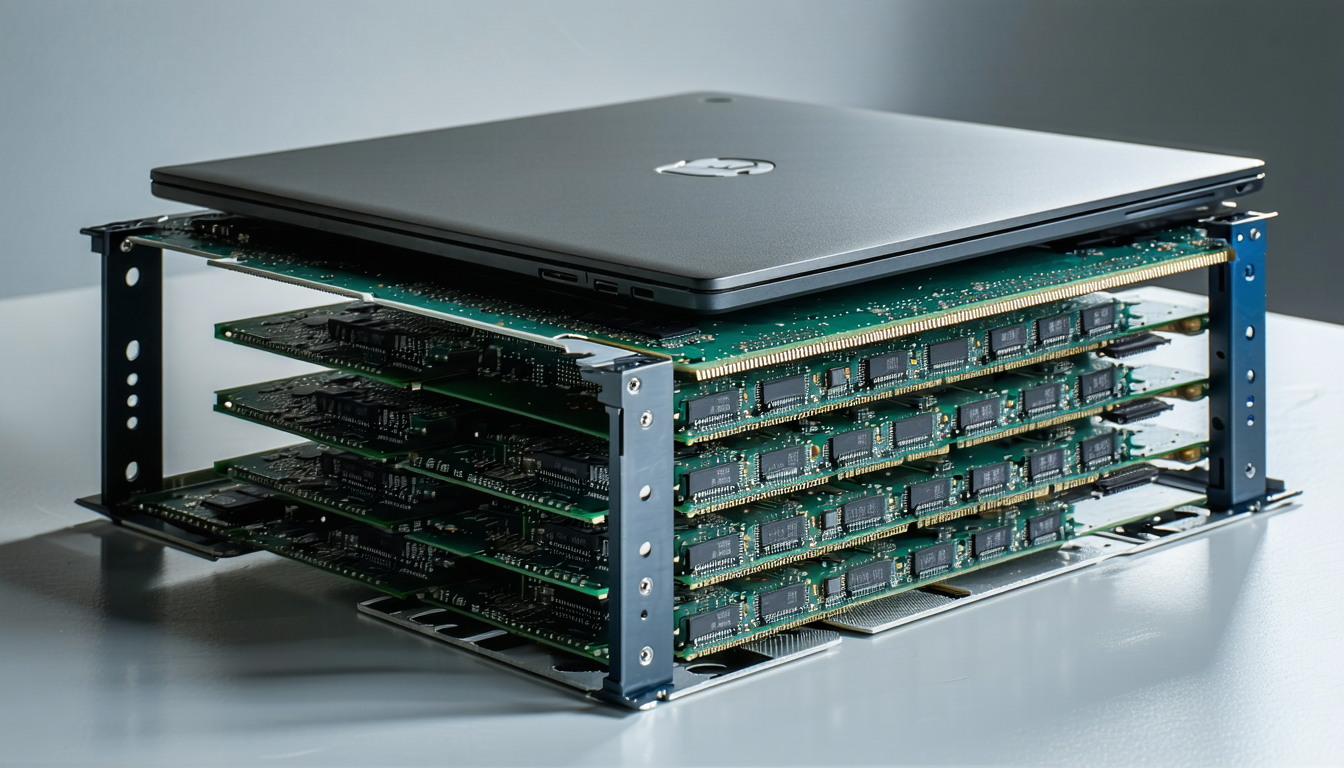
Lenovo reported Q1 FY2026/27 revenue of $26.94 billion, up 43% year on year and ahead of analyst estimates, with AI-related revenue up 60% to $9.3 billion, or about 35% of the total [1][2][3][4]. The number that matters more to anyone with a hardware budget sits further down the same story: Gartner expects DRAM and SSD costs to rise 130% by the end of 2026 [9].
Work backwards through Lenovo's own figures and the picture is less of a pure AI story than the headline suggests. A 43% increase implies a prior-year quarter of roughly $18.8 billion, and a 60% increase in AI revenue implies a prior-year AI base near $5.8 billion, which was already about 31% of the company [5][6]. So AI accounted for roughly 43% of the incremental revenue, and the non-AI remainder still grew about 35% [7][8]. The mix shifted, but not dramatically. Lenovo describes its AI revenue as spanning both enterprise infrastructure and consumer AI PC devices, with the Infrastructure Solutions Group growing and Solutions and Services also contributing [3][11] - a wide enough definition that the 35% figure should be read as a directional claim rather than a clean segment.
The broader spending data cited in the report is real but internally inconsistent, and operators should notice. Gartner puts global AI spending at $2.59 trillion in 2026, up 47%, and expects AI infrastructure to be more than 45% of that [12][13]. That implies at least $1.17 trillion of infrastructure spend next year [14]. IDC, in the same article, has AI infrastructure at $318 billion for full-year 2025, more than $487 billion in 2026, and above $1 trillion only by 2029 [16][17][18]. Gartner's infrastructure number is therefore about 2.4 times IDC's for the same year [15]. Two research houses are counting different things, and neither definition is disclosed here. Use the growth rates, not the totals: IDC's 2026 figure is a 53% increase on 2025 [19], and its Q4 2025 print of $89.9 billion was up 62% year on year, with servers making up 97.6% of that quarter [20][21].
That last figure is the point for buyers. The money is going into complete server systems, not just accelerators, which pulls in memory, storage, networking and services - the same supply chain that stocks a corporate PC refresh [22]. Gartner expects PC prices to rise and global PC shipments to fall about 10.4%; IDC models an 11.3% shipment decline alongside an 18.3% increase in average selling prices [9][10][23]. Those IDC numbers together imply PC revenue up roughly 5% on nearly 12% fewer units [24]. Fewer machines, more money. Budgets set on unit counts will miss by double digits.
Lenovo sits on both sides of this: the buildout drives its server demand while raising its own device costs, leaving faster-growing infrastructure, devices and services revenue to carry the traditional PC business [25]. Buyers do not get that hedge.
What to watch: whether Lenovo's next quarter shows AI revenue growth outpacing total growth by a wider margin, which would mean the mix shift is real rather than definitional; whether IDC's 18.3% ASP increase shows up in renewal quotes before the DRAM contracts reset; and whether the gap between Gartner's and IDC's 2026 infrastructure totals narrows, because one of those numbers is measuring something other than hardware.
Claim ledger
Ranked by verification strength, evidence, and original report placement.
- [1]
Lenovo announced Q1 FY2026/27 quarterly revenue of $26.94 billion.
- [2]
Lenovo's quarterly revenue jumped 43% compared with the same quarter a year earlier, beating analyst estimates.
- [3]
Lenovo's AI-related revenue, across both enterprise infrastructure and consumer AI PC devices, rose 60% to $9.3 billion.
- [4]
AI-related revenue accounts for about 35% of Lenovo's total revenue, more than one third of group revenue.
- [9]
Gartner expects DRAM and SSD costs to increase by 130% by the end of 2026, and consequently expects PC prices to rise.
- [10]
Gartner expects global PC shipments to drop by approximately 10.4%.
Sources & coverage · 1 publisher
The reporting this story was synthesized from, earliest first. Every link goes to the original.
- cryptopolitan.comAshish KumarAug 13Lenovo’s $26.9B quarter hints at AI’s next spending wave
Additional citations
- Cryptopolitan
- Gartner, via Cryptopolitan
- IDC, via Cryptopolitan