Published Invest3 min read
Chain analysis put a Farage aide's name on $8.8M of Trump bets. That is the disclosure test case
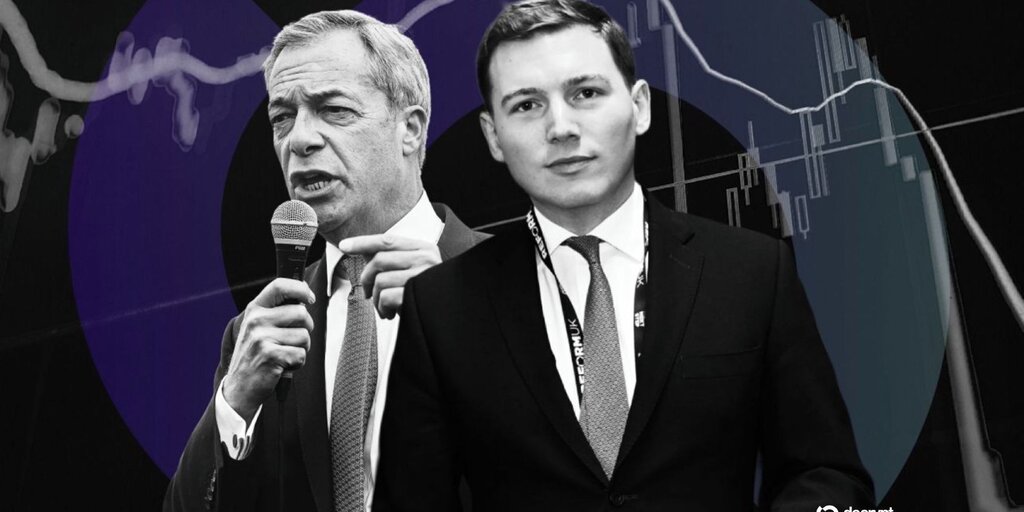
ZachXBT linked an account that staked $8.8 million on Trump to George Cottrell, a Reform UK donor and Farage aide. The deposits arrived via a swap service with no identity checks.
Context for builders, not their beat.See today for builders
What happened
- A Polymarket account funneled roughly $8.8 million into bets on Donald Trump winning the 2024 US presidential election.
- The account was linked to George Cottrell, a political aide and major donor to Reform UK leader Nigel Farage, described as one of Farage's closest confidants.
- On-chain investigator ZachXBT identified the account, operating under the username GCottrell93, and described the connection as high confidence.
- The GCottrell93 account received its deposits in late October 2024 from two unidentified wallets.
- The funds were routed through exchanges including OKX and ChangeNOW, a swap service that does not require identity verification for most transactions.
Compiled by The InvestorSomething wrong?How this is made
Why it matters
On-chain investigator ZachXBT has tied a Polymarket account that staked roughly $8.8 million on Donald Trump winning the 2024 US presidential election to George Cottrell, a political aide and major donor to Reform UK leader Nigel Farage [1][2]. The combination of a named political operative, an eight-figure position, and deposits routed through a service that does not verify identity is the exact fact pattern disclosure rules get drafted around [5][6].
The mechanics are unglamorous. The account, operating as GCottrell93, received its deposits in late October 2024 from two unidentified wallets, moved through exchanges including OKX and ChangeNOW, a swap service that does not require identity verification for most transactions [3][4][5]. ZachXBT described the identification as high confidence [3]. The Trump position produced about $4.4 million in profit [7], a 50 percent return on the amount staked [8]. The same account lost about $655,000 on Iran-related positions, with roughly $550,000 of that in a single bet [9][10], and is net positive overall [11]. On the two disclosed lines alone, that nets out to about $3.7 million [17].
Note who did this work and who did not. The trail exists because Polymarket settles on Polygon using pUSD, a USDC-backed token, so every deposit and withdrawal is permanently recorded, which is how ZachXBT reconstructed the activity [12]. Permanence is normally marketed as a feature. Here the feature is an evidence file: a private individual with a block explorer produced an attribution that no regulator requested and no venue had to disclose. The link rests entirely on that analysis [3], and the origin of the money in the two feeder wallets is still unknown [13].
The operator detail is what changes the category. Cottrell is 32, known in British political circles as "Posh George", and has a prior wire fraud conviction in the United States [14][15]. He is described as one of Farage's closest confidants and a significant Reform UK donor [2]. An account of that size held by someone in that position stops being a trading story and becomes a political finance story, and the follow-on questions -- whose capital, declared to whom -- are ones the platform has no mechanism to answer, because the counterparty was two anonymous wallets [4][13].
Polymarket's own position is already conditional: nominally blocked to US users following a 2022 settlement with the CFTC, while operating freely for international participants [16]. Prediction markets have spent the last stretch arguing they are information infrastructure rather than gambling. The opposing brief now has a citation with a name in it, which is the version that survives a committee hearing: $8.8 million from unidentified wallets, moved through a no-KYC route, into a market on a national election, surfaced by a stranger rather than a compliance function [1][5][13]. According to the reporting, this is precisely the scenario critics use to argue for stronger identity verification and anti-money-laundering controls on these venues [6].
Watch three things. Whether anyone -- Cottrell, Polymarket, or a regulator -- confirms or disputes the attribution, since as it stands it is one investigator's analysis [3]. Whether the two feeder wallets are ever traced to a source [13]. And whether the fix arrives as identity verification at deposit, which would end the anonymous large position, or as position disclosure for politically exposed persons, which would not.
Claim ledger
Ranked by verification strength, evidence, and original report placement.
- [1]
A Polymarket account funneled roughly $8.8 million into bets on Donald Trump winning the 2024 US presidential election.
ReportedSource: cryptobriefing.com, reporting on-chain investigator ZachXBT's findingsView cited source - [2]
The account was linked to George Cottrell, a political aide and major donor to Reform UK leader Nigel Farage, described as one of Farage's closest confidants.
- [3]
On-chain investigator ZachXBT identified the account, operating under the username GCottrell93, and described the connection as high confidence.
- [4]
The GCottrell93 account received its deposits in late October 2024 from two unidentified wallets.
- [5]
The funds were routed through exchanges including OKX and ChangeNOW, a swap service that does not require identity verification for most transactions.
- [6]
The publisher states that an $8.8 million deposit from unidentified wallets routed through a no-KYC exchange is precisely the kind of scenario that gives ammunition to critics arguing these platforms need stronger identity verification and anti-money-laundering controls.
Sources & coverage · 1 publisher
The reporting this story was synthesized from, earliest first. Every link goes to the original.
- cryptobriefing.comEditorial TeamAug 13Polymarket account linked to Farage aide George Cottrell’s $8.8M Trump bets
Cited in this coverage: cryptobriefing.com, reporting on-chain investigator ZachXBT's findings
Cited in this coverage: cryptobriefing.com
Cited in this coverage: ZachXBT, via cryptobriefing.com
Cited in this coverage: ZachXBT's findings, via cryptobriefing.com