Published · yesterdayInvest6 min read
Asked for County Permitting, Handed a Lunar Ice Survey: the Real Gating Input in This File
Nothing in the supplied material mentions data centres, permitting or public affairs. The one genuine gating-input story in the pile is Chang'e 7, and that one is worth the space.
Context for builders, not their beat.See today for builders
What happened
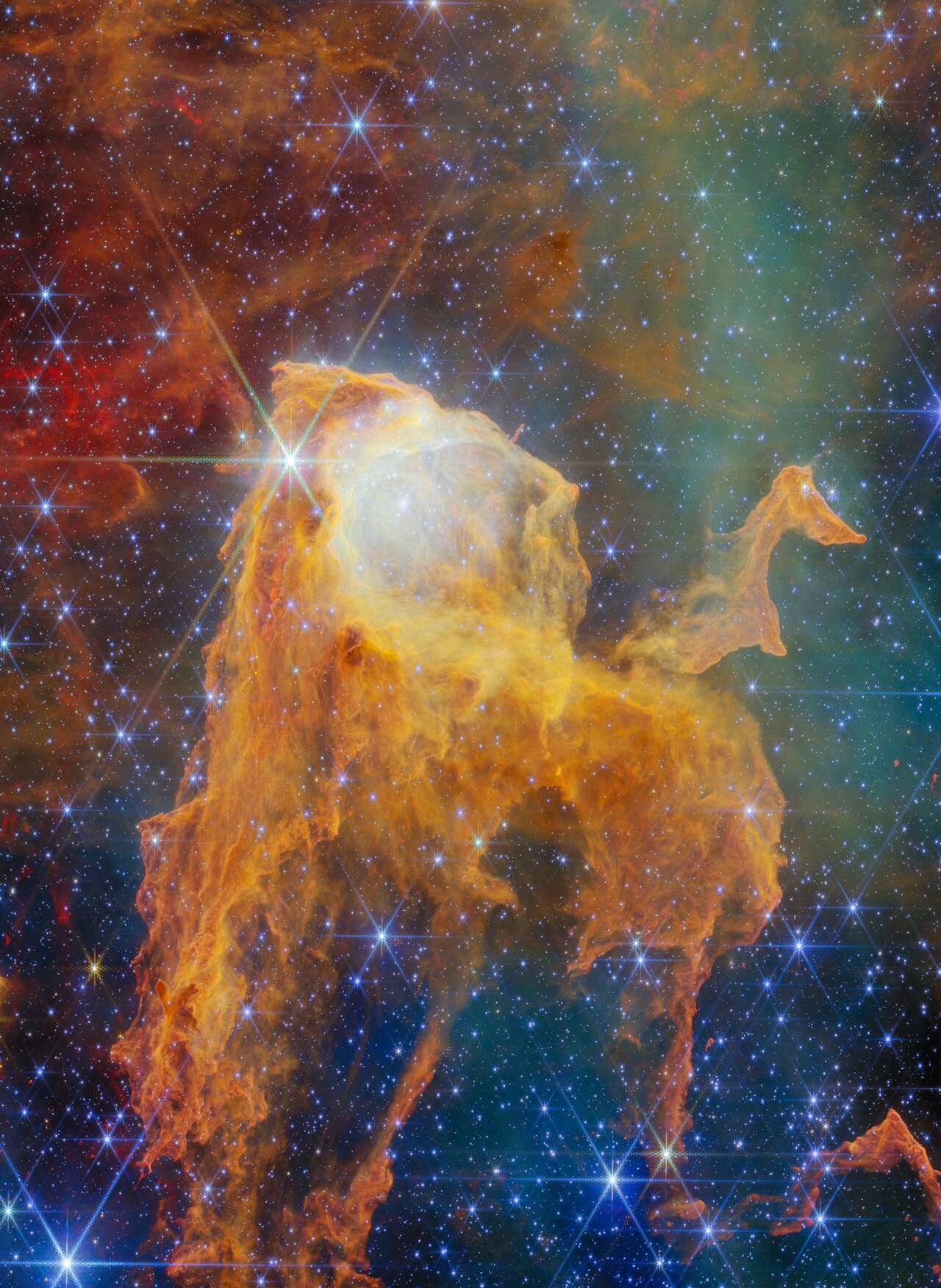
- The NASA/ESA/CSA James Webb Space Telescope Picture of the Month features the Treasure Chest, a cometary globule in the Carina Nebula, which lies about 7500 light-years away.
- Scientific American reports that China's Chang'e 7 mission aims to be the first ever to touch down directly at the moon's south pole, where it will search craters for water ice.
- Blankie is a free ambient sound mixer that ships with 24 built-in sounds and states it has no ads, no subscriptions, no accounts and no tracking.
- The Guardian reports a study, published in Proceedings of the National Academy of Sciences by researchers at Macquarie University and Southern Medical University, in which bumblebees kept extending their tongues after tasting sweet solution.
- NASA's Moon Base under the Artemis programme would be sited near the lunar south pole, as would China's International Lunar Research Station, for which Russia is a major partner.
Compiled by The InvestorSomething wrong?How this is made
Why it matters
What the file actually contains
The angle commissioned for this slot was that a county commission has become the marginal gating authority on compute, and that operators now hire public-affairs staff before releasing capital. None of the supplied material supports any part of it. The pile is a James Webb Picture of the Month showing a cometary globule called the Treasure Chest in the Carina Nebula [1], a Scientific American report on China's Chang'e 7 mission to the lunar south pole [2], the feature page for a free ambient sound mixer that ships 24 sounds with no subscription or account [3], and a Guardian account of bumblebees that keep extending their tongues after tasting sugar solution, published in PNAS by researchers at Macquarie University and Southern Medical University [4]. There is no county, no substation, no interconnection queue and no operator anywhere in it. Writing the briefed piece would mean manufacturing the evidence, so it is not written.
What the file does contain is one story with the structure the brief was reaching for: two capital programmes whose siting depends on a measurement neither of them holds, and only one of the two is about to take it.
The measurement both moon bases are waiting on
NASA's Artemis Moon Base would sit near the lunar south pole, and so would China's International Lunar Research Station, for which Russia is a major partner [5]. Both plans lean on the same physical premise, because polar ice could be worked into rocket propellant or drinking water, which is why its extent matters to each side's outpost design [6]. The premise is not seriously contested at the level of existence: Simone Dell'Agnello of Italy's National Institute for Nuclear Physics tells Scientific American there are big reservoirs of ice water at the poles [8]. What nobody has is the quantity or the distribution across the polar terrain [7].
That gap is the whole point. A base sited on the assumption of accessible ice, in a place where the ice turns out to be thin, sparse or buried in the wrong craters, is a base that has to import its consumables. And the datum that would resolve it has never been collected on the surface. Norbert Schorghofer of the Planetary Science Institute puts it flatly: there has never been a landed mission to find water on the moon [9]. The closest prior evidence is inferential, from NASA crashing a rocket into a polar crater in 2009 and observing a plume of water vapour; no spacecraft has descended into those shadowed craters [16].
So one programme's engineering assumption is about to be priced by the other programme's hardware. Rajeswari Pillai Rajagopalan of the Australian Strategic Policy Institute frames it as intensifying competition in which Chang'e 7 could collect much of the data both nations want on finding water [24].
The hopper is the load-bearing component
Read the mission architecture and the risk concentrates fast. Chang'e 7 comprises an orbiter and a lander carrying both a rover and a hopping robot [25]. The lander will set down at a flat, sunlit location that the China National Space Administration selects only once the spacecraft is in orbit, and the rover works from there with cameras, subsurface radar and soil examination [13]. But the ice is not where the sunlight is. It is in smaller depressions near Shackleton Crater that never see sunlight and sit a few dozen degrees above absolute zero [12]. The rover, tied to the sunlit landing zone, cannot reach the answer.
The hopper can. It fires a rocket thruster to jump up to 15 kilometres at a time into permanently shadowed craters, walks on six legs to ground its own plume has not disturbed, and carries a drill [14]. Shackleton is 21 kilometres across, with a rim that grazes the pole, and no spacecraft has ever landed as close [11]. One hop therefore spans roughly 71 percent of the target crater's diameter [21], which sets the search geometry: coverage is a function of how many times the vehicle can survive taking off and landing, not of how far it can travel in any single leap.
That is a lot of programme value resting on a class of vehicle with almost no flight history. On success, Chang'e 7's hopper would be only the second vehicle after NASA's Ingenuity helicopter on Mars to perform multiple flights on another world [15]. Scientific American also notes a 2025 mission led by Intuitive Machines that attempted to deploy a hopper called Micro Nova on the surface; the supplied text breaks off mid-sentence there, so the outcome is not something this desk will characterise [17].
The schedule tells you where the risk sits
The launch is on a Long March 5 from the Wenchang site on Hainan, with the window opening on the morning of 24 August local time, the evening of 23 August EDT [18]. Transit takes up to six days to lunar orbit, followed by two months of preparation for a November landing [19]. Preparation in orbit therefore runs about ten times as long as the cruise [20]. The hard part of this mission is not getting there. It is everything that happens after arrival, including a landing site that is not chosen until the spacecraft is already overhead and able to look [13].
That deferral is the discipline the compute-permitting angle wanted to claim without evidence: commit the irreversible decision after the gating input has been measured, not before. Here it is written into the flight plan.
The constraint no survey can relieve
If Chang'e 7 does return the first surface-measured picture of polar ice, the United States cannot buy its way into that dataset through partnership. Congressional legislation mostly forbids NASA from collaborating with China, and Scientific American reports a joint lunar effort looks out of reach for now [22]. Meanwhile Chang'e 7 carries equipment from several international partners [23], so the access barrier is specific rather than general.
The consequence is narrow and unavoidable. The asset in question is informational, it will be held by the one party the other is barred from working with, and the barred party's own base siting depends on the same physics. Schorghofer's assessment is that success would make China the leader in lunar science and, setting aside the crewed Apollo landings of more than half a century ago, would put it ahead of everyone including the United States in lunar exploration in the short term [10]. Whether or not that ranking holds up, the operational point stands: a survey you cannot obtain is a survey you have to repeat, and repeating this one means flying your own vehicle into a permanently shadowed crater.
Claim ledger
Ranked by verification strength, evidence, and original report placement.
- [1]
The NASA/ESA/CSA James Webb Space Telescope Picture of the Month features the Treasure Chest, a cometary globule in the Carina Nebula, which lies about 7500 light-years away.
ReportedView cited source - [2]
Scientific American reports that China's Chang'e 7 mission aims to be the first ever to touch down directly at the moon's south pole, where it will search craters for water ice.
ReportedView cited source - [3]
Blankie is a free ambient sound mixer that ships with 24 built-in sounds and states it has no ads, no subscriptions, no accounts and no tracking.
ReportedView cited source - [4]
The Guardian reports a study, published in Proceedings of the National Academy of Sciences by researchers at Macquarie University and Southern Medical University, in which bumblebees kept extending their tongues after tasting sweet solution.
ReportedView cited source - [5]
NASA's Moon Base under the Artemis programme would be sited near the lunar south pole, as would China's International Lunar Research Station, for which Russia is a major partner.
ReportedView cited source - [6]
Because lunar ice might be used for manufacturing rocket fuel or making potable water for astronauts, answering questions about its size and distribution is key for the competing US and Chinese plans to construct crewed lunar outposts.
ReportedView cited source
Sources & coverage · 4 publishers
The reporting this story was synthesized from, earliest first. Every link goes to the original.
- esawebb.org2d agostunning image
- scientificamerican.com2d agoScientific American
- blankie.rest2d agofree ambient sound mixer