Published Build3 min read
The Rung That Isn't There: Allan's Case That Managers Now Have to Manufacture Practice
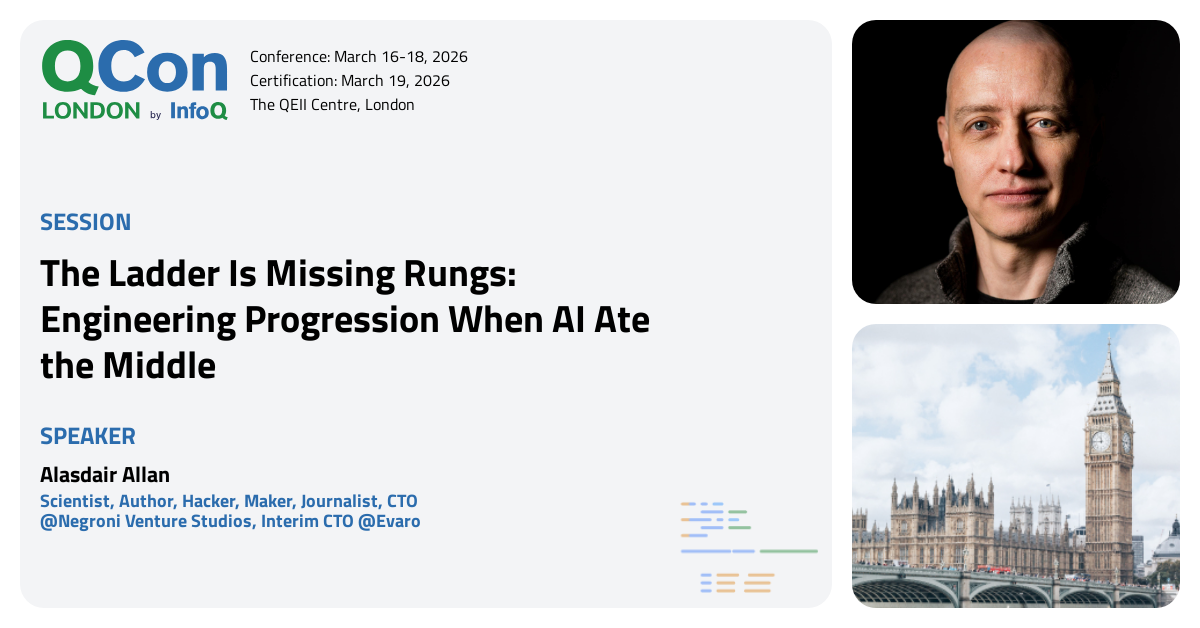
At QCon London, Alasdair Allan argued AI is removing the work that used to train juniors while letting them look senior.
Written for builders.See today for builders
What happened
- In his QCon London talk Engineering Progression When AI Ate the Middle, Alasdair Allan said AI is disrupting career progression by eliminating the learning opportunities at each rung while simultaneously enabling people to perform above their experience level.
- Allan's formulation: AI stunts skill formation, AI transforms work into supervision, and AI slows hiring at the entry level.
- Allan said hiring of young workers has slowed in exposed occupations, while there is no decrease in work for workers over 25, meaning fewer junior developers join the industry.
- Allan: "People weren't being sacked; they just weren't being hired in the first place."
- Using AI requires supervision, and supervision requires coding skills, Allan said; AI productivity benefits may come at the cost of the skills needed to validate AI-written code if junior skill development has been stunted.
Compiled by The EngineerSomething wrong?How this is made
Why it matters
At QCon London, in a talk titled Engineering Progression When AI Ate the Middle, Alasdair Allan argued that AI is eliminating the learning opportunities at each rung of the engineering ladder while simultaneously enabling people to perform above their experience level [1]. The consequence for anyone running a team is that the practice which used to arrive free with a promotion now has to be put on a calendar by a manager. Allan stacks the mechanism in three parts: AI stunts skill formation, AI transforms work into supervision, and AI slows hiring at the entry level [2]. The third is the part managers do not control. Hiring of young workers has slowed in exposed occupations, Allan said, with no decrease in work for workers over 25 [3]. His phrasing: "People weren't being sacked; they just weren't being hired in the first place" [4]. Supervision is the load-bearing word. Using AI requires supervision, and supervision requires coding skills [5]. Allan sizes the gap with Anthropic's own engineers, who he says use Claude in 59% of their daily work but can fully delegate only around 20%, and he places the future of the job in that gap, between generation and judgment [6]. That is 39 percentage points of work that still needs a human verdict [7]. The quality evidence he cites is not flattering in either direction. METR's randomised controlled trial found experienced developers were 19% slower with AI while believing they were 20% faster [8], a 39 point spread between measured and felt performance [9]. Anthropic found junior engineers using AI scored 17% lower on mastery without finishing any faster, which Allan describes as trading learning for nothing [10]. On real open-source projects, zero out of fifteen AI-generated pull requests were mergeable despite passing automated tests [11]. Allan's summary: AI implements functionality, and fails at craft [12]. He also says the gains collapse as complexity rises, with the bottleneck migrating upstream into code review, which is exactly where senior judgment lives [13]. What juniors lose is specific. They will not spend years reading legacy codebases or debugging production incidents at 3 a.m., Allan said; they will point the agent at it and ask for a summary [14]. The pattern recognition that used to come out of that, how systems should be structured, where complexity hides, what breaks at scale, can no longer be acquired traditionally [15]. Allan also says 80 to 90% of engineering questions now go to AI rather than to colleagues, which bypasses the incidental learning of struggling through a problem with a mentor [16]. That matters because most engineering is what he calls blackfield: legacy systems under high load, on a deprecation path everyone agrees on but nobody has time to execute, with business rules encoded in conditions that outlived everyone who understood them [17]. Agents can read the code and test the documentation, Allan said, but they cannot read production, and cannot look at years of request patterns to work out which code paths are load-bearing in ways the code itself does not reveal [18]. The people who can build good contexts for AI are people who carry context in their heads from years of craft, and the pipeline that produced them is breaking [19]. His prescription is the medical residency: you do the scut work because it teaches you, not because it is efficient [20]. Read as a management instruction, that means deliberately keeping work an agent could finish faster and routing it to the person who will learn from it. Allan claims the companies that do this will be the ones with senior developers left in ten years [21]. What to watch: whether any organisation publishes an actual replacement for the old ladder. Allan's closing point is that the career pipeline was built for people who write code and has not been rebuilt for people who supervise it [22].
Claim ledger
Ranked by verification strength, evidence, and original report placement.
- [1]
In his QCon London talk Engineering Progression When AI Ate the Middle, Alasdair Allan said AI is disrupting career progression by eliminating the learning opportunities at each rung while simultaneously enabling people to perform above their experience level.
- [2]
Allan's formulation: AI stunts skill formation, AI transforms work into supervision, and AI slows hiring at the entry level.
- [3]
Allan said hiring of young workers has slowed in exposed occupations, while there is no decrease in work for workers over 25, meaning fewer junior developers join the industry.
- [4]
Allan: "People weren't being sacked; they just weren't being hired in the first place."
- [5]
Using AI requires supervision, and supervision requires coding skills, Allan said; AI productivity benefits may come at the cost of the skills needed to validate AI-written code if junior skill development has been stunted.
- [6]
Allan said Anthropic's engineers use Claude in 59% of their daily work but can only fully delegate around 20%, and that the gap between generation and judgment is where the jobs will live in future.
Sources & coverage · 1 publisher
The reporting this story was synthesized from, earliest first. Every link goes to the original.
- infoq.comBen LindersAug 13How Artificial Intelligence Disrupts Engineering Progression
Additional citations
- Alasdair Allan, reported by InfoQ
- Alasdair Allan
- Alasdair Allan, citing Anthropic
- Alasdair Allan, citing METR