Published Build3 min read
Suno Studio 2.0 adds MIDI, a wavetable synth and sidechain compression in the browser
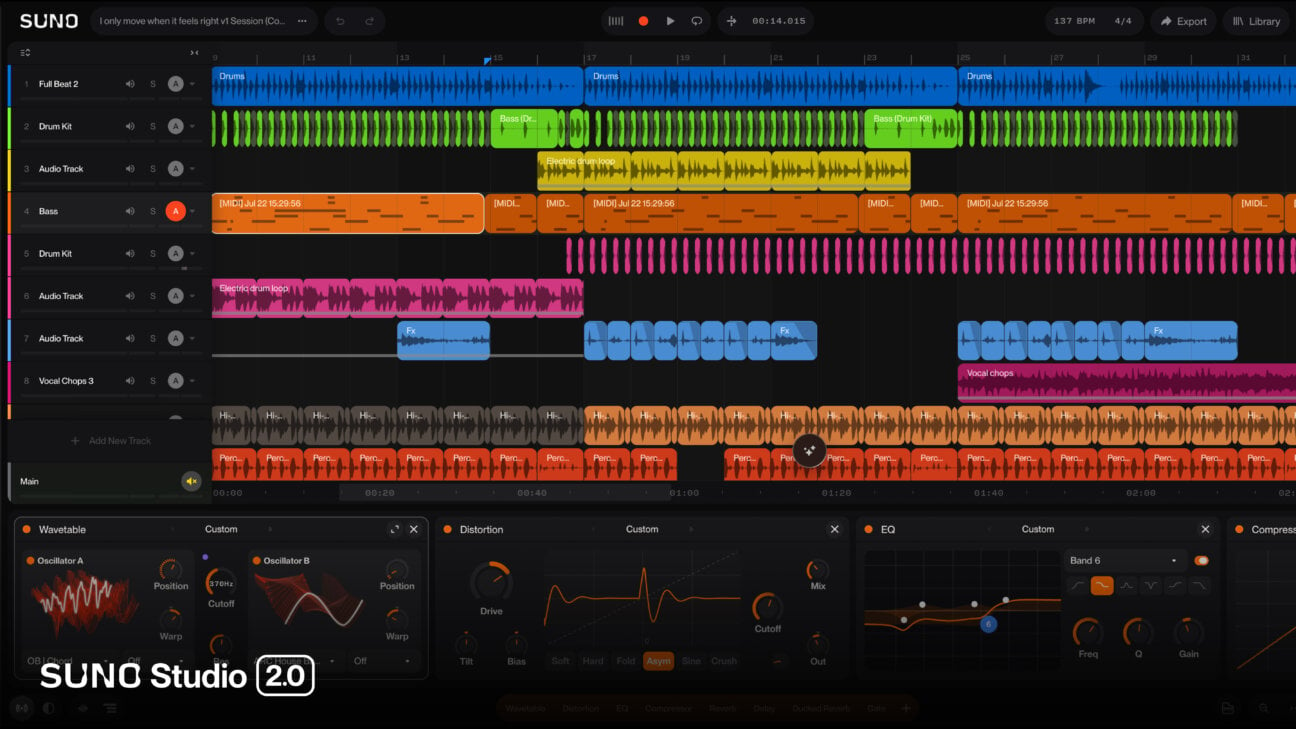
The August 13 release for Premier subscribers adds note-level editing, an effects layer and parameter automation, which changes what a generated track is for.
Written for builders.See today for builders
What happened
- Suno released Studio 2.0 on August 13, available to Premier subscribers.
- Studio 2.0 adds MIDI tracks, built-in synthesizers, audio effects, parameter automation and a chat bar that can create sounds, presets and plugins, expanding Suno's browser-based generative audio workstation.
- Studio 2.0 lets users create and edit MIDI tracks, play built-in instruments with a computer keyboard or an external MIDI controller, and map controller inputs to transport and plugin parameters.
- Suno added a wavetable synthesizer for basses, leads, pads and chords, along with musical-typing modes for chords and arpeggios.
- The effects layer includes tools such as sidechain compression and convolution reverb.
Compiled by The EngineerSomething wrong?How this is made
Why it matters
Suno shipped Studio 2.0 on August 13 to Premier subscribers, adding MIDI tracks, built-in synthesizers, audio effects and parameter automation to its browser-based workspace [1][2]. The interesting part is not the generation, which Suno already had, but the fact that the output now lands next to editable notes, instruments and effects rather than arriving as a finished file [2][11].
Read the feature list as an architecture disclosure. Parameter automation means settings can change over time [7], which requires a timeline that stores values per parameter rather than one static state per plugin. Sidechain compression, listed alongside convolution reverb in the effects layer [6], is harder to fake: it needs a trigger input separate from the audio being processed, which implies some form of internal routing between tracks. Convolution reverb implies impulse-response loading and the CPU or WASM budget to run it in a tab. Those three together describe something closer to a mixer than an export pipeline.
The input side moved too. Users can create and edit MIDI tracks, play the built-in instruments from a computer keyboard or an external MIDI controller, and map controller inputs to transport and plugin parameters [4]. Suno added a wavetable synthesizer aimed at basses, leads, pads and chords, plus musical-typing modes for chords and arpeggios [5]. Controller mapping to transport is the small tell that someone on the team has actually tracked a part: it is a convenience nobody asks for until they are recording.
Context matters for judging the pace. Suno introduced the original Studio in September 2025 as a multitrack workspace for arranging audio, generating stem variations and exporting to other production software [10]. Studio 2.0 pulls note-level MIDI creation and effect design into the same browser session [11]. Worth noting that the source dates the 2.0 release only as August 13 with no year given, so the gap between the two releases cannot be stated precisely [14].
The chat bar is where the claims get softer. According to Suno's announcement, it can generate sounds, design synth presets, create custom plugins and answer questions about the workspace [8]. The Verge reported that these additions are part of Suno's effort to make Studio resemble a fuller production environment combining generative audio with direct editing and mixing controls [9]. "Create custom plugins" is doing a lot of work in that sentence. The reporting does not establish how reliably chat-generated plugins or presets behave across complex projects [12], and there is no stated answer on what a generated plugin is, where it lives, or whether it survives a session reload.
What to watch, in order of how quickly it will bite: controller latency in a browser, automation accuracy, plugin stability, MIDI editing behaviour and export compatibility with established desktop tools, all of which the source flags as requiring hands-on testing [13]. Access is gated to the Premier tier, which limits who can run those tests [1]. The specific question for anyone with a real session: does a project built here open somewhere else, and does the automation survive the trip [10][13].
Claim ledger
Ranked by verification strength, evidence, and original report placement.
- [1]
Suno released Studio 2.0 on August 13, available to Premier subscribers.
- [2]
Studio 2.0 adds MIDI tracks, built-in synthesizers, audio effects, parameter automation and a chat bar that can create sounds, presets and plugins, expanding Suno's browser-based generative audio workstation.
ReportedView cited source - [4]
Studio 2.0 lets users create and edit MIDI tracks, play built-in instruments with a computer keyboard or an external MIDI controller, and map controller inputs to transport and plugin parameters.
ReportedView cited source - [5]
Suno added a wavetable synthesizer for basses, leads, pads and chords, along with musical-typing modes for chords and arpeggios.
ReportedView cited source - [6]
The effects layer includes tools such as sidechain compression and convolution reverb.
ReportedView cited source - [7]
Parameter automation allows settings to change over time, bringing the workflow closer to the control producers expect from a digital audio workstation rather than a prompt-only music generator.
ReportedView cited source
Sources & coverage · 1 publisher
The reporting this story was synthesized from, earliest first. Every link goes to the original.
- letsdatascience.comAug 13Suno Studio 2.0 Adds MIDI, Effects and a Production Chat Bar
Cited in this coverage: letsdatascience.com report on Suno's release
Cited in this coverage: Suno's announcement, as reported by letsdatascience.com
Cited in this coverage: The Verge, as cited by letsdatascience.com