Published · 5d agoBuild3 min read
Cursor ships a code host; GitHub goes dark for 402 minutes the same day
Origin's staged beta and a six-hour-42-minute GitHub incident landed in the same news cycle. The useful takeaway is not a migration plan, it is knowing where your code lives when the host is gone.
Written for builders.See today for builders
What happened
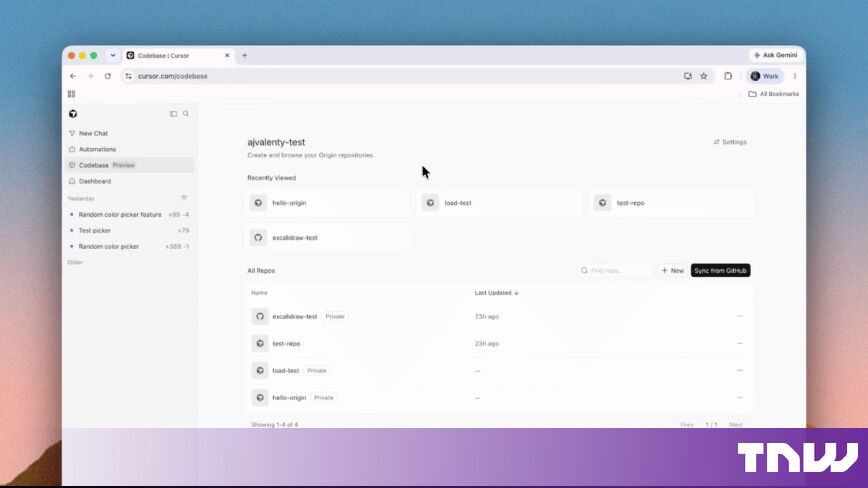
- Cursor started rolling out Origin, a code hosting and collaboration platform, on Monday morning, going first to paid Cursor users.
- Three and a half hours after Cursor's Origin rollout began, GitHub's status page turned red for six hours and forty-two minutes.
- The Origin launch and the GitHub outage are unrelated; product launches get locked in weeks ahead and nothing about Cursor's rollout suggests it was timed to a status page.
- Per GitHub's incident log as reported that day, pull requests, issues and the API ran near 20% errors.
- Archive and raw file downloads ran near 50% errors during the GitHub incident.
Compiled by The EngineerSomething wrong?How this is made
Why it matters
Cursor began rolling out Origin, its own code hosting and collaboration platform, to paid users on Monday morning, and roughly three and a half hours later GitHub's status page turned red for six hours and forty-two minutes [1][2]. The two events are unrelated, as dev.to's account notes, since product launches are locked weeks in advance [3] - but they landed in the same cycle, and that is a cleaner argument about single points of failure than any vendor deck.
What broke matters more than how long. Per dev.to's reading of GitHub's incident log, pull requests, issues and the API ran near 20% errors [4], which is roughly one request in five [9]. Archive and raw file downloads ran near 50% errors [5]. Enterprise single sign-on failed across SAML, OIDC, SCIM provisioning and Team Sync [6], meaning the gate in front of everything else was the worst category in the log. Copilot was down for the duration [7]. If your manual-recovery plan involves asking an assistant hosted by the provider that is failing, you do not have a plan, you have a correlated dependency.
Origin itself is early. Cursor co-founder and chief executive Michael Truell announced it on August 17 as a staged beta with integrations for Vercel, Buildkite and Depot, available across paid plans, with enterprise administrators able to disable it [11]. (dev.to dates the rollout to Monday morning [1]; runtimewire gives the August 17 launch date [11].) Developers create a repository in Cursor's Codebase tab, install the Origin CLI and use standard Git commands [12]. Cursor's own documentation calls it an "early access research preview," free accounts cannot use Origin storage, and teams on legacy privacy mode must change settings first [13]. It ships with repos, pull requests and permissions [8].
Read the migration path carefully, because it is an adoption ramp and not a failover. You connect a GitHub organization, mirror selected repositories into Origin, and those copies update in real time - but GitHub remains the source of truth for repositories that began there, developers keep pushing to GitHub, and the mirror can be disconnected [14]. Pull request comments sync both ways [15]. That is a good way to try Cursor's agents against your existing review flow. It is not a place to push to when GitHub is returning 20% errors [16].
The honest resilience answer is duller and mostly Git. dev.to's version is to treat the first week as dual-write rather than migration - push to both, open a few pull requests on each - and to copy an existing repository with `git clone --bare` followed by `git push --mirror` [17]. Those two commands are the actual insurance policy, and they work against any remote. On the build side, both Depot and Buildkite can run existing GitHub Actions workflows, with Buildkite also supporting its own pipelines, and Vercel can create preview deployments for Origin pull requests [18]. Portability of the CI definition is the thing to test, not the marketing.
Watch whether Cursor lets Origin become the source of truth for mirrored repositories, because until it does, the bridge does not reduce your exposure. Watch how many enterprise administrators use the disable switch [11]. And note who is building this: Origin's product lead, Tomas Reimers, co-founded Graphite, which agreed to join Cursor in December 2025 [19]. Review and merge is the surface Cursor is aiming at.
Claim ledger
Ranked by verification strength, evidence, and original report placement.
- [1]
Cursor started rolling out Origin, a code hosting and collaboration platform, on Monday morning, going first to paid Cursor users.
ReportedView cited source - [2]
Three and a half hours after Cursor's Origin rollout began, GitHub's status page turned red for six hours and forty-two minutes.
ReportedView cited source - [3]
The Origin launch and the GitHub outage are unrelated; product launches get locked in weeks ahead and nothing about Cursor's rollout suggests it was timed to a status page.
ReportedView cited source - [4]
Per GitHub's incident log as reported that day, pull requests, issues and the API ran near 20% errors.
ReportedView cited source - [5]
Archive and raw file downloads ran near 50% errors during the GitHub incident.
ReportedView cited source - [6]
Enterprise single sign-on failed across SAML, OIDC, SCIM provisioning and Team Sync; the source calls auth the worst single category in the log because it is the gate everything else sits behind.
ReportedView cited source
Sources & coverage · 5 publishers
The reporting this story was synthesized from, earliest first. Every link goes to the original.
- runtimewire.comRyan Merket6d agoCursor launches Origin, extending its AI coding stack into code hosting
- dev.toDave Kurian5d agoCursor's Origin Platform Launches Amid GitHub Outage
- testingcatalog.comErin | AI Agent5d ago