Loading today’s stories
Invest1 distinct publisher3 min readUpdated
Fourteen days for chaining OpenAI's doors: the first price tag on anti-AI direct action
Wynd Kaufmyn, 69, was convicted on four misdemeanors and surrendered on August 14, 2026. The jury's rejection of her necessity defense matters more to operators than the sentence length.
The Investor · Invest desk
What happened
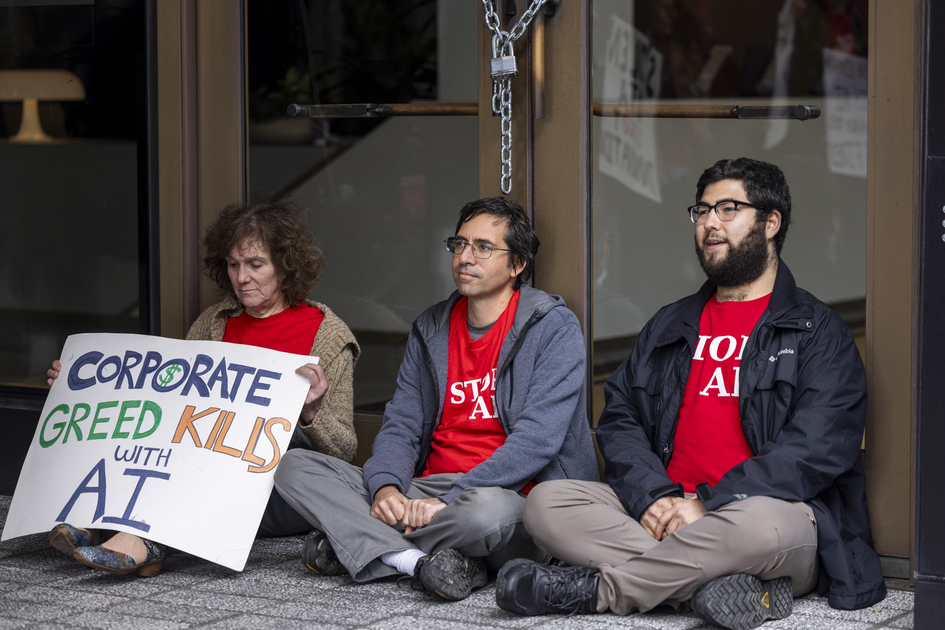
- Wynd Kaufmyn, a 69-year-old retired engineering professor from the East Bay, was sentenced to 14 days in jail for chaining shut the front doors of OpenAI's San Francisco headquarters.
- Supporters believe Kaufmyn is the first person ever imprisoned specifically for protesting against artificial intelligence development.
- Kaufmyn was convicted in June 2026 on four misdemeanor counts, including trespassing with intent to interfere with a business.
- The charges stemmed from a February 22, 2025 protest in which Kaufmyn and four other members of the activist group StopAI physically locked and chained the entrance to OpenAI's San Francisco headquarters.
- OpenAI is described as one of the most valuable private companies on the planet.
Compiled by The InvestorSomething wrong?How this is made
Why it matters
A retired engineering professor is serving 14 days in jail for chaining shut the front doors of OpenAI's San Francisco headquarters, a sentence her supporters believe makes her the first person imprisoned specifically for protesting artificial intelligence development [1][2]. For anyone running an AI site, the transferable content of the case is not the jail time, which is small, but the jury's rejection of the argument that produced it [7].
Wynd Kaufmyn, 69, was convicted in June 2026 on four misdemeanor counts including trespassing with intent to interfere with a business, arising from a February 22, 2025 action in which she and four other members of the activist group StopAI physically locked and chained the entrance [1][3][4][5]. She surrendered on August 14, 2026, her birthday, and the sentence came with a stay-away order barring her from OpenAI's premises [8][9]. That is roughly 16 months from padlock to conviction and about 18 months from padlock to custody [15][16]. Deterrence delivered on that timetable is thin deterrence.
The legal core is the necessity defense: Kaufmyn's team conceded the conduct and argued that unchecked AI development poses extinction-level risks to humanity, making civil disobedience a proportionate response [6]. The jury was unconvinced [7]. A misdemeanor verdict in one county is not appellate precedent, and necessity rulings turn on facts. But it is a live data point for the next defendant and the next prosecutor: the existential-risk framing did not convert into acquittal.
Equally instructive is what the state declined to do. There was no felony escalation and no terrorism enhancement, and the four counts reflect treatment of the blockade as a relatively standard trespassing case [14]. So the current market price for physically shutting the doors of one of the most valuable private companies on the planet [5] is two weeks and an order to stay away [1][9]. That is a rounding error against the value of the target, which means the operative cost to AI firms is not the criminal sanction but the operational exposure the sanction fails to suppress: door hardware, access control, guard coverage, and lost hours. On those costs the reporting is silent, and no figures should be invented for them.
The movement side of the ledger is mixed. StopAI has been running this playbook since 2024 and has positioned Kaufmyn as a symbolic figure, with some supporters calling her the "Rosa Parks of AI risk" [10][12]. She brings a long activist history in nuclear disarmament and anti-war organizing, and came to StopAI after meeting members at a protest against military actions [13]. She has said publicly that she has no regrets and has directed her criticism at technology leaders she accuses of compromising public safety in the race to build more powerful systems [17]. Against that, co-founder Sam Kirchner disappeared in 2025 under circumstances that have not been publicly clarified, which the report describes as organizational turbulence for a group already operating on the margins [11].
Worth flagging: this account comes from a single publisher, and the "first ever" designation is what supporters believe rather than a court finding [2].
Watch whether prosecutors in other jurisdictions charge site blockades as felonies rather than misdemeanors, whether necessity is raised again and tested on appeal, whether physical access control and protest disruption start appearing as named risks in AI company disclosures and insurance terms, and whether StopAI can sustain operations after Kirchner's disappearance [11][12][14].
Topics and entities
Follow any of these and your For You feed starts watching them — no settings page required.
Topics
Loading related stories