Loading today’s stories
Product1 distinct publisher2 min readUpdated
United's Denver simulator hall has a ceiling, and it is about 24,000 pilots
86 devices, 32,000 training events a year, and a nine-month recurrent cycle for 18,000 pilots. The arithmetic leaves roughly a quarter of the plant for hiring.
The Product Desk · Product desk
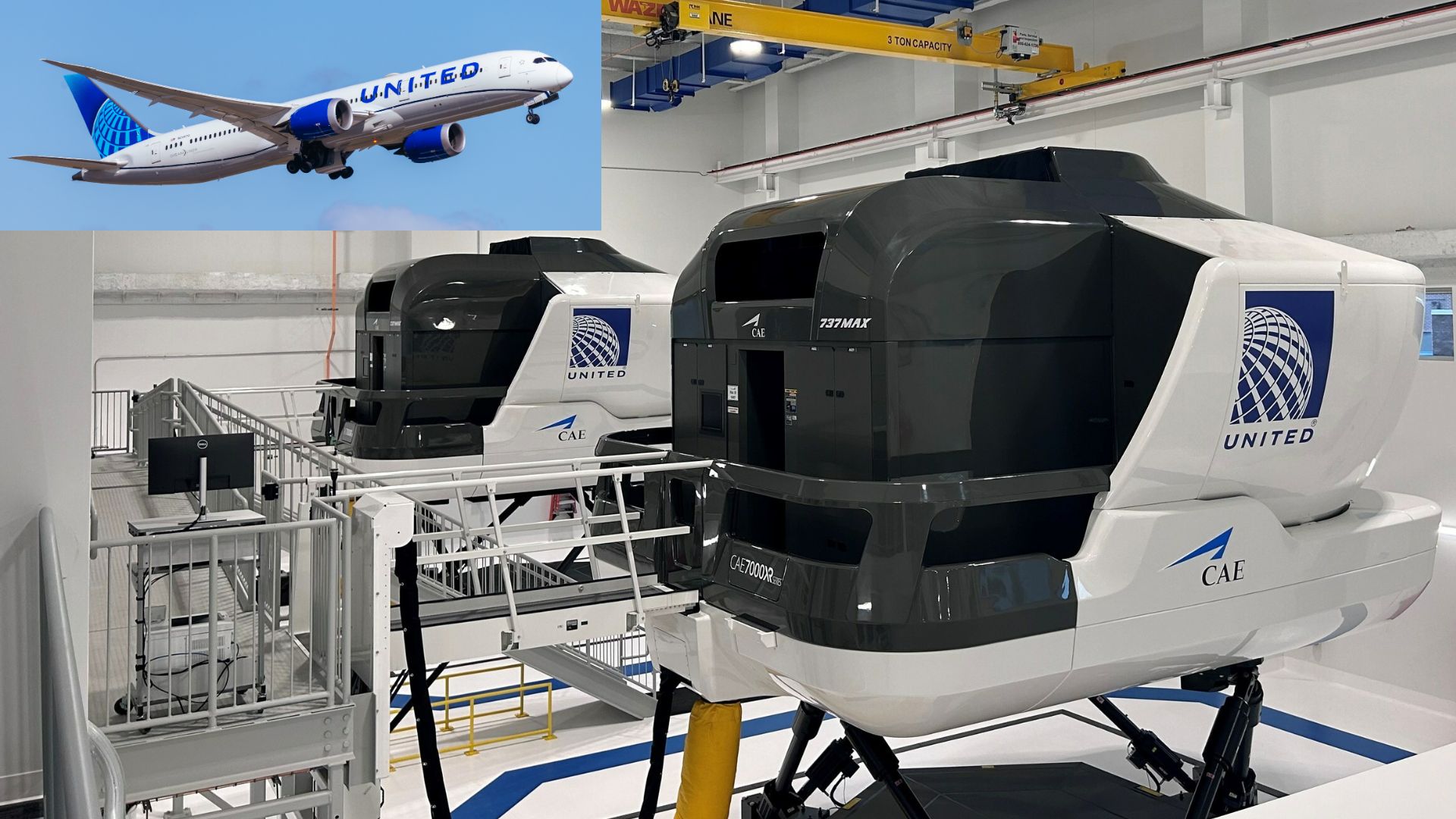
What happened
- United Airlines completed the first phase of an expansion at its Denver Flight Training Center, pushing the simulator fleet to 86 training devices with capacity to train up to 860 pilots each day.
- The complex is nearly 700,000 square feet and is described as the world's largest pilot training facility.
- United now operates 52 full-motion flight simulators alongside 34 fixed training devices.
- The expansion added 40 CAE-built training devices since 2022.
- Together the devices can support more than 32,000 training events each year.
Compiled by The Product DeskSomething wrong?How this is made
Why it matters
Start with the obligation the airline cannot defer. Every one of the roughly 18,000 active pilots the center serves has to be back in a box every nine months to keep a certificate current [8][6]. That is 1.33 visits per pilot per year, or about 24,000 recurrent events against a stated ceiling of more than 32,000 [1][5]. Recurrent work is three quarters of the plant before a single new hire is qualified [1]. The remainder, roughly 8,000 events, has to absorb initial qualification and fleet transitions [3].
Run the same numbers backwards and the ceiling gets specific. Thirty-two thousand events a year supports about 24,000 pilots doing nothing but recurrent training [2]. That is 6,000 above the current population, a third more pilots [2], and it assumes the initial-qualification queue vanishes, which it cannot, because every added pilot arrives through it first [6].
There is also a measurement problem sitting in the same announcement. Capacity for 860 pilots a day across 362 operating days is 311,320 pilot-days a year, close to ten times the 32,000 events figure [4]. Per device, the two numbers describe 10 pilots a day but only about 372 events a year, which is roughly one per device per calendar day [6][7]. An event, then, is a multi-day qualification rather than a session. Anyone sizing United's training ceiling should work from the events number, since that is the one that maps onto the nine-month cycle.
Cost is reported with the same looseness. The publisher's headline prices 86 simulators at $145 million [16], while its own text attaches the figure to one building that opened in 2024 and counts 40 CAE devices added since 2022 [14][4]. What the 86-device fleet cost is not in the material. The recurring number is clearer and larger in the long run: more than 1,600 people at the site covering instruction, evaluation, scheduling and hiring [9], keeping 86 devices lit around the clock for 362 days [7]. At 209 pilots per device [5], instructor and evaluator supply is a constraint on the same order as the bays themselves.
Which is why the phase-two calendar is the operative fact. United bought the land in 2023, had two parcels near the airport rezoned by Denver City Council in July, expects to break ground in 2027 and expects service around 2030 [12][13]. That is about seven years from purchase to first session, with three of them construction [8]. Simulator capacity arrives on a building schedule, and the pilot headcount United can carry in the early 2030s is being decided against concrete nobody has poured yet [17].
Loading topic controls
Loading related stories