Product1 distinct publisher3 min readPublished
The Austrian tester says state of health varies by as much as 13.5 percent between the best and worst examples of one model, which turns battery condition from a cohort assumption into a per-car inspection line, sold by the company that found it.
The Product Desk · Product desk

Compiled by The Product DeskSomething wrong?How this is made
A remarketing manager with a lane full of same-model EVs coming back off lease prices them from one grid: year, mileage, trim. AVILOO's finding says that grid can be wrong by 13.5 points of state of health between the best and worst car on the lot [2], and the company's chief executive, Marcus Berger, argues there is no way to tell which car is which without testing it independently [3].
The mechanism is ordinary, which is why it will persist. AVILOO says smaller-battery cars, which need more charging cycles to cover the same distance, degrade faster than larger-pack models [9], and its dataset covers North and South America, Europe, Australia and Asia partly to capture what climate does to a pack [8]. Same badge, different weather and different charging habits, and the model average stops describing any car you can actually put on a truck.
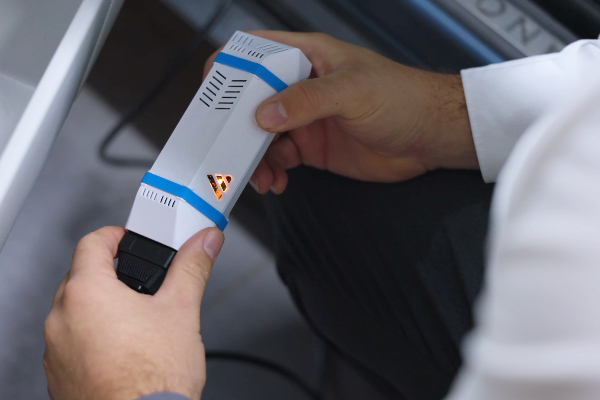
The other half of the argument is about who holds the tape measure. The Austrian company's FLASH Test [17] reads the car through its OBD port in three minutes and estimates health with trained models instead of repeating the dashboard figure [4], and its case, per the release, is that a manufacturer's software can report state of health differently from make to make [10][20]. For a desk comparing two brands in one spreadsheet, that inconsistency is the underlying problem, and the variance number sits downstream of it.
The scale survives division. More than 500,000 tests across 20 models [1] averages about 25,000 tests per model [11], enough to trust a median. That scale comes with a couple of gaps worth flagging, though. The study uses roughly half of the million-plus tests in AVILOO's wider database [12] because it counts only certified vehicles [13], and the announcement gives neither the per-model medians it says it calculates [16][6] nor a price for the test [7]. That leaves an operator holding the claim that variance is expensive without either input needed to price a response.
AVILOO sells the remedy alongside the diagnosis, including a financially backed battery warranty launched across Europe this summer [5], with the report itself on a twice-yearly cadence [14]. Vendor-funded data can still be accurate, and the useful discipline is noticing which number the vendor chose to lead with.
The audience for this is narrower than the release implies. A private buyer gets a bargaining chip. The desks that need it are the ones carrying thousands of batteries they will never drive, and for them the calculation turns on what 13.5 points of state of health does to your price. If that exceeds the cost of a three-minute test, per-unit testing pays, and if it does not, a cohort discount wide enough to cover the worst car is cheaper administration. Then there is the question of who eats the variance after the car is sold on. A lessor or a warranty writer holds it for years and has reason to pay for measurement. A dealer turning the unit in thirty days is buying certainty for somebody else's balance sheet, which is how inspection costs end up in the wrong place.
Ranked by verification strength, evidence, and original report placement.
AVILOO said the current edition of its study covers more than 500,000 independent tests on AVILOO Certified vehicles from 2022 to 2026 across 20 popular EV models.
AVILOO CEO Marcus Berger said a gap of ten or fifteen percent in state of health is a real difference in range, in what a car is worth and in what you can rely on it for, and that you cannot know where your car sits in that range without testing it independently.
The AVILOO FLASH Test is described as an independent three-minute diagnostic performed via the vehicle's OBD port that calculates battery health using trained models rather than relying on the vehicle's own dashboard reports.
AVILOO launched its Battery Warranty across Europe this summer, giving buyers of used EVs a financially backed guarantee on battery health.
The article does not publish any of the median State of Health figures or per-model results from the study.
The article does not state a price for the AVILOO FLASH Test.
Distinct publishers with included, body-backed reporting in this cluster.
Follow any of these and your For You feed starts watching them — no settings page required.
invest
The pop is not the exit: 13 of Forge's 20 recent VC-backed debuts sit below issue price1 distinct publisher
Evidence-backed comparisons of source perspectives and observed adoption signals. Read the methodology
Which Builder, Operator, and Investor concerns the observed source mix emphasized—not a truth score.
Evidence, demonstrated adoption, hype gap, incentives, and confidence are assessed independently, each on its own current evidence. How these are measured.
One release, no tables
A study said to rest on half a million measurements reaches the reader as a single quantitative fact - 13.5 points - and Interesting Engineering marks its own source as a press release. The medians the report is built on, the models they belong to and the per-model sample depth are all absent, so the strongest finding cannot be checked, only repeated.
Counted by the counter
The volume story is real but entirely self-audited: 500,000 tests here, a million in the database, a warranty live across Europe - every figure from AVILOO. And the sample is circular, since a Certified EV is by definition a car someone already paid AVILOO to test. Not one dealer group, fleet, insurer or lender is named as a user, which is the evidence that would turn these counters into adoption.
Superlative ahead of the data
'World's largest independent study' is a big frame for a release that publishes no results, and the CEO's 'ten or fifteen percent' stretches 1.5 points past the widest gap his own data is said to contain. The underlying idea - that per-car condition beats cohort assumption - is sound and probably understated in the market; the gap sits between the billing and what has actually been shown.
The finder sells the fix
Follow the argument to its conclusion and it lands on a purchase order. The finding is variance; the stated remedy is independent testing; the seller of the test, the certificate and the European battery warranty is the party that found the variance, defined the metric and controls the data. That does not make 13.5 points wrong - it means the number needs an outside check before it prices anything.
Provenance clear, substance unchecked
We can be fairly firm about the shape of this story: one outlet, one release, an explicit press-release attribution, and a well-documented commercial interest. What we cannot judge is whether the 13.5-point spread survives contact with the underlying data, and until the twice-yearly tables actually publish, nobody outside AVILOO can.