Product1 publisher2 min readPublished
Storyworth expands weekly memoir prompt to include phone options
Phone recording has been available at Storyworth since 2013, but the automated transcript only arrived in 2024. Two formats added in early 2026 hand the follow-up question to software or to a relative.
The Product Desk · Product desk
What happened
- Storyworth's original path had the storyteller answer a weekly prompt in writing, by email reply or through an account, and that written route is still available.
- Phone recording dates to 2013 but relied on human transcription; automated transcription arrived in 2024, and Story Calls takes an answer by phone, landline included, transcribed word for word.
- In early 2026 the company added Magic Interviews, which runs the phone conversation, asks follow-up questions, and shapes the exchange into a written narrative added to the memoir.
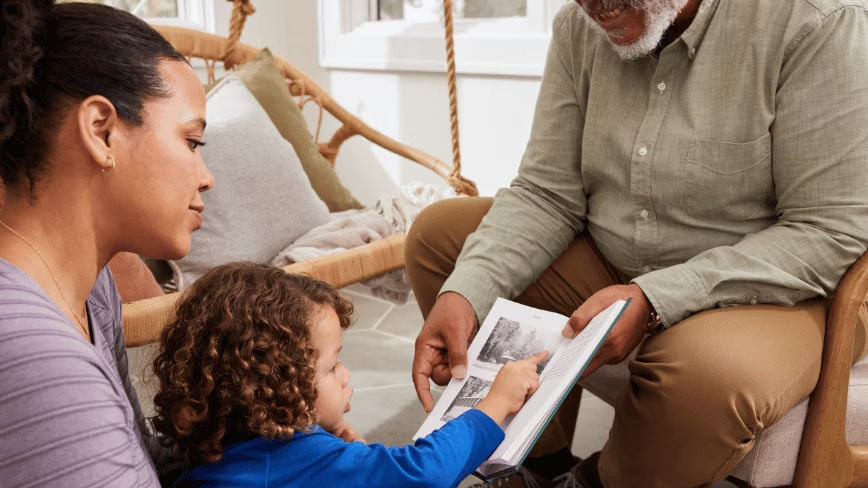
- Family Calls puts a relative or friend on the line to ask questions and add memories, keeps both voices in the recording, and files a cleaned-up transcript into the book.
Compiled by The Product DeskSomething wrong?How this is made
Why it matters
- capability A landline answer takes typing and screens out of the step where storytellers stall, so the parent who never replied to the weekly email can finish an entry without touching a keyboard.
- decision The family decides how much shaping happens between speech and page at the moment of capture, and a verbatim transcript and a polished narrative are different documents to hand down.
- constraint Each follow-up question narrows what the archive ends up holding, and The Next Web says the guided version is not truer for being smoother.
- precedent Automated transcription turned an eleven-year-old channel into a default path. Any team whose users abandon a text box has a worked example in that: change the input medium before adding a model.
The Next Web argues that the form of the question, not the condition of the memory, produces the adjectives: asked to tell his life, a willing storyteller says a childhood was "happy" and a marriage was "good" [10]. A written reply asks that storyteller to compose a paragraph; a call asks him to talk.
Storyworth could take the call in 2013, the year Nick Baum and Krista Baum founded the company after he recorded his 82-year-old father's answers [8][20]. Back then the phone path depended on human transcription [2]. Automated transcription came eleven years later [15]. The channel had been there the whole time, waiting on a cheap way to turn speech into text. The model in the stack did not invent the input medium; it made an eleven-year-old one affordable enough to put in front of everyone.
A verbatim transcript keeps the loops, digressions and phrasing of speech, even when the result is less orderly than written prose, according to The Next Web [11]. The storyteller can revise the text afterwards or add photographs, but the first record is the spoken answer [19].
There are now four ways to answer one weekly prompt: the written reply, the word-for-word call, the guided interview, and the two-person call [16]. For the adult child who set this up for a parent, the choice sets what the family will be able to read in twenty years.
The three phone formats sort on two things: who asks the follow-up, and whether the words survive as spoken. Story Calls: software sends the prompt, the words survive [4]. Magic Interviews: software asks, the exchange gets shaped into narrative [6]. Family Calls: a relative asks, the transcript gets cleaned up [7]. The fourth cell, a relative asking while the record stays verbatim, is not on offer [17]. The Next Web notes that guided conversation does not therefore produce "a deeper or truer memory", because every question places a frame around the past [13].
The Next Web's account does not include completion figures for either route, so the case for the phone is a design argument. The publication's own reading is that the product "is beginning to mediate the act of remembering, not merely preserve its result" [14][18].
Two questions carry over to any product where people quit at a text field. Does the step require the user to compose, and would saying it out loud clear it? When your software tidies what the user gave you, does the untidied version stay in the record? Of Storyworth's three phone formats, only Story Calls answers the second one yes [17].
What to watch
- Whether landline access extends to Magic Interviews and Family Calls, or only to Story Calls, since the account describes the two newer formats as phone conversations without specifying the line.
- Whether Storyworth keeps the raw recording available beside the shaped narrative that Magic Interviews writes into the memoir.
- Whether the conversational formats are priced separately from the hardcover book; the account does not mention pricing.