Loading today’s stories
Product1 distinct publisher3 min readUpdated
Insilico credits its AI with a drug discovery. The patent credits five humans.
Only people can be inventors under US law, so the file on an AI-derived molecule has to show human contribution. Teams that do not document it are building patents someone can challenge.
The Product Desk · Product desk
What happened
- Insilico Medicine used its computer models to propose a promising drug for pulmonary fibrosis and claimed in a press release that the molecule had been "discovered by" its generative AI platform.
- When it came time to file for a patent protecting the new chemical structure, Insilico made no mention of AI; the patent names five humans, including CEO Alex Zhavoronkov, as the drug's inventors.
- US courts concluded that no matter how fundamental an AI is to a discovery, it is humans and only humans who can be credited as inventors for the purpose of winning patent rights.
- Ryan Abbott, a partner at the LA law firm Brown, Neri, Smith & Khan, brought a pro bono test case naming an AI called DABUS as inventor of a better food container, whose intricate geometric surface lets it transfer heat well and stack easily; because no human contributed to the design, Abbott argued the AI should be named inventor.
- In 2022 an appeals court in Washington, DC, said such "metaphysical matters" were beside the point and noted that US statutes describe an inventor as an "individual," the plain meaning of which is a human being.
Compiled by The Product DeskSomething wrong?How this is made
Why it matters
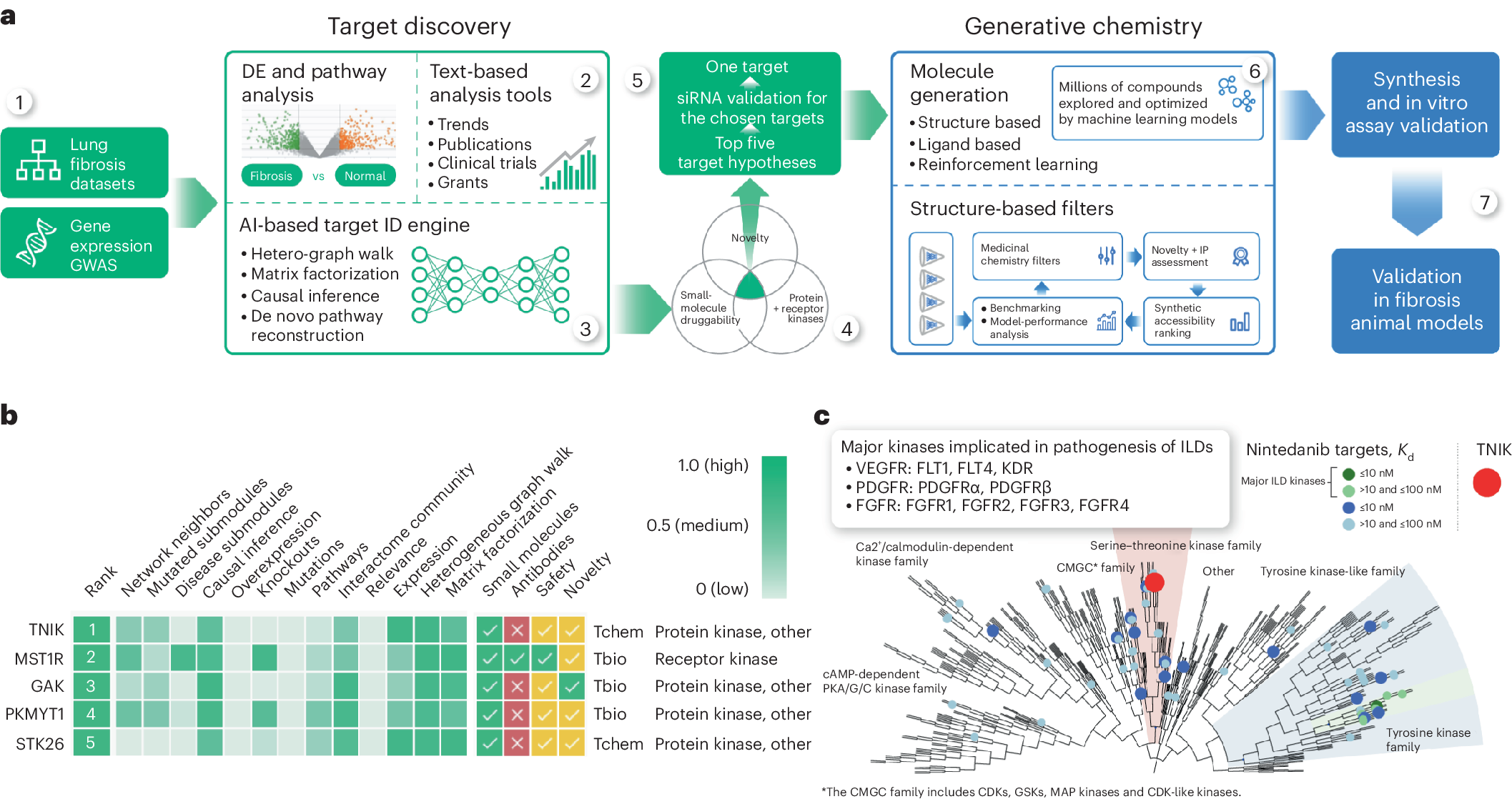
Insilico Medicine used its computer models to propose a drug for pulmonary fibrosis and said in a press release that the molecule had been "discovered by" its generative AI platform [1]. When it filed for the patent on that chemical structure, the company made no mention of AI and named five humans as inventors, including CEO Alex Zhavoronkov [2].
The same molecule, described two ways for two audiences [15]. Only one of those descriptions is enforceable, because under US law it is humans, and only humans, who can be credited as inventors [3].
That rule was settled the hard way. Ryan Abbott, a partner at the LA firm Brown, Neri, Smith & Khan, brought a pro bono test case naming an AI called DABUS as the inventor of a food container whose geometric surface transfers heat well and stacks easily, arguing that since no human contributed to the design, the machine should be listed [4]. In 2022 a federal appeals court in Washington, DC, declined to engage with what it called "metaphysical matters" and rested on statutory text: US law describes an inventor as an "individual," and the plain meaning of that word is a human being [5]. "There needs to be a human inventor or there's no invention and no patent," says Sarah Korman, a patent attorney who is now chief business officer and legal officer at Isomorphic Labs, the Alphabet spinout; speaking at MIT Technology Review's EmTech event, she added that there is "no doubt" the law will have to evolve [6].
Nobody in this argument claims the models cannot invent. The US Patent and Trademark Office has itself said that an AI system, like other tools, "may perform acts that, if performed by a human, could constitute inventorship under our laws" [7]. So the live question is not whether the machine gets credit but whether any human contributed enough to be named [8]. That matters operationally, because one way to invalidate a patent is to show the wrong inventors are listed, and Abbott expects challenges on exactly that basis to AI-generated drugs [8].
The regulatory posture has moved, and not toward clarity. Under the Biden administration the patent office published guidance to help applicants work out whether and when humans qualify as co-inventors of an AI discovery; after Trump took office the agency reversed course and now treats AI as merely a tool, like a calculator, with no requirement to mention it at all [11]. Silence in the file is permitted. It is not the same as a defensible record.
Which is why the practical answer at Insilico is procedural rather than philosophical. Zhavoronkov says human chemists still synthesize the compounds, make variants, and test them in animals: "That's the person who is going to be named on the patent." Even in a fully roboticized pipeline, he argues, "someone will still push the button and give the budget" [12]. Whether pushing a button is inventorship is, per Abbott, a question for future cases [14].
Watch for the first inventorship challenge to an AI-derived drug patent, since that is where the don't-ask posture gets tested [8]. Watch the copyright analogue too: the US Copyright Office is already refusing registration for AI-generated images and text, which has drawn objections from the Motion Picture Association of America, whose members use those tools [10]. And watch what your own lab notebooks say. Abbott's argument is that excluding AI-assisted output from protection would dampen drug development, a result at odds with the constitutional purpose of granting exclusive rights, which is to "promote the Progress of Science and the Useful Arts" [9][13].
Loading topic controls
Loading related stories