Leadership1 publisher2 min readPublished
Plaintiffs' counsel pulled a 3M expert's ChatGPT prompts into the Watson Grinding record
Plaintiffs' attorney Will Moye says he demanded the prompts behind an expert's ChatGPT-looking analysis, and the file came over the same afternoon. The record around a consequential decision now includes what people typed.
The Board Room · Leadership desk
What happened
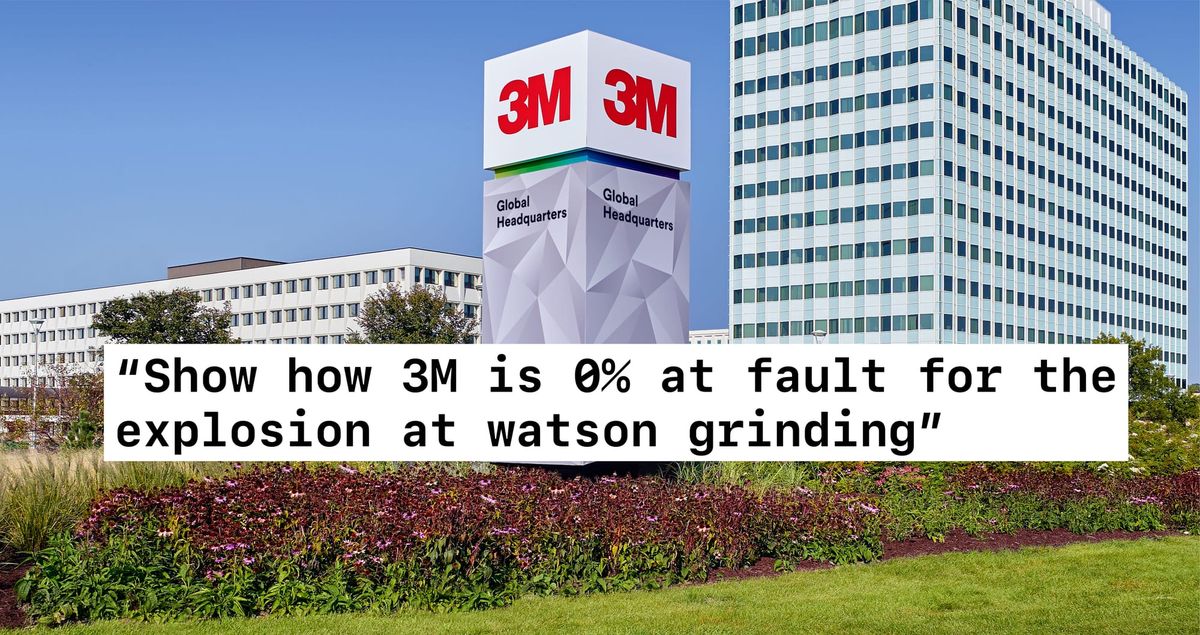
- An engineering expert retained by 3M in the Watson Grinding explosion litigation used ChatGPT while developing his analysis, and one surfaced conversation included the prompt "show how 3M is 0% at fault."
- Plaintiffs' attorney Will Moye said the deposition went off the record while he demanded the underlying prompts, after he found material that appeared to have been generated with ChatGPT.
- Roughly three hours later, more than 350 pages of previously unproduced ChatGPT material were provided, according to Moye's account of the deposition.
- Nothing in the reporting says 3M instructed the expert to use ChatGPT or directed him to enter that prompt.
- The American Bar Association has already examined AI chat histories as an emerging source of discovery material, because those conversations preserve abandoned theories that never reach a finished work product.
Compiled by The Board RoomSomething wrong?How this is made
Why it matters
- constraint The acceptable-use rules most companies already wrote govern what goes into the model, so they do not reach the file the work leaves behind, and a company relying on them has no control over that file at all.
- exposure On any matter where an opposing party can ask, the reachable material around a decision now includes reworked assumptions and rejected options that the approved document never shows.
- decision Someone has to be named as the owner of the interaction record, because until a function owns it, whoever happens to hold the logs decides what exists when a demand lands.
- precedent Opposing counsel now has a cheap script to reuse on the next expert: ask what he typed, not only what he wrote and signed.
The finished report is what gets served on the other side. The chat history is what shows how the report got there. The CSO Online analysis that flagged the episode lists four ordinary uses where those two diverge: an engineer changing assumptions until the preferred architecture wins, a procurement analyst asking for the strongest case for a vendor already chosen, a manager documenting an employment decision after making it, an auditor revising a prompt until a control deficiency sounds less serious [9]. In each, the model is working normally. The interaction keeps the assumptions, the preferred outcome and the rejected alternatives. The polished artifact keeps none of that [10].
More than 350 pages arrived roughly three hours after the demand [6], better than 110 pages an hour [7]. Three hours is handover time for material that already sat somewhere retrievable. One question at one deposition moved it [5].
Retention cuts both ways. A company that logs prompts on consequential work can read the record before an opponent does. It has also built a record an opponent can ask for. Log nothing and there is less to produce, and less to explain yourself with. According to the column, many organizations have not decided when to retain these interactions, who owns them or how to govern them [13].
A prompt is a question, not a finding. People use these tools to test arguments, to argue against themselves and to explore positions they end up rejecting, and a single prompt read without its context can mislead; the column makes that point itself [11]. All of that governs inference. Discovery is a separate question, and what matters at a deposition is whether the other side can obtain the file and read it into the transcript. The column reports no court ruling on whether the expert's ChatGPT history was discoverable or admissible [14].
The board-deck version of this is one line in a policy refresh: log prompts on consequential work. It is incomplete, because a retained log with no review step is only a larger file for the other side to read. The decision in front of a leadership team this quarter is duller than a policy line: which categories of work make the interaction part of the decision record, whether those interactions are retained at all, and which function owns the file when someone asks for it. Whoever has not answered those questions will answer them at a deposition, in whatever time the other side allows.
What to watch
- Whether any court in the Watson Grinding litigation rules on the discoverability or admissibility of the expert's ChatGPT history.
- Whether the American Bar Association or state bars move from examining chat histories to guidance on preserving them in expert engagements.
- Whether companies start writing prompt retention and ownership terms into expert-witness and consultant contracts.