Leadership1 distinct publisher3 min readPublished
Management at the University of Sydney says its AI guardrails belong in policy, while the union wants them enforceable in the enterprise agreement, and that venue argument is the part other employers should study.
The Board Room · Leadership desk

Compiled by The Board RoomSomething wrong?How this is made
The dispute that matters here is about venue rather than content. A guardrail written into policy can be revised by the body that wrote it; a clause in an enterprise agreement has to be bargained out again, which costs time and leverage. So when a university spokesperson says it supports many of the objectives in the unions' claims but believes it more appropriate to implement many of them through relevant policies instead of the Enterprise Agreement [6], the position amounts to a retained right to change the paper later, and that is the trade-off other knowledge-work employers will be asked to make.
What a strike day buys, if it buys anything, is a limit that survives a change of management. Branch president Peter Chen said the university had rebuffed the union "at every opportunity" on enforceable AI protections [4], and the NTEU's NSW division secretary, Vince Caughley, cited the university's own green paper describing AI as the most "fundamental transformation" education has seen, along with chatbots already used to help teach online-only classes elsewhere in the sector [7]. Caughley framed the ask as best practice and due diligence rather than commercialisation or the interests of venture capital [8]. Inside an agreement, due diligence acquires a process and a dispute clause; inside a set of principles, it stays a statement of intent.
A skeptic reads the 0% trust result as an artefact [2]. Sydney's NTEU branch is the largest in Australia and the campus has long been a hotbed for activism [11], the survey was internal, and the record does not tell us how many arts and social sciences staff answered or how the sample was drawn. Grant all of that. A zero still prices something management needs: the cheap route through an AI transition runs on internal guidance and voluntary compliance, and that route requires goodwill, which this faculty says it is withholding. The Student Representative Council struck in solidarity and picketed online classes [12], which narrows the available goodwill further.
The AI claim is also not free-standing, which is why a policy fix is unlikely to close it. Staff are contesting a proposal for teaching-only roles with no research component and no scope for future growth, against a background of growing class sizes and reduced student satisfaction [9]. Prof Laura Shepherd, who sits on the bargaining team, put the student side of it: people spend around $50k on degrees for quality and access to research leaders [10]. Automated delivery combined with a role type stripped of research produces a cheaper teaching workforce, a shift that job security and workload clauses can limit but that ethical-use language cannot touch.
Management was approaching its fifth month of bargaining when the pickets went up [13], and the union says it is confident of a deal within the year while noting that senior leaders including the provost, Prof Annamarie Jagose, are absent from the table [14]. Read that expectation as twelve months from the start, and roughly seven months of bargaining remain [15], with the previous round at Sydney having produced the longest running industrial action at an Australian university [16]. Chen's framing was that higher education is the canary in the coal mine, and that where it goes on AI will travel through the rest of the economy [5]. Whether or not the sector generalises that well, the venue question does: an employer that keeps its AI commitments in policy this quarter will be arguing next quarter about whether a chatbot-taught unit is a consultation or a dispute.
Ranked by verification strength, evidence, and original report placement.
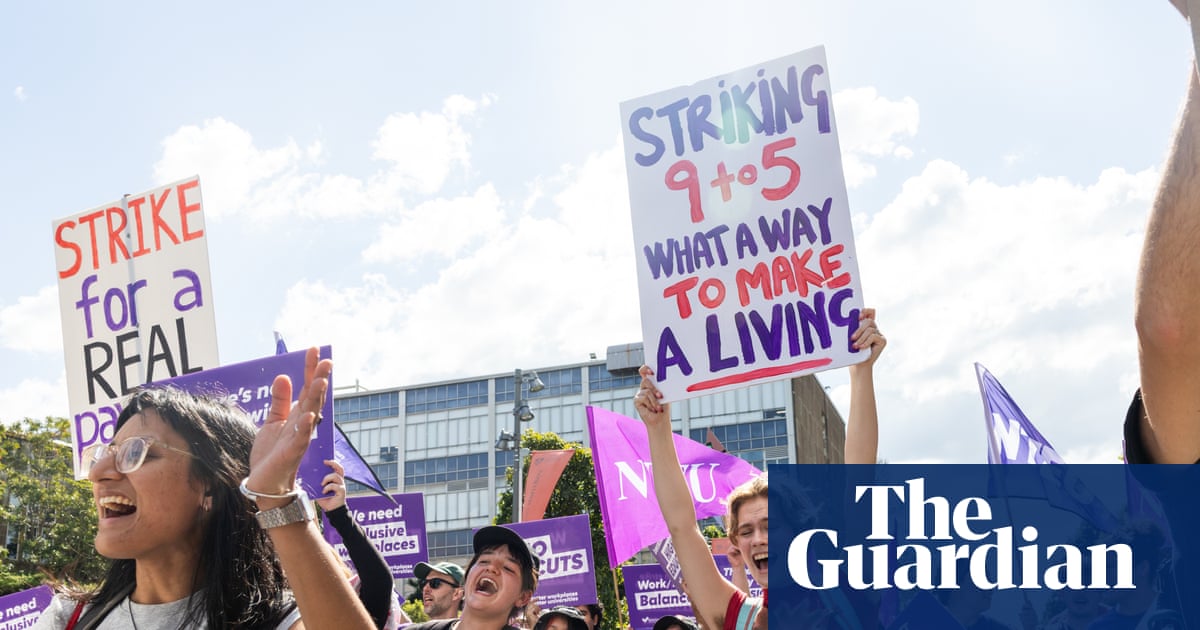
Around 2,000 union members at the University of Sydney walked off the job on Wednesday in a 24-hour strike, driven by the issue of trust alongside longstanding concerns over staff protections from artificial intelligence, workload fairness and job security.
In an internal University of Sydney survey whose results staff received the same week members agreed to strike, 0% of respondents in the faculty of arts and social sciences agreed with the statement: "I trust the University of Sydney to act in the best interests of staff, students and the broader community."
The University of Sydney advised students that "almost all" scheduled classes would move online as a result of the strike, while others were rescheduled or cancelled.
Peter Chen, National Tertiary Education Union branch president at Sydney University, said management had rebuffed the union "at every opportunity" to enforce appropriate protections around the use of AI.
A University of Sydney spokesperson said it was "continuing to engage" with the union, called the industrial action "premature", said its principles and guardrails were developed in consultation with its community, and said it supports many of the objectives of the unions' claims but believes it is more appropriate to implement many of these through relevant policies instead of the Enterprise Agreement.
Caughley said: "We are asking for best practice, we are asking for due diligence. Not their own commercialisation aims and certainly not the interest of venture capital."
Follow any of these and your For You feed starts watching them — no settings page required.
leadership
Macquarie charges $2,174 a unit for psychology now taught partly by a chatbot1 distinct publisher
science
A Bronze Age oasis ware now has a provenance, and an eight-part claim to being a brand1 distinct publisher
science
One sleuth, 54 more papers, and an antibody that was never going to work1 distinct publisher
product
Meta blocked the search terms and left the videos up: nine takedowns from a list of 20-plus2 distinct publishers
Evidence-backed comparisons of source perspectives and observed adoption signals. Read the methodology
Which Builder, Operator, and Investor concerns the observed source mix emphasized—not a truth score.
Evidence, demonstrated adoption, hype gap, incentives, and confidence are assessed independently, each on its own current evidence. How these are measured.
Strong on the day, silent on the documents
The Guardian's reporter was at the entrances, and it shows: the headcount, the 7am picket, the quiz on the megaphone and the bake sale for lost income are all first-hand, and both sides speak on the record. What is missing is everything the argument rests on. The 0% trust figure comes with no response rate or comparison faculty, the green paper is characterised by the union official citing it, and the AI principles the university would rather rely on are named but never shown.
A governance fight with barely any AI in view
Strip out the bargaining language and remarkably little deployed technology remains. Sydney's own AI use is represented by a spokesperson's reference to principles and guardrails; the concrete example of chatbots teaching classes belongs to other, unnamed universities. The measurable adoption in this story is of governance documents, not systems — and the one operational shift anyone can count is the day almost all classes went online because staff were outside.
The bellwether line outruns its evidence
Chen's canary in the coal mine does more work than anything around it supports: nothing here demonstrates that a university enterprise agreement clause has ever moved AI terms in another industry. The 0% trust result is arresting and lands in the opening line with no methodology behind it, and the sector-wide claims about satisfaction rankings are asserted by the people making them. Against that, the reporting is admirably unbreathless about the walkout itself and gives the university's venue argument room to stand on its own, which keeps the overstatement mild.
Everyone quoted is at the bargaining table
Five of the six named voices are union officials, bargaining-team members or a striking student officer, and the sixth is an unnamed spokesperson for the employer they are bargaining against. That is not a flaw in the reporting so much as the shape of the event, but it means every contested assertion arrives from someone whose leverage depends on it: the union's account of being rebuffed, the university's claim that its guardrails were built through consultation, the satisfaction rankings, the green paper's alarming adjective. No regulator, no independent academic, no student survey body appears to arbitrate.
Trust the day, hold the interpretation
We are confident about what happened on Wednesday and about the exact words each side used, because a reporter was present and quoted them. We are much less confident about what it means: the timeline of a settlement rests on an ambiguous within the year, the sector-spillover thesis is untested, and there is no second outlet to check the internal survey or the record-length precedent. Read the venue dispute — policy versus agreement — as the durable part; treat the rest as an opening position from both sides.
Distinct publishers with included, body-backed reporting in this cluster.