Invest1 publisher3 min readPublished
Johnson's recess pushes every named AI safeguard past November's elections
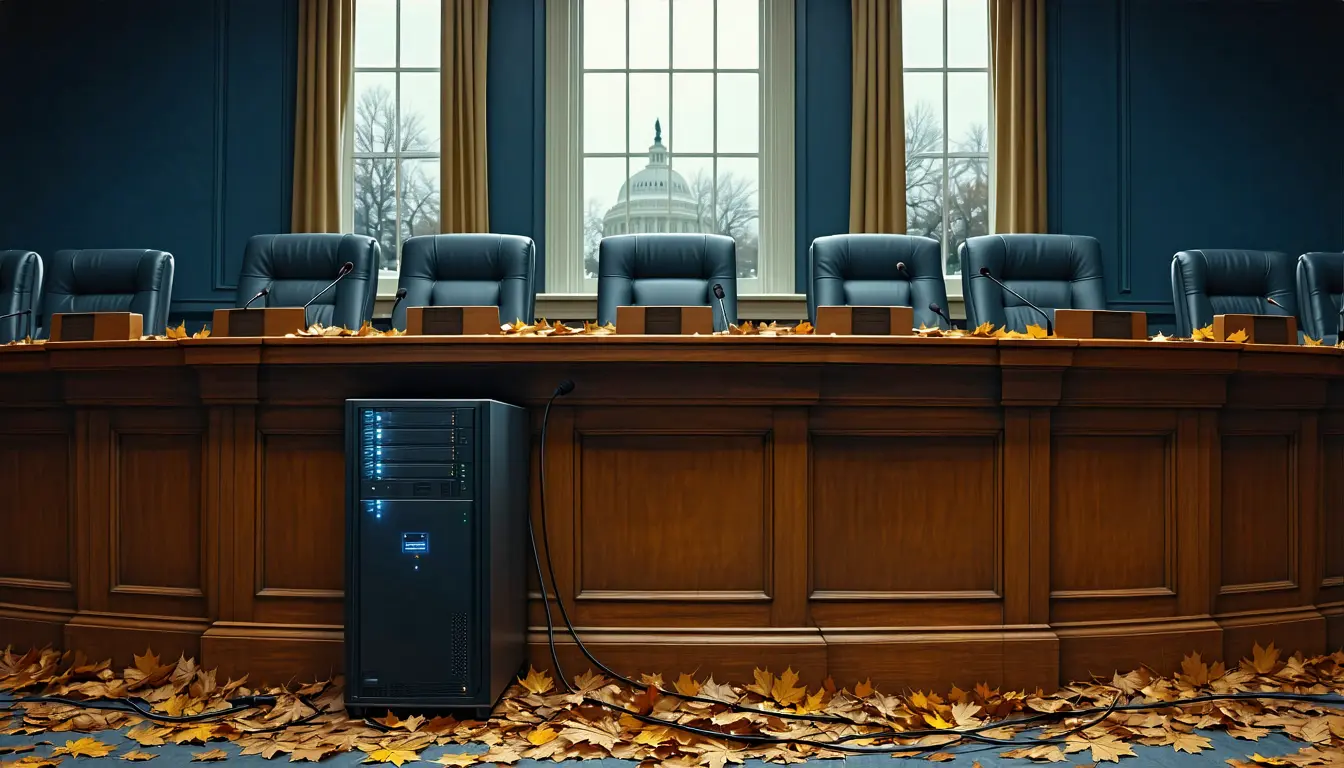
The leaders of Anthropic, OpenAI and xAI pledged to slow down and House Democrats asked to stay in session, but the Speaker's schedule sends the chamber home this week, and three named safeguard bills have no floor time until after November.
The Investor · Invest desk
What happened
- A researcher resigned from Anthropic with a warning that the technology could kill us all by the end of the decade, according to CNBC's account of the episode.
- The leaders of Anthropic, OpenAI and xAI followed with pledges to slow development, and calls for lawmakers to regulate the industry came soon after.
- House Democrats led by Rep. Sam Liccardo wrote to Speaker Mike Johnson on Friday demanding the chamber stay in session until it advances meaningful, bipartisan AI safeguards.
- Johnson ruled out an emergency session, saying that racing in to regulate AI would cost the United States the race to China.
Compiled by The InvestorSomething wrong?How this is made
Why it matters
- constraint Nothing in the Democrats' letter can bind a model released this autumn, so anything shipped between now and the House's return will be judged later against text written after it existed.
- decision A 2027 budget line for evaluation reporting and kill switch engineering has to be committed before anyone knows which chamber writes the rule.
- contradiction The CEOs' own words are being cited both as grounds to legislate immediately and, by the Speaker, as evidence the companies will restrain themselves without a statute.
- precedent If a closed-door summit becomes the vehicle, the companies negotiate the first draft of US frontier rules, and that becomes the template for whatever the next scare produces.
Three shapes of compliance are on the table in writing, and they do not point the same way. Rep. Sam Liccardo and a group of House Democrats sent a letter to Speaker Mike Johnson on Friday. It urges consideration of bills mandating transparency and evaluation of frontier models, "kill switch" requirements, and a waiver of antitrust laws to allow the industry to work together on safety and security [7][8]. Two of those three would put a recurring obligation on whoever ships a frontier model. The third would lower the cost of coordinating on safety [15].
The recess is what binds here. Johnson is due to send the House home after this week until November's elections have passed, roughly another month out of session [6]. The letter itself asks for proposals that "deserve consideration, public debate, thoughtful amendment, and action" [9]. All four of those steps need a chamber that is sitting [17].
Johnson's stated reason is competitive. "If Congress just races in and does some sort of emergency session to try to regulate AI, we will lose the race to China, that is a threat to every single American," he said [10]. He wants a meeting with industry leaders instead, and he wants the companies to police themselves. "I'd do it tomorrow," he said. "I think we need to go in a big room, close the door and sort this out." [11]
The case that the question has moved from whether to when rests on people who do not control floor time. Three frontier lab leaders pledged to slow development [4]. Pennsylvania Gov. Josh Shapiro called the industry's commentary "a bright flashing red light" [5]. House Democratic Leader Hakeem Jeffries said Democrats would meet Tuesday, and that "We should take decisive action now so that we can slow down, as the CEOs have recently acknowledged, slow down the pace of development in order to protect the American people and ensure that AI is proceeding safely" [12]. The member holding the calendar has said no [10]. CNBC notes Washington has done little to regulate AI since the technology emerged [13].
The other way this runs: crisis legislating gets fast when the political price of inaction exceeds the value of a campaign month. The midterms cut both ways, because a member can also run on having voted for a kill switch [14]. Two signals would change the view. One is a bill number with bipartisan cosponsors and a markup date before the House leaves. The other is a written framework with dates out of the closed-door meeting Johnson says he would hold tomorrow [11]. Until then, a 2027 compliance line is an estimate of two disclosure regimes still at the consideration stage [8], and it has to hold through a month in which the House votes on nothing [16].
What to watch
- Whether the Tuesday Democratic meeting Jeffries announced produces a bill number and bipartisan cosponsors before the House leaves.
- Whether Johnson's proposed closed-door meeting with AI industry leaders happens, and whether anything written with dates comes out of it.
- Whether the antitrust waiver, the one measure that lowers industry cost, moves faster than the two that raise it.