Invest1 publisher3 min readPublished
Anak Krakatau's two short bursts cancelled 1,558 flights and stranded 170,000 passengers; Indonesia's Geological Agency says activity has been intensifying since July and it cannot say whether a bigger eruption follows.
The Investor · Invest desk

Compiled by The InvestorSomething wrong?How this is made
The ratio worth holding onto is duration against consequence: 30 seconds of eruption at 3:53 a.m. Sunday and 16 more about three hours later [1], 46 seconds of venting in total [1], against airspace that stayed shut until 8:59 a.m. Monday [4], roughly 29 hours after the first burst [2]. That works out near 2,300 seconds of closure for every second the vent was open [6], which is the useful way to think about ash risk: the exclusion window sets the cost, and it scales with where the plume travels rather than with how long the volcano performed.
Inside that window Soekarno-Hatta absorbed 963 of the 1,558 cancellations, a little under 62 percent [5][3], leaving 595 spread across the seven other closed fields, about 85 apiece [4]. The passenger count divides to 109 per cancelled flight [5]. And the tally is a floor rather than a total, because it was struck on Sunday evening while the closure order still had a Monday morning to run [9].
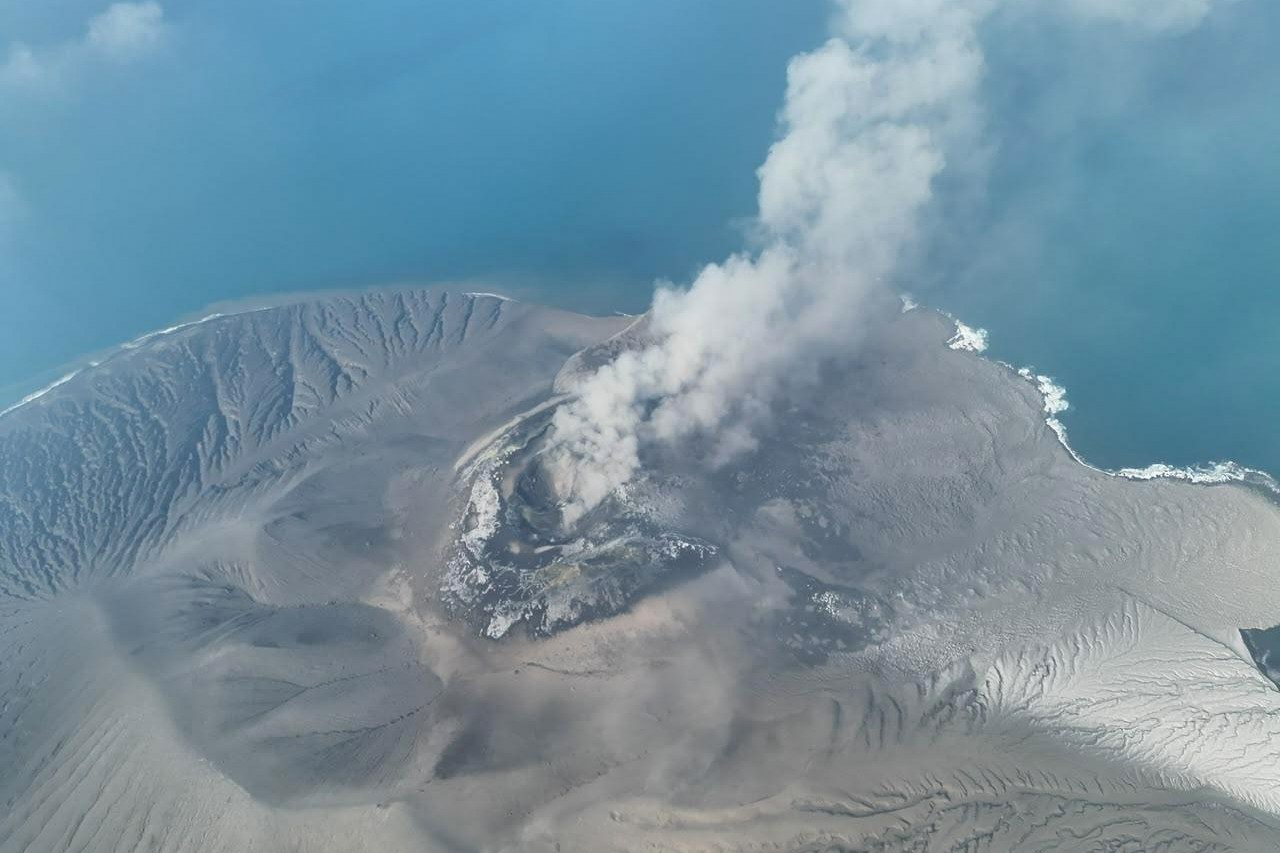
Nobody was evacuated and nobody was hurt: the nearest settlement sits more than 16 kilometres from a crater whose exclusion radius is 3 kilometres [6], better than five times the distance [8]. The damage went where the plume went. Ash fell across parts of Jakarta and Lampung [7], one cloud at 20,000 feet drifting northeast over Jakarta, Banten and West Java, a second at 50,000 feet spreading to Bengkulu and the Indian Ocean west of Sumatra [8], with Bali and Medan disrupted as well [12] and schools in ash-affected areas allowed to teach from home [13].
Whether this is an operating cost or an anecdote rests on what Lana Saria of the Geological Agency said: activity has intensified since July, Sunday's was the strongest eruption of that run, and the repetition points to a continued supply of magma and volcanic gases [9][10]. She also said officials cannot predict whether a larger eruption will come [10]. That is a monitoring statement, not a forecast. The distinction is exactly what a network planner has to price.
The material carries no cargo tonnage, no loss estimate and no compensation terms, so the freight side of this cannot be sized from it; the only account of who eats the disruption is a Spanish tourist bound for Madrid who said he had heard nothing from his airline [14], and a passenger who shrugged that it was force majeure [15]. What the record does carry is the civil aviation director general's warning that aircraft rotations, fleet availability and terminal capacity cascade after reopening [11], which is where the second and less visible tranche of cost sits.
The benign reading is that the July-to-September sequence tapers and this was a single 29-hour outage at the country's busiest field. The version I find more interesting, or rather more expensive, is a run of short closures, each individually absorbable, which pushes Jakarta-based carriers toward carrying standing schedule slack they currently do not pay for. The third path involves a different failure mode altogether: in 2018 a flank collapse at the same volcano produced a tsunami that killed at least 430 people in Sumatra and Java [16]. The evidence supports the middle reading only as far as Saria's magma sentence goes, which is not very far, and the test is clean. If Soekarno-Hatta clears the next two quarters without a second ash closure, this was a headline rather than a line item.
Ranked by verification strength, evidence, and original report placement.
Anak Krakatau, in Indonesia's Sunda Strait between Java and Sumatra, had shown signs of activity since Friday before erupting for 30 seconds at 3:53 a.m. Sunday and for 16 seconds about three hours later, according to Indonesia's Geological Agency.
AirNav Indonesia closed airspace around Soekarno-Hatta and Halim Perdanakusuma airports in Jakarta and six other airports, including Radin Inten II in Lampung, because of volcanic ash.
All eight closed airports were ordered shut until 8:59 a.m. Monday.
By Sunday evening the closure of eight airports had affected 170,000 passengers from 1,558 cancelled flights, including 963 flights at Jakarta's Soekarno-Hatta airport alone.
No casualties were reported and no evacuation order was issued; the nearest settlement is more than 16 kilometres from the volcano, and authorities warned people to stay at least 3 kilometres from the active crater.
Volcanic ash spread across parts of Jakarta and Lampung province on Sumatra's southern tip, according to Indonesia's Center for Volcanology and Geological Hazard Mitigation.
Publishers with included, body-backed reporting in this cluster.
1 article · September 6, 2026
Follow any of these and your For You feed starts watching them — no settings page required.
Evidence-backed comparisons of source perspectives and observed adoption signals. Read the methodology
Which Builder, Operator, and Investor concerns the observed source mix emphasized—not a truth score.
Evidence, demonstrated adoption, hype gap, incentives, and confidence are assessed independently, each on its own current evidence. How these are measured.
Named agencies, one newsroom
Almost every figure carries an institution's name on it: the eruption clock from Indonesia's Geological Agency, the eight closures from AirNav Indonesia, the ash spread from the volcanology and hazard mitigation centre, the two plume altitudes jointly from that agency and the Darwin advisory centre, the recovery warning quoted from the transport ministry. What is missing is a second newsroom testing any of it, and the two headline numbers — 1,558 flights and 170,000 passengers — arrive without an attribution or a method, which is exactly where an independent check would matter most.
Disruption counted while it was still running
The real-world footprint is concrete and quantified: eight airports shut, 963 cancellations at Soekarno-Hatta alone, ash over Jakarta and Lampung, schools cleared to teach from home, spillover delays at Bali and Medan. The count stops before the event does. It was struck on Sunday evening against a closure order that ran to 8:59 a.m. Monday, and this reporting ends before anyone confirms the airports reopened on schedule or that the rotation backlog the ministry flagged cleared.
The tally reads as a floor
The arithmetic runs the quiet way. The cancellation count was frozen on Sunday evening with a night of closure still to go, so the true totals sit above the published ones, and Fortune declines to extrapolate. The 2018 tsunami that killed at least 430 people appears as history with its mechanism explained rather than as a hint of what comes next, and Saria's refusal to forecast a larger eruption is carried intact instead of being sanded down. Restraint of that kind leaves the framing slightly below what the facts would support.
Agencies grading their own response
The institutions describing the disruption are the ones that caused and managed it: AirNav closed the airspace, the transport ministry explains the closure as safety first, and the Geological Agency both measures the volcano and sets the 3-kilometre exclusion radius. None of them is selling anything, and the choice to shut airspace is hard to spin either way, so the pressure is institutional rather than commercial. The one line that cuts against a tidy account comes from a passenger who says his airline had not contacted him at all.
Firm on the event, thin after it
The eruption timeline, the closure order and the hazard assessment are solid: named agencies, named officials, a video briefing. Confidence gives back ground on the numbers and the aftermath — one outlet, a passenger total with no stated provenance, an ash-cloud picture that stops at Indonesian and Australian monitoring, and a story that ends at the reopening deadline rather than at the reopening.