Loading today’s stories
Product1 distinct publisher2 min readUpdated
Anthro Energy puts a date and a tonnage on polymer electrolyte: 12,000 tons, 25 GWh, late 2027
The Louisville plant carries about $43.4 million in federal support and no publicly named buyer. Its whole thesis is that the polymer drops into cell lines that already exist.
The Product Desk · Product desk
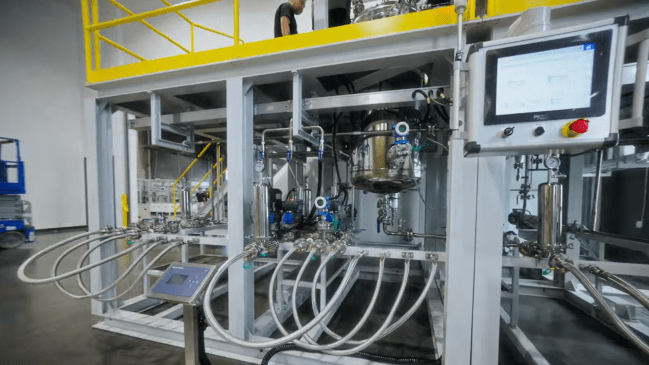
What happened
- Anthro Energy broke ground in mid-August on a battery materials facility in Louisville, Kentucky, describing it as the first US-owned and operated advanced electrolyte manufacturing plant of its kind.
- The facility is expected to begin commercial production in late 2027.
- Planned output is about 12,000 metric tons of advanced polymer electrolyte per year.
- That annual output would be enough material for as much as 25 GWh of lithium-ion battery production.
- The Anthro Proteus platform replaces the conventional liquid electrolyte in lithium-ion batteries with an advanced phase-change polymer electrolyte.
Compiled by The Product DeskSomething wrong?How this is made
Why it matters
Divide the tonnage by the capacity and the announcement yields a number it does not print: roughly 0.48 kg of polymer electrolyte per kWh of cell [1]. Anthro's own two figures, about 12,000 metric tons a year [3] supporting up to 25 GWh of lithium-ion production [4], are what fix that ratio, and it is the first thing a cell engineer will check, because it decides whether one plant serves a couple of large customers or a long tail of small ones.
The load-bearing claim is not the chemistry. It is that the phase-change polymer runs on lines that already exist [5][6] and can be adopted without standing up a separate manufacturing ecosystem [7]. That is also the part with no fallback. A bespoke electrolyte needing a bespoke line has no buyer at this volume; the tonnage clears only if it goes into cells that were going to be built anyway.
What the material does not contain is a customer [4]. No automaker, no cell maker, no price per kilogram, which makes 25 GWh a ceiling the company has set for its own output rather than a book of orders [4][4].
Public support adds to about $43.4 million: close to $25 million from the Department of Energy under the Infrastructure Investment and Jobs Act [8], plus $18.4 million in investment tax credits under the Inflation Reduction Act's 48C programme [9][2]. Against the 25 GWh it claims to support, that is roughly $1.7 million per GWh [3]. The two instruments do not behave alike. Grant support arrives as spending; a 48C credit is only worth something once the capital is actually in the ground.
The parts a purchasing department screens on are duller than the polymer. Inputs free of Foreign Entity of Concern restrictions from the first day of operations [10], and a site close enough to the Battery Belt to serve customers across the South and Midwest [11]. Anthro also lists electric mobility, consumer electronics, robotics, energy storage and defence among target applications [12]. Those carry qualification cycles of very different length, and a defence programme and a consumer cell buyer will not arrive on the same schedule, which is another way of saying the 25 GWh will fill unevenly if it fills at all.
Anthro's own framing is that the plant could show polymer electrolytes moving out of laboratory and pilot scale into large-scale battery manufacturing [14]. That framing concedes where things stand. The safety argument against leakage and thermal runaway in liquid systems is old ground [13]; what was missing was a tonnage and a date, and those now exist [2][3]. A signed customer does not.
Loading topic controls
Loading related stories