Science1 distinct publisher3 min readPublished
A Nature Sustainability study joins household poverty data to seagrass-adjacent populations and finds 6.5 million people whose food and income come from meadows that sit outside almost every development plan.
The Scientist · Science desk

product
The "24 million cars" data centre stat is a unit error, and citing it costs you the argument1 distinct publisher
science
HKUST's 4,116-city model finds more than a tenth of sustainability gains beyond city limits1 distinct publisher
Compiled by The ScientistSomething wrong?How this is made
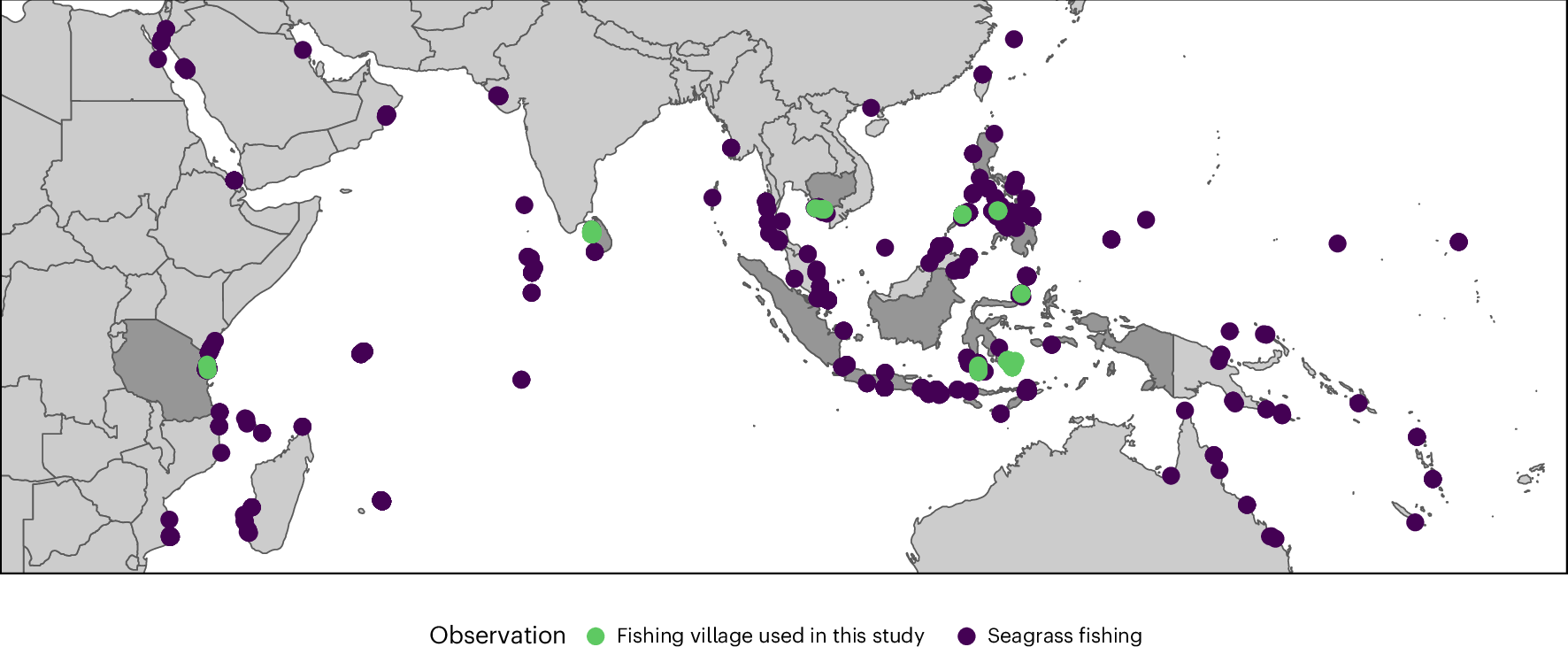
Two different measurements are doing work here, and they do not carry the same weight. The 18 million figure comes from joining household-level poverty data to estimates of populations living close to mapped seagrass [5]. That is a spatial overlay with survey data attached, and it tells you how many people in poverty fish where meadows are, but it stops short of telling you how much of any given meal comes out of one. The 6.5 million figure is the load-bearing one, because it is a claim about exclusivity: those households have the habitat as their entire basis for subsistence and fishing-related income [3].
The arithmetic between the two is where the food-security argument actually lives. Divide 6.5 by 18 and you get about 36 percent [15]; subtract, and roughly 11.5 million people fish these meadows but have somewhere else to go [16]. A household with a second fishing ground takes a meadow's decline as a cut in earnings. A household without one takes it as a subtraction from what it eats. Those are different exposures, and lumping them into one headline total loses the distinction that matters for triage.
The study also reports that households in extreme poverty were significantly more likely to be wholly seagrass-dependent, and that seagrass-dependent households earned 23 percent less than other fishers [6][7]. The authors read this as a coastal poverty trap, where households with few alternatives stay tied to low-return livelihoods in a vulnerable habitat [8]. This design leaves the direction of the arrow unsettled. Poverty plausibly pushes people toward the cheapest fishery to reach, one you can walk into with limited gear [4], and thin returns then keep them there. A cross-sectional income comparison cannot separate that from the reverse reading, and the paper frames its result as a suggestion rather than a mechanism [8].
The thing this does not tell you is what happens after a meadow goes. No one here has tracked an actual seagrass loss event and measured the protein and cash that left with it. Dr. Benjamin Jones of Project Seagrass, one of the lead researchers, puts it as loss of food, income and security following loss of habitat [9], which is a reasonable inference from measured dependence, though it sits in a weaker evidentiary class than the count itself.
The count is the contribution, and it is explicitly a floor: the paper says at least 18 million [1]. Project Seagrass describes it as the first large-scale empirical evidence that these meadows function as a safety net for people in extreme poverty [12], and the same release notes that the habitat is largely absent from poverty, development and conservation agendas [10]. That absence is the practical finding. Coastal development and land-based pollution are named as the primary threats, with the most dependent communities holding little influence over the decisions driving decline [11]. Appraisals of those decisions have not had a number for the people with no substitute. Now there is one, with an error bar pointing upward.
Ranked by verification strength, evidence, and original report placement.
A Project Seagrass-led study found that at least 18 million people in poverty across the Indo-Pacific fish in seagrass meadows.
The research was led by scientists from Project Seagrass, a seagrass conservation organization, and is published in the journal Nature Sustainability.
The study found 6.5 million people who are entirely dependent on seagrass meadows for subsistence and fishing-related income.
Seagrass meadows support accessible fisheries that can be reached on foot or with limited equipment, making them especially important to households with few alternative sources of food or income; women and other marginalized groups frequently play central roles in these fisheries.
The study linked household-level poverty data with seagrass-proximate population estimates.
Across the Indo-Pacific, households in extreme poverty were significantly more likely to be entirely dependent on seagrass meadows for their fishing activities.
Distinct publishers with included, body-backed reporting in this cluster.
phys.org
1 article · September 3, 2026
Follow any of these and your For You feed starts watching them — no settings page required.
Evidence-backed comparisons of source perspectives and observed adoption signals. Read the methodology
Which Builder, Operator, and Investor concerns the observed source mix emphasized—not a truth score.
Evidence, demonstrated adoption, hype gap, incentives, and confidence are assessed independently, each on its own current evidence. How these are measured.
Peer-reviewed paper, single relayed account
Every figure a reader takes away — 18 million, 6.5 million, 23% — arrives through one phys.org write-up built on material from the organization whose scientists wrote the paper. What lifts it above a bare announcement is specificity: named authors, named journal, a DOI, and results stated precisely enough to be wrong in public. What holds it down is that nobody in this reporting has opened the paper independently, so the method behind the counts is taken on trust.
Nothing yet but the paper itself
The study's own argument is that seagrass sits outside poverty and development planning, and our coverage offers nothing that would show that beginning to change: no ministry, donor, fisheries agency or conservation programme is reported responding. The only concrete event is the paper's publication, which measures scholarly output, not uptake.
Numbers modest, framing loud
Two registers are at work. The counts and the earnings gap are careful and checkable. The wrapper — 'changes how the world needs to see seagrass', 'first large-scale', 'first time' — is what a conservation organization writes about its own study, and it is the interpretive layer, the poverty trap and the SDG warnings, that outruns what one paper relayed by one outlet can support. The gap is in the claims about significance, not in the arithmetic.
One organization, all three roles
Project Seagrass produced the finding, supplied every quote in the story, and is among the bodies that stand to be funded if donors accept its conclusion that seagrass belongs in poverty policy. That alignment does not make the count wrong; it does mean the research, the framing and the ask travel together from one interested party, through an outlet whose stock in trade is running institutional research announcements substantially as received.
Enough to report, not to lean on
Peer review and a citable DOI give the headline numbers real footing, and figures this specific tend to get corrected fast if they are wrong. Against that: one publisher, no independent read of the method, no error bars, and no country-level split in what reached us. We would repeat the 18 million as a study finding; we would not yet treat the 6.5 million as a settled population figure.