Loading today’s stories
Science1 distinct publisher3 min readUpdated
243 jars, 11 sites: a shape model for Edo pottery that inherits the dates it replaces
An Open Archaeology study measured Ogame jar outlines with Fourier analysis and a Random Forest classifier. The method is auditable; the chronology it produces is still borrowed.
The Scientist · Science desk
What happened
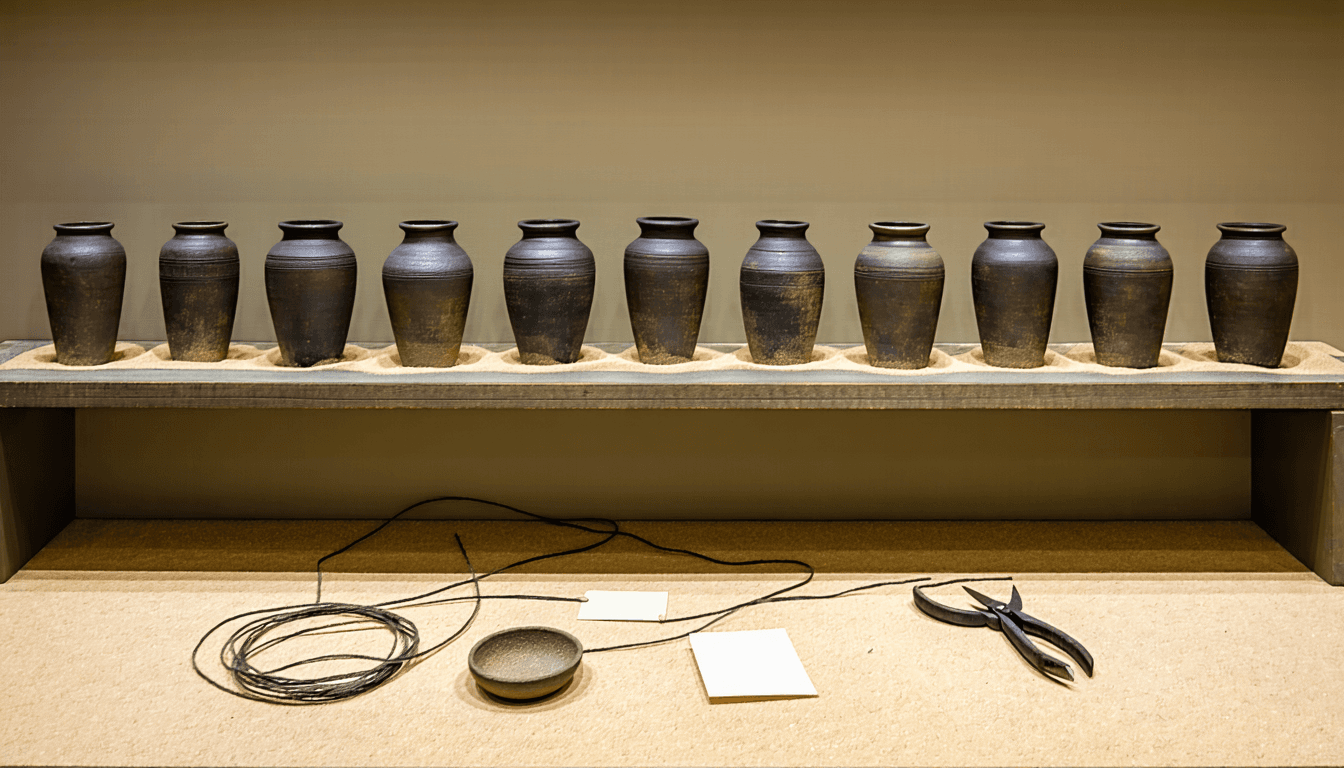
- A study published in the journal Open Archaeology by Associate Professor James Frances Loftus of the Institute of Science Tokyo examined how the shapes of large ceramic vessels known as Ogame evolved during Japan's Edo period (1603-1868).
- The study analyzed the shapes of 243 jars recovered from 11 kiln and mortuary sites across the Saga and Fukuoka regions of Japan.
- Loftus digitized the outline of each vessel using Elliptical Fourier Analysis, a geometric morphometrics technique, then trained a Random Forest machine learning model to classify jars into chronological stages based on morphological characteristics.
- Jars produced during the early 17th century displayed considerable variation in shape, whereas vessels made during the 18th century became increasingly uniform.
- The study links the transition toward uniform shapes to the consolidation of the Tokugawa shogunate, the Qing maritime trade ban and the expansion of domestic production networks.
Compiled by The ScientistSomething wrong?How this is made
Why it matters
A supervised classifier learns the chronology it is handed. Loftus digitized vessel outlines with Elliptical Fourier Analysis and trained a Random Forest to assign undated jars to chronological stages [3][12]. Those stages came from the securely dated material, which was dated by conventional archaeological means. The method therefore does not retire visual typology [8]; it fixes a typology's assumptions in measurable form and applies them with a consistency no eye sustains across 243 objects. That is worth having, and it is a different thing from replacement.
The sample deserves a pause. 243 vessels across 11 sites averages about 22 per site [13]. Spread across the 265 years the study covers, it is fewer than one vessel per year of the Edo period [14]. Chronological stages cut from that leave small groups per stage, and the account circulated by phys.org reports no accuracy score, confusion matrix or cross-validation result for the model [16]. Without one, a reader cannot tell whether the undated jars were placed with confidence or simply placed.
The second finding complicates the first. Jars from kiln sites have broad shoulders and flared rims over a relatively compact lower body, suited to moving liquids and fertilizer [6]. Jars from burial sites are taller, narrower and more enclosed, which Loftus reads as deliberate manufacture or selection for funerary use rather than reuse of domestic containers [7]. Shape, in other words, encodes function, and the assemblage mixes kiln and mortuary sites [2]. If the funerary share of the sample moves across the period, a model asked for a date can answer with a use.
The same ambiguity attaches to the headline pattern. Variation in early 17th century jars gives way to uniformity in the 18th [4], which the study links to Tokugawa consolidation, the Qing maritime trade ban and the growth of domestic production networks [5], and reads as evidence of workshop regulation and specialization that still left room for culturally specific forms [17]. Falling variance is consistent with that. It is also consistent with a later sample drawn from fewer surviving producers. Only per-stage counts by site would separate the two, and they are not in the summary [16].
What the approach does buy is auditability. Outline coefficients and a trained model can be re-run by a researcher who disagrees, which is not true of a published drawing and a confident paragraph. It also points the quantitative effort somewhere useful. Earlier work traced how these historical pressures reshaped porcelain and largely left utilitarian wares alone [10], and Loftus claims the first quantitative demonstration that the same developments show up in everyday forms [11]. The durable contribution is a checkable shape record for containers that held water, soy sauce, fertilizer and human waste, and that also served as coffins [9].
Loading topic controls
Loading related stories