Loading today’s stories
Invest1 distinct publisher2 min readUpdated
Screwworm ban lifts at one Arizona gate: 700 head a day against a 1.2 million-head trade
The Aug. 24 reopening at Douglas caps Mexican cattle volumes far below the pre-ban flow, and any expansion depends on a clean run at a single crossing.
The Investor · Invest desk
What happened
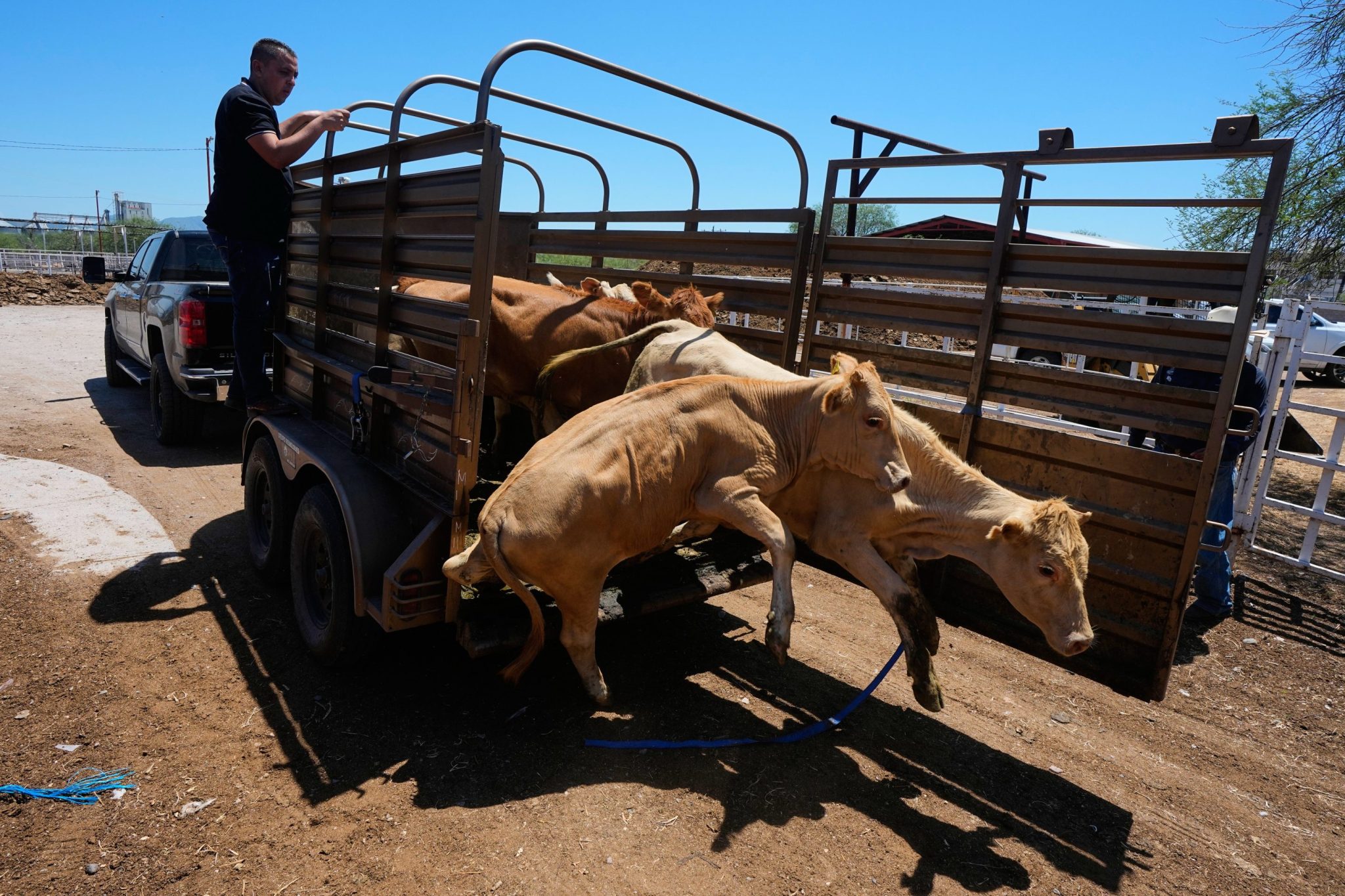
- The United States is set to resume livestock imports from Mexico beginning Aug. 24 at the Douglas, Arizona border crossing, which borders Agua Prieta in Mexico's Sonora state, ending a yearlong ban imposed over the New World screwworm fly.
- If the reopening goes smoothly, the US Department of Agriculture could allow imports through additional ports, though shipments will initially be subject to restrictions aimed at preventing spread of the parasite.
- Under the protocol defined by US authorities, only 700 cattle per day will be allowed through in the first week of reopening, rising to 900 in the second week and increasing gradually to 1,300 cattle per day, according to Arturo Ruiz, responsible for animal health for the state of Sonora, speaking to the Associated Press.
- The new rules require cattle to be fitted with radio-frequency identification ear tags and screened by electronic readers and trained dogs, with USDA officials conducting inspections before the animals cross into Arizona.
- Before the border closure, Mexico exported about 1.2 million head of cattle to the United States each year, mainly from its northern states.
Compiled by The InvestorSomething wrong?How this is made
Why it matters
Take the arithmetic of the pipe. Mexico's pre-closure trade averaged roughly 3,288 head a day spread over a full year [1]. At the ceiling the reopening schedule builds toward, and assuming the lane runs seven days a week, Douglas clears about 40 percent of that [3]. The opening fortnight, at the two lower steps, moves fewer than 12,000 animals in total [7]. In a US market where consumers are paying record beef prices and some have simply eaten less meat [11], that is a trickle with a start date attached.
Mexico's cattle export business was worth $1.2 billion last year [7]. Divided by the pre-ban head count, each animal carries about $1,000 [5]. Treat that as an order of magnitude rather than a price: the ban dates from May 2025 [6], so the dollar figure and the annual head count almost certainly do not describe the same twelve months.
The epidemiology sits awkwardly against the reopening. The outbreak, detected in November 2024, has reached 30 of Mexico's 32 states, and Sonora, the state feeding this crossing, logged its first case on Wednesday at Munihuasa, near the Chihuahua and Sinaloa borders [8]. Mexico counts 1,969 active cases, which authorities present as less than half the figure of a year ago and as evidence of containment, while conceding eradication will take time [9]. That implies something above 3,900 cases last August [6]. The fly is also already north of the line, with cases being fought in Texas and New Mexico [10]. What the protocol buys, then, is not a clean border but a governor on how many animals can be screened in a day.
Juan Carlos Ochoa, president of the Regional Livestock Union of Sonora, wants the opposite of a governor: he says the restrictions will limit shipments when both countries need more cattle moving, and told the Associated Press that authorities should think less politically and more technically [15][16]. Mexico's government accepted the US terms regardless, and some ranchers are unhappy about it [17]. On the US side, Juan Carlos Anaya of Grupo Consultor de Mercados Agricolas said domestic ranchers could not cover the missing supply, which contributed to closures at some meat-processing plants and hurt feedlot operations [12]. A queue at one port does not repair either balance sheet, and every rancher with animals ready is competing for the same handful of slots. Martin Alfonso Ibarra, who says the export halt cut his income 40 percent last year, has sixteen calves he hopes to send north [14][18].
For him the reopening is a real event. For a US packer buying against record prices, it is not yet supply.
Loading topic controls
Loading related stories