Science1 publisher3 min readPublished
A pulse pair at two photon energies, plus either an energy-resolving detector or a reconstruction trick, lets one exposure hold the same helium nanodroplet at two moments, which averaging over many particles cannot do.
The Scientist · Science desk

Compiled by The ScientistSomething wrong?How this is made
The unmixing is a charge-counting problem rather than a timing one. A pnCCD does not stamp arrival times; it collects the charge each photon deposits, and because that charge scales with photon energy, a pixel can testify about color [7]. The two colors used here sit about 0.2 keV apart, roughly a fifth of the lower energy [19], and the whole assignment rests on that margin. Michael Meyer, a group leader at the SQS instrument, describes the mess directly: one pixel may hold a single photon from the first pulse and several from the second, and one photon can light up more than one pixel [8]. So the analysis runs over individual pixels and small clusters of them, gathering charge back together before deciding which pulse it belongs to [7].
How often that decision is right is a number the phys.org account leaves out. Many photons could be sorted into one pulse or the other, but no fraction is given, and neither is the detector's energy resolution nor the number of particles imaged [18]. For anyone costing out beamtime, the assignment fraction is the number that decides the experiment, because it sets how much of each diffraction pattern survives separation.
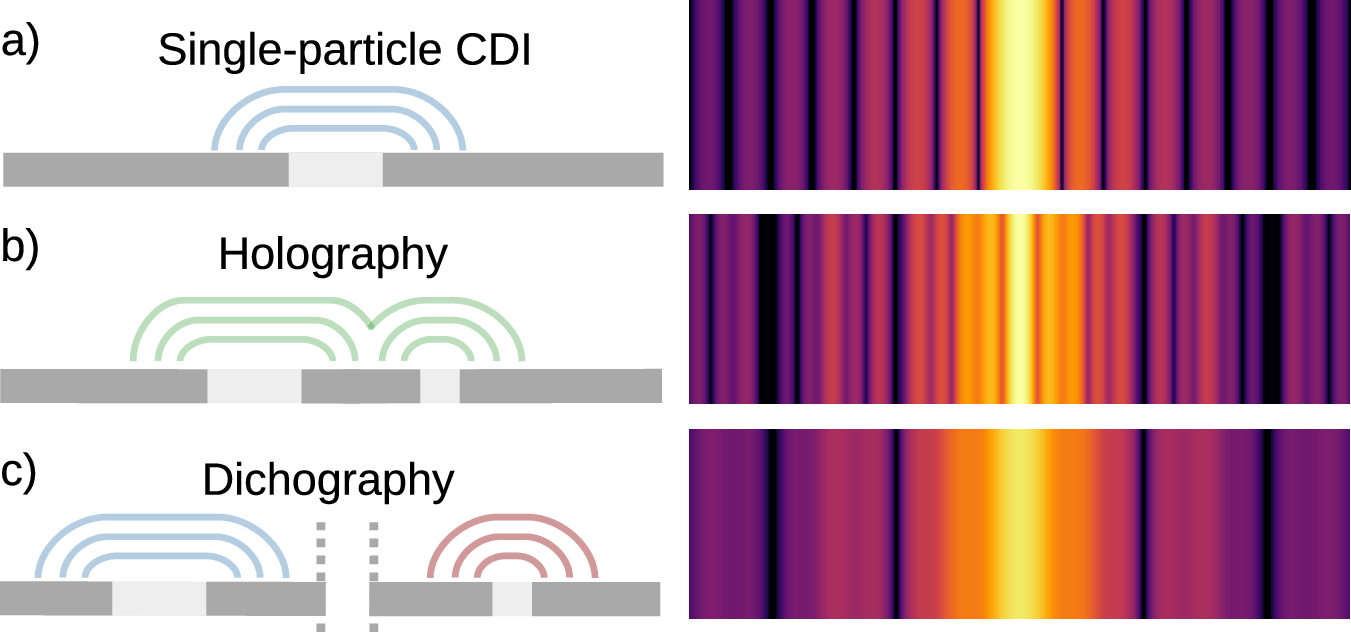
The second route sidesteps the detector's physics. Dichography, as its inventors call it, recovers the two patterns by mathematical reconstruction [9]. Both routes need the color difference to exist; only one needs hardware that can measure it [10].
Alessandro Colombo of the physics department at ETH Zurich says these are, to his knowledge, the fastest nanoscale movies ever recorded, and then defines a movie as multiple frames of the same object [11]. That is two frames, at a delay the machine can vary [14]. A stopwatch with two readings is exactly the instrument you want when the object is not reproducible: Yevheniy Ovcharenko, the study's principal investigator at European XFEL, notes that nanoparticles are less uniform than individual molecules, which forces the measurement onto the very same sample [12]. The conventional recipe of different samples at different delays after a trigger suits molecules that are copies of one another, and the team argues it does not give precise results for particles that differ in size, shape, orientation or internal structure [13].
Nothing here has yet been shown on a biomolecule, though the announcement names nanoparticles or biomolecules on their natural timescale as the ambition [20]. The published work is a feasibility demonstration of both separation methods at one instrument [17]. Linos Hecht, the ETH Zurich doctoral candidate who is first author on both papers, argues the method is flexible precisely because it leans on no specific sample property [16]; that is a claim about the method's logic, and one sample class has been through it so far.
The capability now has a published clock; the error budget has not been published. Marcel Mudrich of the University of Kassel, who proposed the experiment with an SQS colleague, calls it a starting point for a new type of study [15], and the framing is right: the delay is settable and the colors are separable, while the fraction of photons that survive the sorting is what will decide whether a given expanding nanoplasma or fragmenting cluster is actually resolvable [14].
Ranked by verification strength, evidence, and original report placement.
The second method uses mathematical reconstructions, and its inventors call it dichography.
One method exploits the detector's capability to discern energy levels for each individual pixel while the other uses mathematical reconstruction, and both methods take advantage of the two different colors or photon energies.
Alessandro Colombo of the Department of Physics at ETH Zurich said that to his knowledge these are the fastest nanoscale movies ever recorded, if by movie one means multiple frames of the same object.
No detector is fast enough to record two snapshots taken femtoseconds apart separately; the two images end up superimposed in a single recorded image.
An international team published two complementary methods for disentangling two diffraction patterns captured by the same X-ray detector, in two separate articles in Nature Communications.
The European XFEL can produce successive flashes of two different colors bright enough to image a particle twice within femtoseconds.
Follow any of these and your For You feed starts watching them — no settings page required.
Evidence-backed comparisons of source perspectives and observed adoption signals. Read the methodology
Which Builder, Operator, and Investor concerns the observed source mix emphasized—not a truth score.
Evidence, demonstrated adoption, hype gap, incentives, and confidence are assessed independently, each on its own current evidence. How these are measured.
Peer-reviewed underneath, one telling on top
The physics sits in two Nature Communications papers, and the account carries the parameters that matter: 120 metres of undulator at roughly 1.0 and 1.2 keV, delays of tens to hundreds of femtoseconds, a pnCCD doing the energy discrimination. What a reader cannot check from here is how well any of it performed, because assignment efficiency, detector energy resolution and the number of recorded patterns are all missing, and the only people speaking are on the papers.
One endstation, one droplet species
Use of the technique so far amounts to a single set of runs at SQS on helium nanodroplets doped with xenon, reconstructed at two delays. No second facility, no external user group and no other sample appears anywhere in the reporting, and Mudrich himself calls it a starting point.
'Movie' here means two frames
The extreme-high-speed-camera comparison and the fastest-ever line do more work than the data: two reconstructed views of one droplet at 50 and 750 femtoseconds, in which the xenon clusters had barely begun to change. phys.org does report the constraints (dichography needs bright data and reasonably balanced colour contributions), but they land after the superlative, and no prior result is cited for the ranking to beat.
Every voice is on the paper
Colombo, Ovcharenko, Meyer, Hecht and Mudrich are authors or SQS staff, and the piece follows a facility announcement whose practical payoff is proposals for beamtime on the new two-colour mode. None of that impeaches the measurement; it does mean the judgement about how widely the method will apply comes from the people who built it, including Colombo's closing prediction that the limitations will matter less over time.
Firm on what was done, thin on how well
We are on solid ground about the setup and the two methods, both peer-reviewed and described in concrete numbers. We are much weaker on performance and reach, since the figures that would settle those were not published here and no second outlet has independently retold the work.
science
Junk DNA with a day job: fly chromosomes pair by matching repeat barcodes1 publisher
science
Narwhal tusks hide two spirals twisting against each other, and the mismatch is the point3 publishers
product
Canva's forecast cut turns model routing into a product line item1 publisher
science
Mount Sinai puts a youth protein on aging microglia, and the mice answer1 publisher
Publishers with included, body-backed reporting in this cluster.
1 article · September 7, 2026