Loading today’s stories
Product1 distinct publisher2 min readUpdated
Oak Ridge printed a pressure vessel. The forge queue is still the constraint.
ORNL and Idaho National Laboratory are aiming wire-arc printing at the one reactor input that design work cannot route around. The hard part is not the printing.
The Product Desk · Product desk
What happened
- Oak Ridge National Laboratory and Idaho National Laboratory have joined forces to develop wire arc additive manufacturing for industrial pressure vessels, which must withstand extreme pressure, heat and harsh operating conditions.
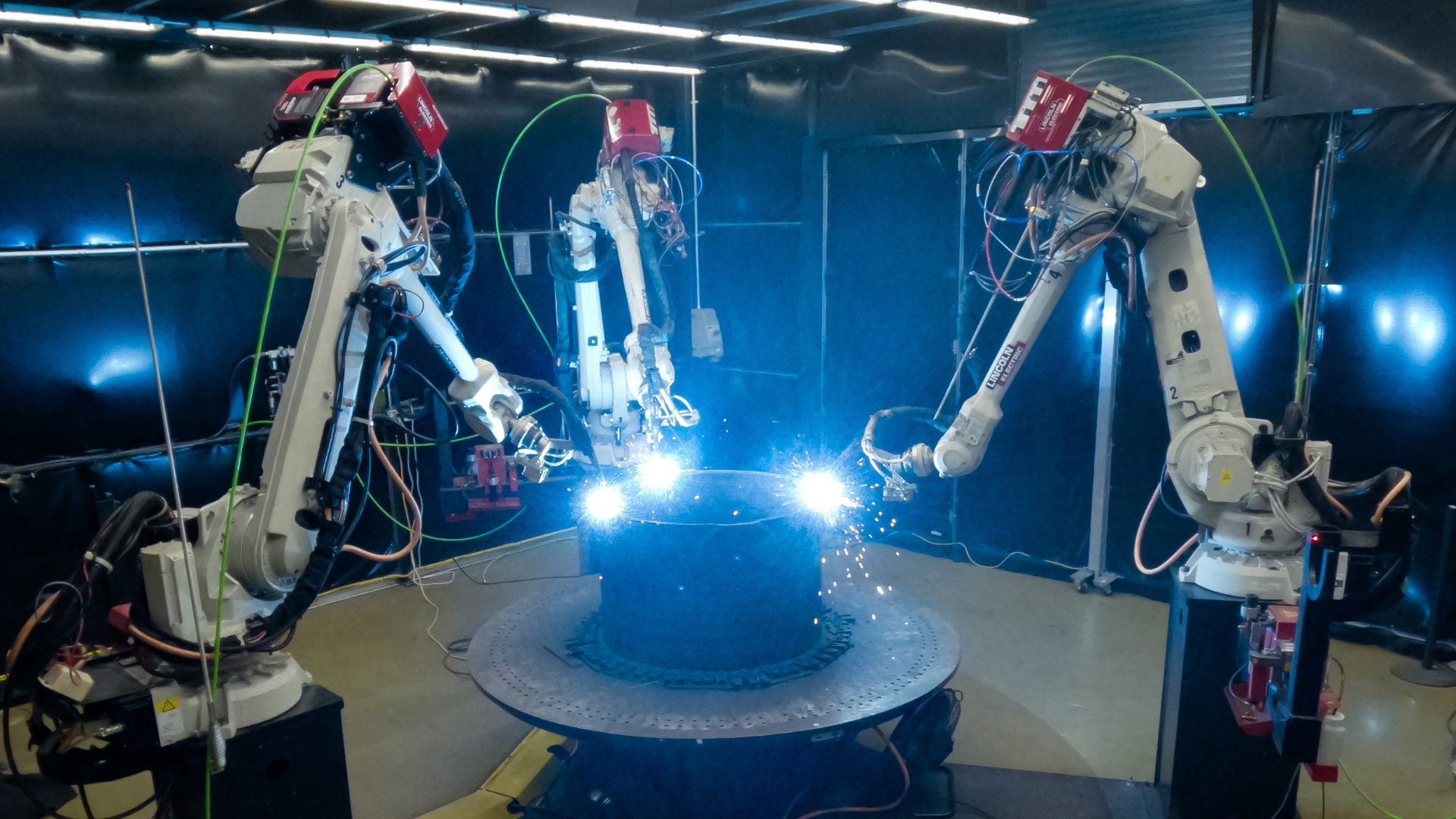
- ORNL recently demonstrated the technology by printing a nuclear-relevant pressure vessel measuring roughly three feet by five feet using MedUSA, a platform that coordinates three robotic arms and builds metal structures by melting steel wire with electric arcs.
- The technology could give US manufacturers another option as domestic forging capacity remains limited, a shortage that could create supply challenges as the country pursues new nuclear projects.
- Researchers produced a large, enclosed vessel using a steel alloy relevant to nuclear applications, an early step toward using additive manufacturing for components traditionally produced through forging.
- The laboratories plan to combine large-scale additive manufacturing with digital engineering and real-time monitoring, tracking a component's shape and material properties as it takes form.
Compiled by The Product DeskSomething wrong?How this is made
Why it matters
Forging capacity is the input in a reactor program that no design review can argue with, and the two labs are explicit that limited domestic capacity is what this collaboration is aimed at [1][3]. Take that framing at face value, because it sets the test the work has to pass. A printed vessel substitutes for a forged one only if a buyer can put it inside a pressure boundary, and the account is clear that printing is the easy half: each component still has to be shown capable of surviving years in an extreme environment before it enters service [11].
So the load-bearing part of the announcement is not the three arms. It is the monitoring plan behind them. ORNL and INL want to track a part's shape and material properties while it is being built, and use that record as the evidence of fitness, which ORNL calls "born-qualified" [5][6]. Jorgen Rufner, INL's advanced manufacturing group lead, says the aim is to evaluate a component's performance as it is produced, which could shorten qualification timelines [7]. That is an argument about evidence, not metallurgy. It proposes swapping a post-build test campaign for a data file generated during the build [6].
Which is where the record thins out. The only hardware from this platform that has been inside a reactor at criticality is a set of neutron sensor brackets, in Antares Nuclear's R1 Mark-0 at INL in June [8]. Brackets hold instruments. They do not hold pressure, and the material system was the same but the duty is not [8]. The vessel itself is a demonstrator at roughly three feet by five feet, and born-qualified vessels are described as a long-term goal rather than an available option [2][6]. Nothing in the account names a code body or regulator that has agreed to accept in-process data in place of testing [12].
The division of labour is the most concrete thing here: ORNL supplies the printing through its Manufacturing Demonstration Facility, INL supplies nuclear materials, digital engineering and data science [9]. That is the shape of a qualification programme, not a supply line. Treat it as a bet that the bottleneck can be moved rather than removed: from a shortage of large forgings to a case file that someone with authority has to accept [3][6]. The first is a capital problem with a known price. The second has no published timetable, and the labs have not offered one.
Loading topic controls
Loading related stories