Product1 publisher3 min readPublished
Bodega peptides fail their own label test at about $94 a vial
A shop on Bedford Avenue sells injectable peptides next to the gum. WIRED bought four kinds, paid a startup to have them tested, and got back a negative on every label with no answer about what was in the vials.
The Product Desk · Product desk
What happened
- WIRED paid $376.20 at Mr. Green, a bodega on Bedford Avenue in Brooklyn, for vials of PT-141, BPC-157, NAD+ and retatrutide, sold near the counter with the candy and the rolling papers.
- Finnrick, an Austin startup that brokers peptide tests for consumers, reported in August that none of the four samples held its labelled active ingredient, including a BPC-157 vial with no BPC-157.
- The same tests found only low levels of heavy metals and endotoxins, which indicated the vials were unlikely to be actively harmful.
Compiled by The Product DeskSomething wrong?How this is made
Why it matters
- cost The buyer carries the entire verification bill: roughly $94 a vial at the counter, then a separate lab fee weeks later to learn only that the label was wrong.
- constraint A label claim analysis cannot tell a customer what they injected, so a negative result closes the file without producing a compound anyone can look up, report or treat.
- precedent If brands really do share upstream vendors, as Mazoyer describes, vetting one label buys a customer nothing about the next vial on the next shelf.
- decision Anyone listing or checking out this category has to decide whether a supplier's own label counts as evidence, since the two independent tests on the record could not confirm a single one.
The test Finnrick brokers is a label claim analysis. Marco Krause, the chief executive of the laboratory that ran the samples for Finnrick, told WIRED: "What we offer is simply a label claim analysis. So you send us what you claim to think it is, and then we run it against a standard and verify whether or not it's the right compound." [13] The buyer supplies the guess, the lab checks the guess against a standard, and when the guess is wrong the report says wrong. Krause said what the vials actually held was hard to say [12].
Someone who has already injected a vial bought under a sign reading "research use only" wants an identification [21]. WIRED got four negatives, plus a note that the samples carried low levels of heavy metals and endotoxins and so probably were not actively harmful [8].
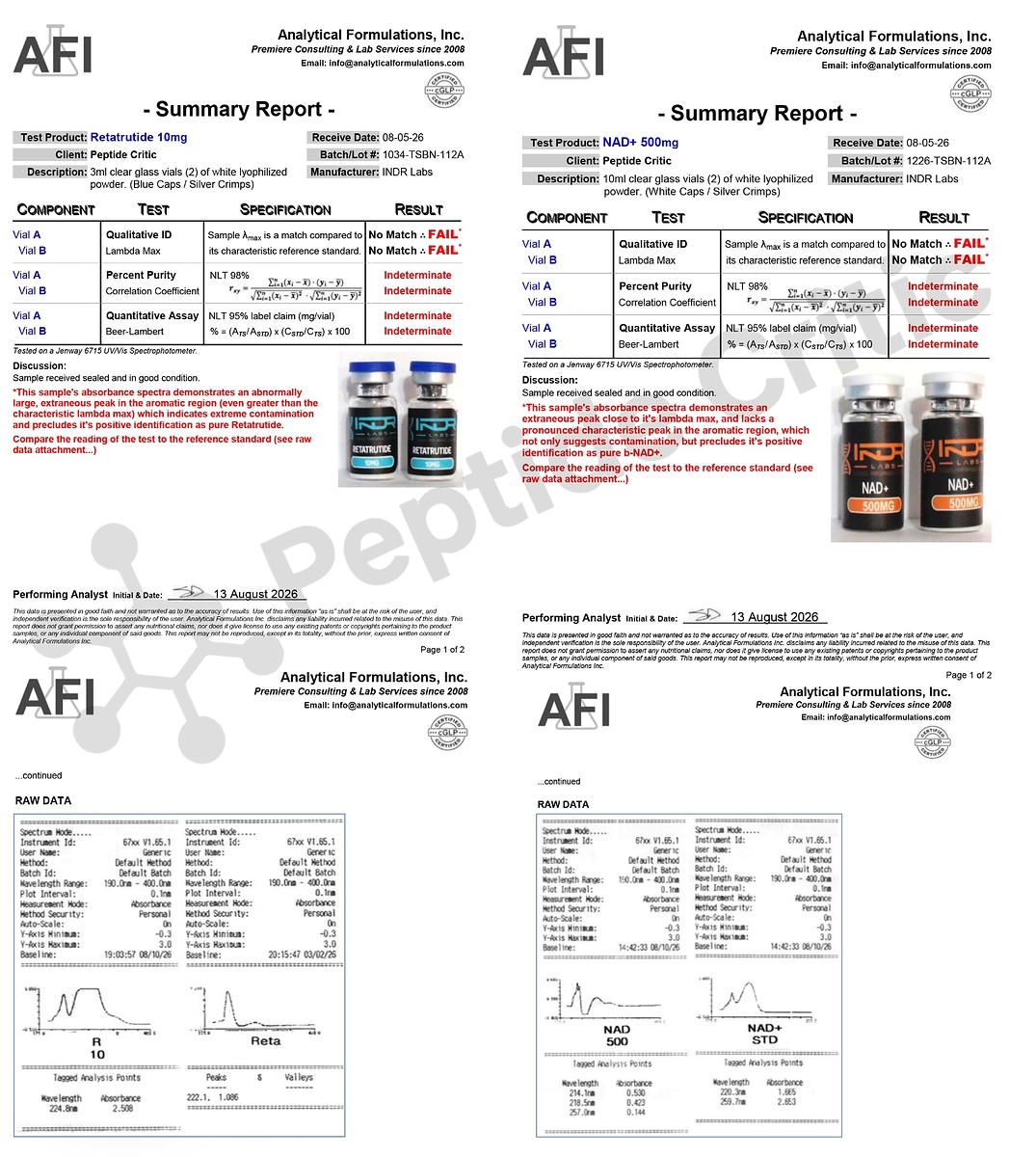
Four vials for $376.20 works out at about $94 each [24], before the testing fee, and Finnrick told WIRED the results would take a few weeks [7]. Jeff Colhoun of the vendor directory Peptide Critic paid for his own round at a different lab, Texas-based Analytical Formulations, which could "not positively identify" the four vials he bought at Smoker's World down the block [19][20]. Between them the two buyers had eight vials tested from two shops on one street and got back no confirmed match to any label [25].
On the supply side, Finnrick CEO Raphael Mazoyer called WIRED's samples "just duds" [14] and pointed to turnkey services that let almost anyone open a peptide business [16]. "There are a whole bunch of labels popping up that have the same upstream vendor," he said [17]. He also said he cannot be sure what is behind the three-month rise in dud results, partly because his company has been testing more samples as it has grown [15]. So the increase is an observation about his caseload. If the shared-supplier explanation holds, checking one brand tells a buyer little about the next label on the shelf, because it may come out of the same tank [18].
Both purchases were made in person, and both tests were commissioned by the buyer afterwards [26]. No payment processor, online marketplace or hosting platform appears anywhere in that chain. What the reporting does describe is a shop counter, an upstream vendor no one has named, and two consumers paying labs out of pocket.
Anyone who does own a listing surface or a checkout in this category is left with the results a verification step can actually return, and the action each one triggers. In these two rounds there were two results: not confirmed, and not identifiable. Both tell a customer to bin the vial without telling them what they took. Many of the buzziest peptides have never been through the drug approval process, WIRED reports, several are not legal to sell for human consumption in the US, and the evidence for their claimed benefits is thin [22].
What to watch
- Whether Finnrick publishes a denominator for its dud results, which would turn Mazoyer's three-month uptick into a measured rate.
- Whether Mr. Green and Smoker's World keep selling vials, and whether either set of lab results draws state or FDA attention.
- Whether any peptide label starts publishing per-batch third-party test results a buyer can check before paying.