Product1 distinct publisher3 min readPublished
The Chicago startup says its graphite-free lithium-metal cell held capacity through 9,315 cycles, but the figure arrived without third-party validation or an energy density, which is the number a pack engineer designs around.
The Product Desk · Product desk

Compiled by The Product DeskSomething wrong?How this is made
A cycle count is the cheapest strong number a battery company can publish. It's also the one a buyer can do least with. Divide 9,315 cycles by 365 and you get roughly 25.5 years of daily full cycling [14]. A cell with that kind of life has moved cycle life out of the set of things that constrain a purchase decision. The result answers a question that wasn't holding up anyone's programme.
What the announcement does is lead with the test the cell passed. What a pack engineer does with an announcement is try to fit the cell into a fixed volume and mass budget, which takes watt-hours per kilogram. That figure was not disclosed for the tested cell, according to InsideEVs [4], and no third party has checked the cycle number either [3].
There is also a gap between two of the company's own statements. In June, chief executive Emilie Bodoin told Bloomberg the technology is "half the weight and double the energy density of the battery that we're all using today" [6]. In August, the cell that logged 9,315 cycles came without an energy density attached [1][4]. Both can be true of different cells, and until somebody says otherwise, a procurement team should read them as different cells [17].
The reason this gets attention has little to do with the cell and everything to do with what was taken out of it. Graphite does no electrochemical work; it is a host that holds lithium ions between charges while taking up room and adding weight [7]. Pure Lithium deposits lithium metal directly onto a copper current collector, so the anode is formed during manufacturing [5]. More than 90% of the world's graphite is processed in China, per US government data [8], while the EU wants to process 40% of its own annual needs of strategic materials by 2030 and cap any single third country at 65% [10]. That is at least 25 percentage points to remove from one country's share [15], on graphite that already sits on the EU's strategic list [9].
The five efforts named in the reporting sort onto two axes. First axis: re-source the anode material, or delete it. Talga's mine in Swedish Lapland, Vianode's synthesis in Norway and CarbonX's replacement material in Delft sit on the re-source side [11]; Pure Lithium and LionVolt in the Netherlands remove the graphite anode instead [12][16]. Second axis: is there a validated cell at a disclosed energy density, and a line that can quote a price. Pure Lithium's pilot line is still being built [13], and LionVolt belongs to the frontier chemistries Europe reached for after Northvolt collapsed [12]. So far, every entrant sits on one axis or the other; none yet occupies both.
Two lines in a supplier questionnaire do most of the work here: which cell logged the cycles and at what energy density, measured by whom; and the earliest date the pilot line can quote per kWh. Without answers, this belongs on a watch list rather than in a 2027 anode sourcing plan.
Ranked by verification strength, evidence, and original report placement.
The energy density of the tested cell has not been disclosed, InsideEVs reported.
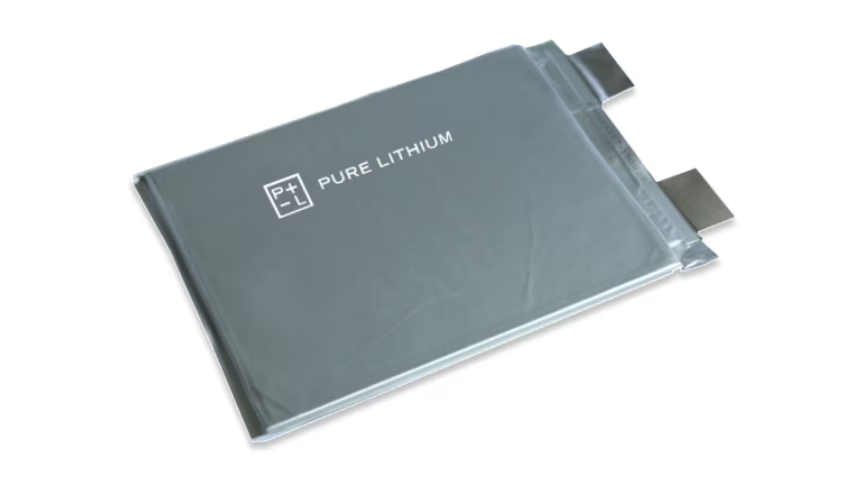
Instead of a graphite anode, Pure Lithium deposits lithium metal straight onto a copper current collector, forming the anode during manufacturing.
Graphite does no electrochemical work; it is a host that holds lithium ions between charges while taking up room and adding weight.
More than 90% of the world's graphite is processed in China, according to US government data.
Both natural and synthetic graphite sit on the EU's list of strategic raw materials.
Distinct publishers with included, body-backed reporting in this cluster.
1 article · August 29, 2026
Follow any of these and your For You feed starts watching them — no settings page required.
product
Nebius funds $4.5bn of AI capacity on terms that pay lenders mostly in stock2 distinct publishers
build
The $559M-versus-$12.3B quarter matters more than the $65B run rate4 distinct publishers
product
The Mac mini is sold by the gigabyte, which makes its refresh a DRAM story4 distinct publishers
product
A DOJ probe of a16z board seats asks whether venture portfolios are interlocking directorates1 distinct publisher
Evidence-backed comparisons of source perspectives and observed adoption signals. Read the methodology
Which Builder, Operator, and Investor concerns the observed source mix emphasized—not a truth score.
Evidence, demonstrated adoption, hype gap, incentives, and confidence are assessed independently, each on its own current evidence. How these are measured.
Solid on graphite, thin on the cell
This story runs on two grades of fact. The supply-chain half is checkable and attributed — US government data for China's 90%-plus processing share, the EU's own strategic list and its 40% and 65% targets for 2030. The battery half rests entirely on Pure Lithium's own announcement: no test report, no cell format, no rate or depth-of-discharge, and, as The Next Web notes via InsideEVs, no energy density. A cycle count without conditions is a claim, not a measurement.
One cell on a bench
Nothing has been adopted. The result is a laboratory cell, the pilot line is still being built, and no customer, offtake or sample shipment appears anywhere in this reporting. The only real-world activity nearby belongs to other companies — Talga's mine, Vianode's furnaces, CarbonX's material, LionVolt's anodes — and those are Europe's projects, not Pure Lithium's traction.
Headline outruns the bench
A graphite-free cell that could 'break China's grip' is a large promise attached to one unvalidated laboratory result and an unfinished pilot line, and the June line about double the energy density has no disclosed density behind it. The gap would be wider still if The Next Web had not put its caveats in the third paragraph and closed by calling the honest summary what it is: one good lab result, one continent's deadline.
Claim and claimant are the same party
Every performance number here originates with a company that needs capital to finish a pilot line, and the loudest of them was delivered by its chief executive in an interview. The EU deadline supplies urgency the technology has not earned yet, and the four European firms named all have their own reasons to be associated with a graphite problem. Nobody quoted is positioned to say the result is unremarkable.
Trustworthy about its own limits
Middling, and for an unusual reason: the single account we have is candid about what it cannot stand behind, so the uncertainty is documented rather than hidden. The policy and processing figures would survive a second look; the cell claim has no second look available, from this publisher or any other in our coverage.