Product1 distinct publisher3 min readPublished
Spark led a $26M round on the premise that buried-asset records can be bought once instead of chased per project. The one outcome number on offer comes from a customer's own study of paving it could have skipped.
The Product Desk · Product desk

Compiled by The Product DeskSomething wrong?How this is made
Josh Mackanic's founding story is a phone-call story. An unrecorded pipe turned up in one of his excavations at PG&E, and establishing who owned it and whether the crew could tap it took three days and $60,000 in delay [2]. The search, not the shovel, is the unit of work CivilGrid is priced against.
Which makes the choice of outcome number worth a second look. The savings PG&E identified are paving costs, spread across 1,600 planned gas distribution projects [8], which works out to roughly $37,500 a project [9]. That is money saved at the planning desk, not in the trench. The account does not explain the mechanism by which the map produces a paving saving, and the study was run by the same customer that supplied the endorsement quote, from PG&E's Christine Cowsert [7]. No customer count, renewal figure, or measured change in strike rates appears anywhere in it [14]. Treat it as a live utility doing arithmetic on its own pipeline: more than most Series A decks carry, less than an independent result.
Here is what teams tell themselves they are buying: strike prevention, because 200,000 strikes a year is the harm in the pitch [4]. Here is what somebody will actually open it for on Monday: deciding where the pipe goes before the design freezes. Mackanic describes his core user as the person at the very early stages of deciding what gets built [11]. Field safety and pre-design engineering are different jobs, and in most utilities and engineering firms they are different budget lines.
The moat claim deserves close reading, because it is not a software claim. Mackanic says better subsurface visibility is not a new idea, and that what nobody had done was collect and secure the data and build relationships with the parties most likely to pay for it [12]. Coverage assembled that way is local. A dataset that is complete inside PG&E's territory tells a county three states away nothing about whether its own water district ever handed over a file. Note the ratio: the savings a single utility says it found are about 2.3 times the whole round [10]. If that holds anywhere else, the hard part is not finding buyers, it is getting the next record holder to open its drawer, which is roughly Mackanic's own argument for why utilities running lean would rather this came from outside [13].
Two axes settle whether this is a purchase or a demo. First, where your delay starts: in the pre-design question of what is down there, or in the field once the crew is already standing on it. Second, whether the record holders in your footprint, the water district and the county and the neighbouring gas utility, are actually in the dataset for the jurisdictions you build in. Both yes, and the subscription retires a recurring scramble that currently gets paid for in delay days. Either one no, and you are buying a very good map of somebody else's ground, then making the same phone calls.
Ranked by verification strength, evidence, and original report placement.
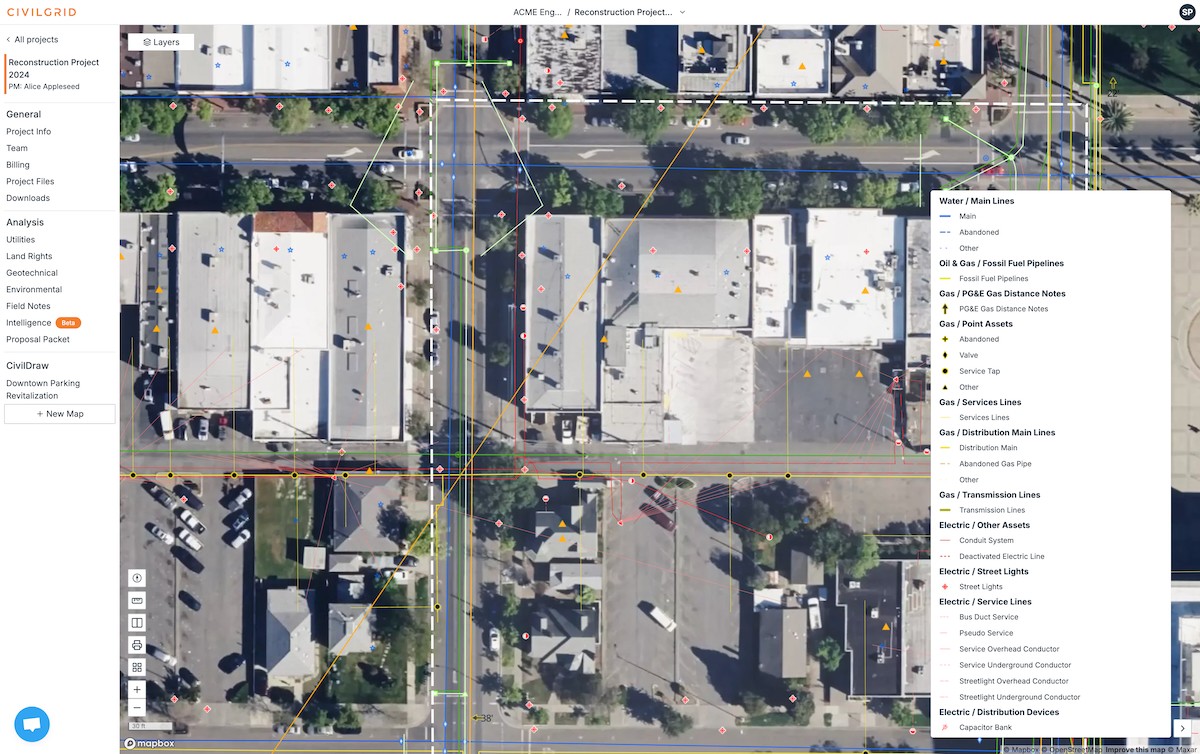
A case study performed by PG&E identified $60 million in avoidable paving costs across 1,600 planned gas distribution projects by using CivilGrid.
Josh Mackanic left a 10-year engineering career at Pacific Gas and Electric and founded CivilGrid in 2020.
Mackanic told TechCrunch that a job of his was shut down by a pipe in the excavation that his team did not know about, and that the three-day effort to establish whose pipe it was and whether it could be tapped cost $60,000 in delay.
PG&E has visibility only into the electric and gas lines it owns and operates; pipes carrying sewage or water belong to other companies, as does the information about where they are.
CivilGrid gathers disparate data on utility assets, property ownership and environmental regulations and sells access to governments, civil engineering firms and utilities, including Mackanic's former employer PG&E; he calls it a "Google Maps for what's underground".
CivilGrid raised a $26 million Series A led by Spark Capital, with investment from Afore, A*, Ford Street Ventures, SNR, and Energy Impact Partners, a fund with a number of utility companies as limited partners.
Distinct publishers with included, body-backed reporting in this cluster.
1 article · August 27, 2026
Follow any of these and your For You feed starts watching them — no settings page required.
build
SGLang's one-GPU Qwen3.8-27B recipe is the useful half of the release1 distinct publisher
product
OpenAI's plan to hand everyone a coding agent leaves the hard part to the model1 distinct publisher
invest
Tiny corp wants Etched's numbers. Jane Street led $700M at $21B without publishing any1 distinct publisher
product
Anthropic's usage policy says no explicit content. Opus 4.6 said yes 10 times out of 10.1 distinct publisher
Evidence-backed comparisons of source perspectives and observed adoption signals. Read the methodology
Which Builder, Operator, and Investor concerns the observed source mix emphasized—not a truth score.
Evidence, demonstrated adoption, hype gap, incentives, and confidence are assessed independently, each on its own current evidence. How these are measured.
Single-source, vendor-and-customer-supplied
All factual weight rests on one TechCrunch exclusive built from a founder interview, a PG&E statement supplied for the announcement, and a case study the customer ran on itself. Round mechanics are specific and checkable in kind, but the market-size statistic is uncited and the one outcome number has no disclosed methodology or independent audit.
One flagship utility, no breadth disclosed
There is concrete, named deployment at a major US utility spanning a 1,600-project planning study, plus stated sales into governments and civil engineering firms. But no customer count, revenue, seat, or renewal figure is given, so breadth beyond the single reference account is unknown.
Framing outruns verified outcomes
The 'Google Maps for what's underground' framing, the uncited 200,000-strikes problem statement, and a $60 million savings number that exceeds the round by roughly 2.3x set expectations well above what is demonstrated: one customer-run study of savings identified rather than realized, and a permit-filing roadmap described in the conditional. The gap is moderate rather than severe because the underlying failure mode and the named customer relationship are concrete.
Announcement-aligned sources throughout
Every voice in the cluster benefits from the story landing well: the founder gave an exclusive at the moment of a raise, the lead and syndicate investors have just priced the company, the PG&E statement was prepared for the announcement, and Energy Impact Partners' utility limited partners place investor and customer interests in the same ecosystem. No adversarial or independent source appears.
Round facts firm, impact claims soft
Confidence is moderate: the raise, syndicate, buyer categories, and the existence of the PG&E case study are stated precisely by a named publisher and are unlikely to be wrong on their face. Confidence in the business's demonstrated impact and traction is much lower, since it rests on one publisher, one interview, and one self-run customer study with no corroborating source in the cluster.